
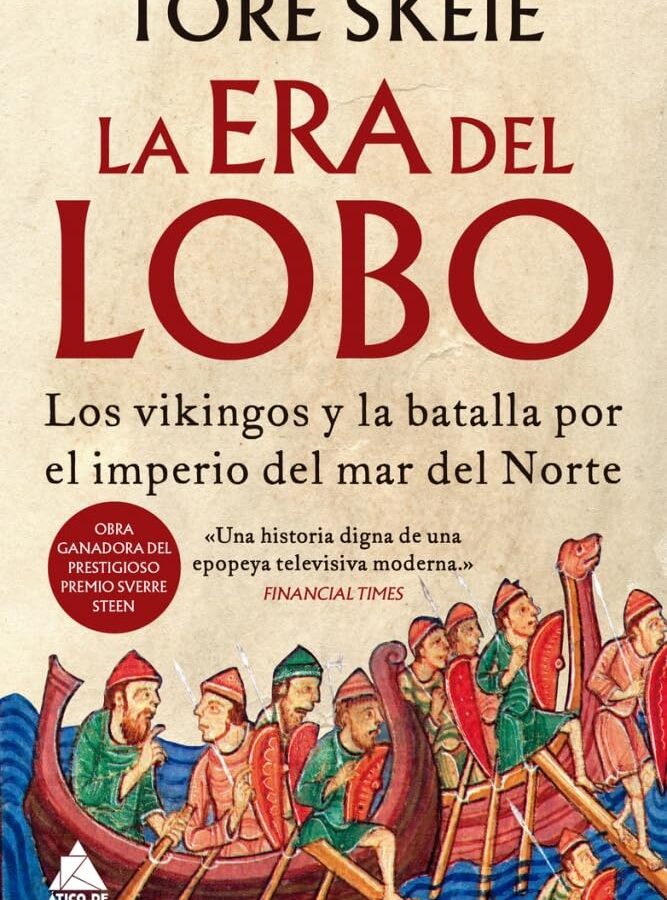
For a few decades now, thanks to the investigative and divulgative work of authors such as the Norwegian historian Tore Skeie, I have been uncovering a history of the Nordic peoples that is far richer and more fascinating than the sketchy lines I learned more than sixty years ago through novels and graphic stories. A history built often from the chronicles written by their own enemies and completed by sagas and legends that survived for centuries thanks to Viking oral tradition.
The Wolf Age, the essay by the aforementioned Tore Skeie published by Ático de los Libros, again demonstrates that behind the clichéd image of the Viking—as a brutal warrior who sails, raids, kills, and vanishes—there lay a society far more complex.
At the beginning of the eleventh century, northern Europe was a vast board on which kings and warrior lords moved, fragile alliances full of betrayals, and clans driven by unrestrained ambitions. Norway, Denmark, and England fought for dominance of the North Sea while the three main actors of this essay — Olaf Haraldsson, Edred “the Indecisive,” and Cnut “the Great,” accompanied by a remarkable woman, Emma of Normandy — played out a saga of wars, infidelities, marriages, conversions, and power struggles.
One of the author’s major insights is to warn us that we cannot view that world through the lens of our present borders. England and Scandinavia formed part of the same political, economic, and human space. Skeie states that “the sea was not a border: it was the road. A vast liquid highway through which warriors, traders, news, ideas and, above all, money circulated.”
The power of those kings did not yet rest on organized states, but on their ability to keep professional armies loyal. And loyalty had a price. There was money to be paid: to pay soldiers, buy loyalties, and reward fidelity. Raids, extortion, and tributes fed a system in which war was not merely a way to conquer territory: it also served as an economic necessity.
England thus became a highly desirable prey. Its robust wool trade attracted large quantities of wealth from the continent. The Vikings understood where the money was and went in search of it.
From raiders they turned into tax collectors and, thanks to their strength, finally became masters and lords.
This is the starting point that Tore Skeie presents.
Sven “Split-Beard,” king of Denmark, no longer wanted to settle for collecting from the English: he sought to govern them. What he truly achieved was by his son Canute, whose greatest achievement was to raise the so‑called North Sea Empire. By conquering the Great Island, he understood that the challenge lay in keeping the realm subdued.
Canute used the sword, but also politics. His marriage to Emma of Normandy, widow of Ethelred, was a formidable operation designed to legitimize a dynasty born out of conquest.
And beside him appears Olaf Haraldsson, perhaps the figure who best embodies the contradictions and transformation of that world.
Olaf had been a raider before becoming king and was ultimately exalted to the altars for his role in installing Christianity in the northern lands. He even traversed the coasts of the Iberian Peninsula during his expeditions. His evolution symbolizes the transition between two eras: from a chieftain whose realm was essentially his fleet to a monarch who required territory, laws, taxes, ministers of God, and an administration.
Skeie demonstrates that Christianity also played a decisive role in that transformation. Its adoption cannot be understood solely as a spiritual matter. It allowed, first, to fuse with ancient Nordic customs and, second, to establish alliances, legitimate dynasties, and bring the new Scandinavian kingdoms into the European political order, while also strengthening Christian prelates in the power chain. For a while, according to the author, Christ and Thor coexisted without too many problems. The “White Christ” of those warriors bore much more resemblance to a victorious king than to the Christ of peace and love that is worshiped today.
That is probably one of the most interesting aspects of The Wolf Age: explaining how the Vikings gradually ceased to be what they had been.
The warrior navigators transformed into administrators. Fleets gave way to territories; plunder gave way to taxes; chieftains gave way to kings. And the Scandinavian kingdoms began to resemble more and more those European states that for centuries dedicated themselves to looting with blood and fire.
Tore Skeie does not speak to us only about wars, conquests, and betrayals. He explains, in a transcendental sense, the end of one world and the birth of another. How was it possible for men from the north to become a people so different.
This is a compelling essay to read, despite the large amount of data it handles: one only has to look at the bibliography and the various sources. This Skeie’s work is coherent, well written, and the reader might well feel they are looking at a novelized history.
To finish, I would like to offer a reflection: perhaps the true paradox of that “Wolf Age” is that the Vikings achieved their greatest success when they stopped being themselves and adopted the ways of life of the peoples they had plundered.
—————————————
Author: Tore Skeie. Title: The Wolf Age. Translation: Laura Martínez. Publisher: Ático de los Libros. Sales: All Your Books.