
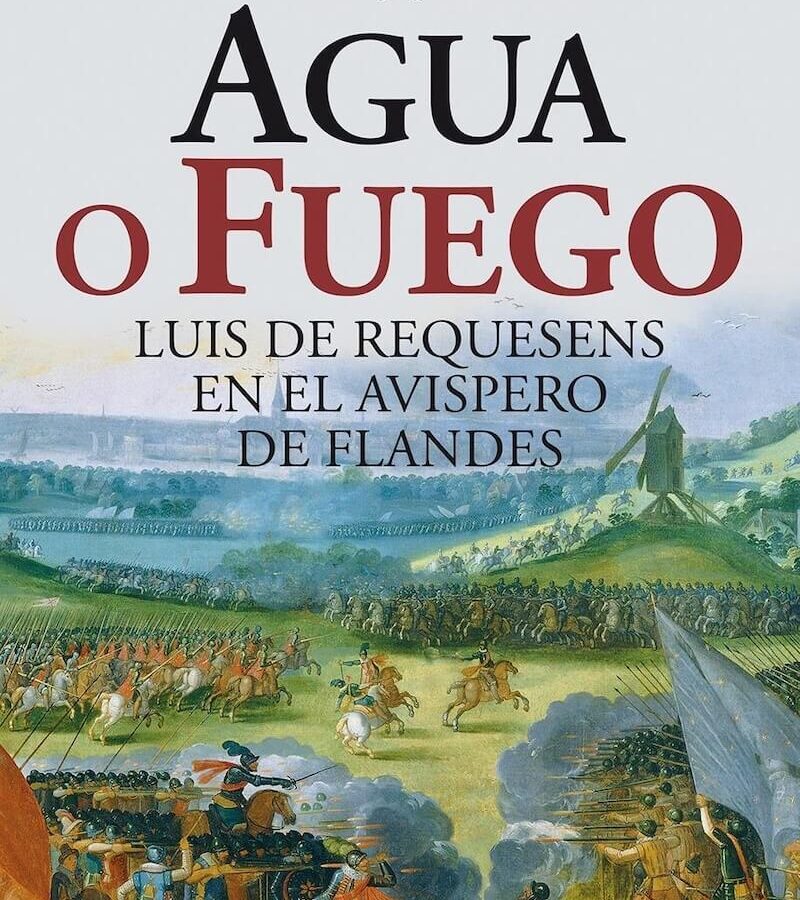
The year 1573 was drawing to a close and Flanders was a hornet’s nest. The Duke of Alba, with his relentless policies, had failed to quash the revolt that was igniting the Low Countries, and Philip II sent to Brussels Luis de Requesens to replace him as governor-general. This represented the most difficult challenge of his long career in the service of the Spanish Monarchy.
In this Making Of, Victor J. Jurado Riba explains how he wrote Water or Fire. Luis de Requesens in the Hornet’s Nest of Flanders (Desperta Ferro).
***
Water or Fire began to take shape ten years ago.
In 2016 I began my doctoral thesis, with Luis de Requesens as the protagonist.
With the energy of a young student eager to conquer the world, keen to achieve a biographical reconstruction of the nobleman—and a prosopography of the Catalan clientele in general—I began to devour books and archives. Above all, archives. I have always believed that to understand how the figures of the past thought and reacted to problems, one must access manuscript documentation. That man whom you study wrote those letters by his own hand, that bond has something special; in fact, I have seen the signature of Luis de Requesens— the one that appears on the book’s colophon— sealing letters or orders that I could almost repeat from memory. For all of this, Barcelona and Simancas were the key. In Barcelona I essentially found documentation related to his family, the person behind the governor-general, where he exposed with the plainness of a man, a father, a husband, his problems—not devoid of drama on many occasions, though rarely exaggerated;
in Simancas I found the governor, the link between the monarchy and a rising people, the successor of the “Duke of Iron” who could barely keep afloat a number of wavering states and entreated Philip II, letter after letter, for a solution from Madrid.
But that thesis was overly broad; I did not focus solely on the Low Countries—and within Flanders, not only on the war. After nearly a thousand pages of original manuscript purged, revised and, paradoxically, expanded with the war in Flanders at its center, we have Water or Fire.
But reader, do not be alarmed, the book does not recount the adventures of a bunch of youngsters at the emperor’s court. Essentially, it needed to contextualize the figure of a noble unknown to the general public of modern Spanish history, although indeed lauded by many specialists and enthusiasts. Rome, the Alpujarras, Lepanto, Milan…, the path to Flanders was significant, but he had not stood out militarily, at least not on his own. The question that arises is simple: Why? Why did the king entrust a noble with military expertise to oversee the succession of government of the Duke of Alba, who stood among the monarchy’s military ranks? If the great duke had failed, what could Requesens do? And he asked himself the same: he tried to avoid his appointment actively and passively, but all was in vain. On 17 November 1573 he entered Brussels, the place where he died on 5 March 1576.
There he faced a situation even worse than he had anticipated from letters, and that his prudence could not salvage in any way: the army was enormous, but they could not pay for it and debts grew daily; the rebels controlled the sea, a terrible impediment to the success of actions and trade; the loyal states were weary of the war and of the presence of Spaniards… Even upon arrival, he faced the fall of Middelburg and the loss of Walcheren.
Prudence quickly proved useless, becoming arms the main means by which that hornet’s nest could be pacified. The victory at Mook, uprisings, the siege of Leiden, the campaigns of Holland and Zealand… all is narrated in the present book through the voices of the protagonists. One perceives their triumphs and their misfortunes at a moment when a curious reality emerges: the Spaniards were the nerve of the king’s armies, but money was the nerve of the war. Without the latter, the former was of little use, and everything began to crumble. And Flanders fell precisely for this reason, when the circus-like financial juggling based on advances, promises, and bills of exchange dissolved in the face of the debt default of September 1, 1575.
Thus, in Water or Fire, I narrate the story of a man who, against his will, served his king to the very end. His handwritten letters, cited throughout the book, are the reflection of someone who, despite all his efforts, could not achieve what was practically impossible. A task doomed to fail from the start, due to lack of money and an excess of enmity. Flanders consumed his spirit first, and then took the life of the —as Gerónimo de Roda recounted to Philip II— “the best servant and minister and the most faithful vassal Your Majesty had in his service.”
—————————————
Author: Víctor J. Jurado Riba. Title: Water or Fire. Luis de Requesens in the Hornet’s Nest of Flanders. Publisher: Desperta Ferro. Sales: All Your Books.