
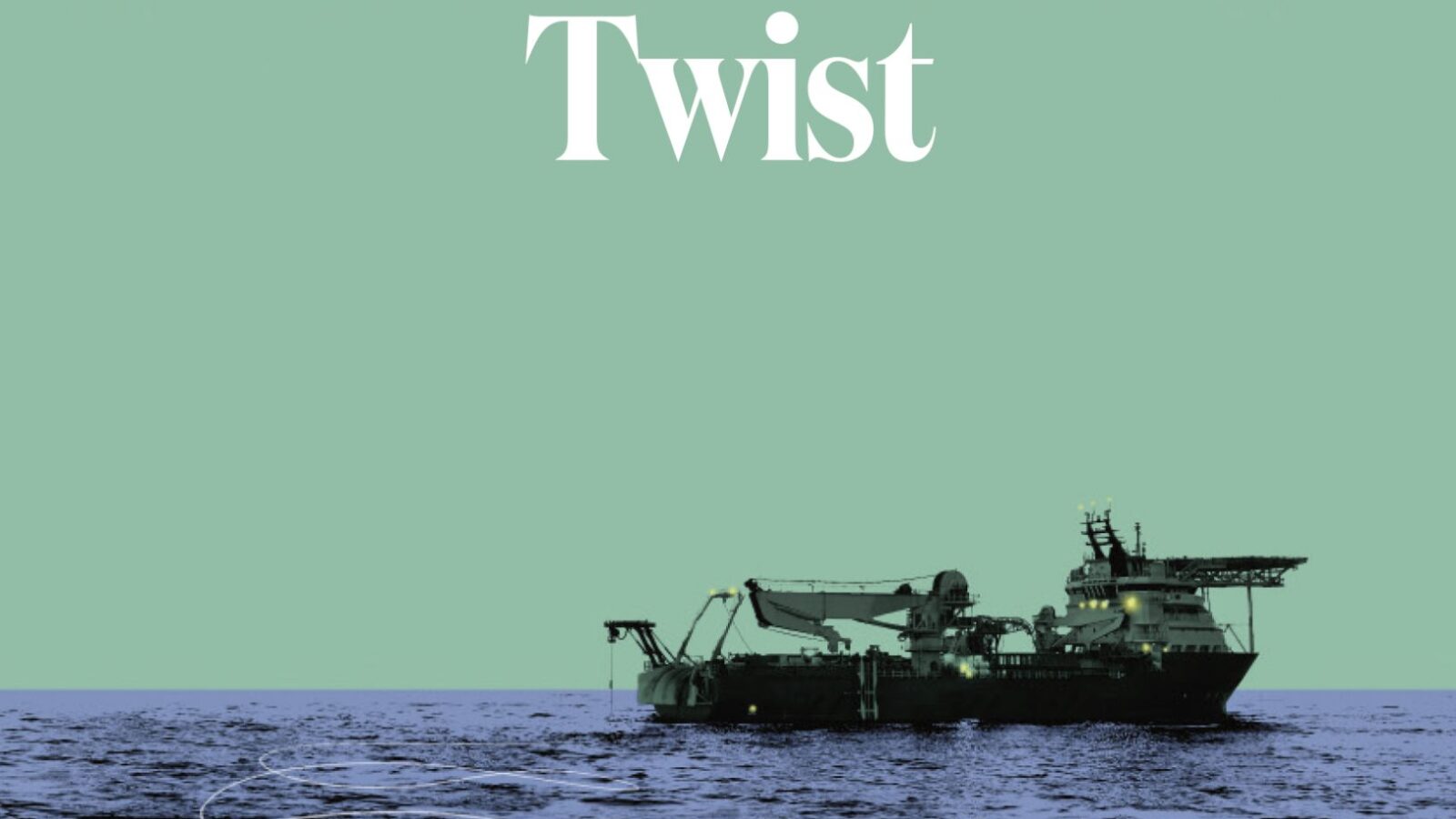
Under the sea there are cables. That simple notion, almost an obvious truth we prefer to forget, lies at the heart of one of the most profound and best-written novels of recent years. Everything we call digital—the cloud, emails sent in a second, and video calls with someone on the other side of the world—appears to be made of air. It is not. It travels along fibers laid on the ocean floor, fragile lines that break and that someone must repair. Colum McCann has turned that paradox into the heart of Twist: the most modern depends on the oldest, the ethereal rests upon the physical, and the fleeting requires the eternal to exist, even if we do not want to see it.
The ocean here is much more than a backdrop. It is the abyss, the last unexplored territory of a planet we believe we know completely, a mystery within the Earth itself. McCann regards it with a mixture of astonishment and respect that recalls the finest sea literature, but without any pastiche. In the face of that immensity, the cables become a mere line, almost a human handwriting upon the vastness. The novel ponders this contrast with a depth that never becomes heavy: what we are against what lasts, what remains of us when the connection is cut.
It is impossible to read Twist without hearing the echoes of Heart of Darkness. There is a journey along the African coast, a narrator who observes and doubts, and a man who fascinates and escapes, who ventures into his own darkness. McCann does not imitate Conrad: he converses with him. What in Conrad was the river and the jungle becomes here the seabed, and the question about colonialism becomes another equally unsettling one: who controls the veins through which the world’s information circulates.
The great achievement of the novel lies in Conway, a co-protagonist and antagonist at once. He is the man who descends into the depths, the one who repairs what others do not even know exists. To the narrator, he embodies everything he would have liked to be: brave, physical, free, even in his rebellion and in his falls. The relationship between them, made of admiration, envy, and a quiet form of love, has the complexity of the great literary bonds. Conway’s oscillations, his evasions, his silences, sustain the tension of the book and give it a tragic dimension that goes far beyond the anecdote.
All of this is told with a highly stylized prose that, nonetheless, never loses plausibility. It is a rare virtue. McCann knows how to move from the short sentence, almost schematic, dry as a logbook entry, to the long, contemplative sentence, on the edge of philosophical reflection. That shift in rhythm is not a whim: it marks the breathing of the book, its moments of action and thought. The prose is precise and musical at once, and in it every word seems weighed before it is placed.
Another of its virtues is the capacity to introduce reflections of every kind—meta-literary, philosophical, technical—without losing track or confusing the reader. The narrator contemplates writing, truth and fiction, technology and its servitudes, theater, and death. Those digressions, which in less skilled hands would stall the narrative, here enrich it because they arise from the story itself and return to it. McCann thinks while he tells, and he tells while he thinks.
Twist is a novel about connections: those that join continents beneath the sea and those that join people, equally fragile and equally necessary. It is also a novel about the fragility of everything we believe to be solid. A single tug, a twist, that twist in the title, is enough for us to disappear or for the world to go dark. Fascinating, demanding, and beautiful, Twist confirms Colum McCann as one of the most ambitious writers of his generation. It is one of those books that, when you close it, makes us gaze at the smartphone with new eyes and think, for a moment, about the silence at the bottom of the sea.
—————————————
Author: Colum McCann. Title: Twist. Translation: Marina Perezagua. Publisher: Feltrinelli. Sales: All Your Books.