
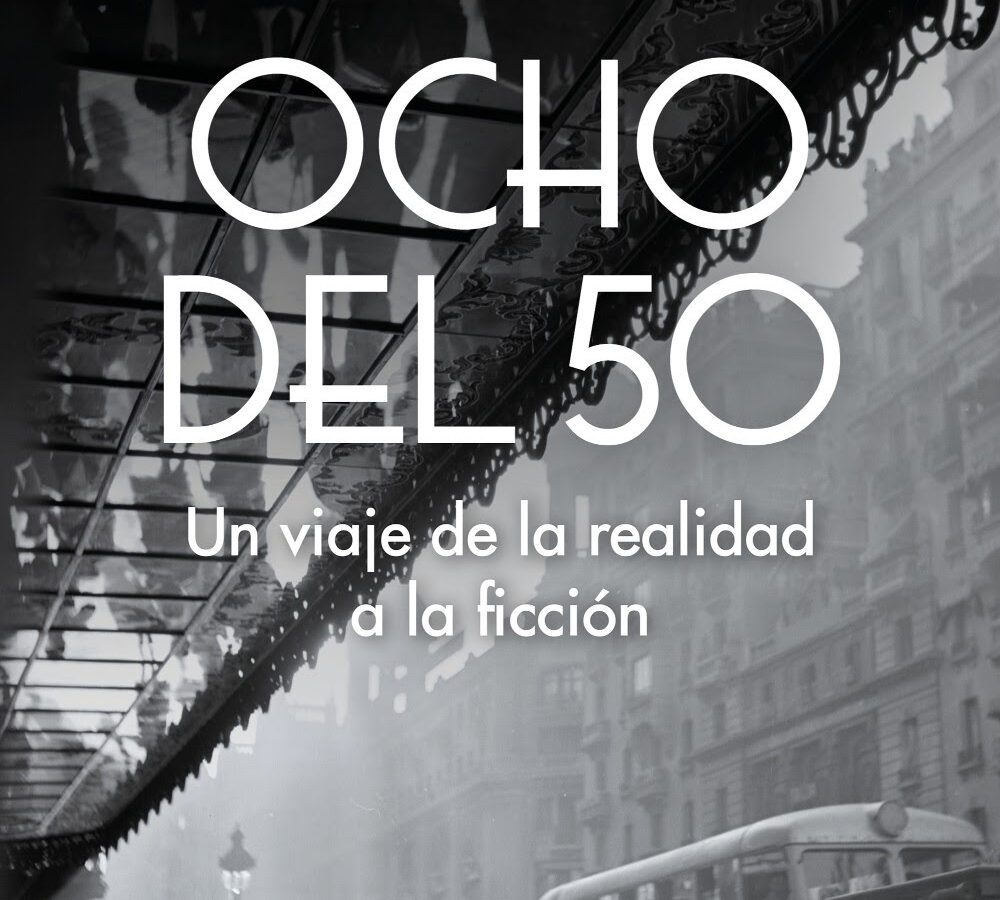
Winner of the 43rd edition of the Espasa Prize, this essay traces the life and works of Antonio Rabinad, Juan Marsé, Carmen Martín Gaite, Concha Alós, Alfonso Grosso, José Manuel Caballero Bonald, Ángel Vázquez, and Jesús Pardo—eight authors chronologically linked to the Generación del 50, whose narratives carry a pronounced autobiographical load and treat memory as a source of fiction.
At Zenda we present an excerpt from Ocho del 50 (Espasa), by Antonio Soler.
***
If indeed they were our literary predecessors, we did not feel the need to kill them. Quite the opposite. If we did not love them (to some of them we clearly did), at least we respected them. It wasn’t against wind and tide, but against an air that relegated them and tried to consign them straight to the attic of old junk. We were emerging from a dictatorship. Spain was opening to Europe, we were modern, we had afforded ourselves the immaculate suit of cosmopolitanism, and that troupe of writers became the tailors, the Berza Generation. The perpetual victims of Francoism with their needy characters, Civil Guards, shantytowns, and a few bourgeois with fangs sharp or not who came and went from mass.
But no. Slowly the stones were put down. And the Berza Generation was replaced by the more respectful Mid-Century, or simply the generation of the 50s. And it turned out that there was everything there. Because—who were they exactly? Were they López-Salinas and Pacheco, Antonio Ferres and a few die-hard socialist-realism militants, accompanied by Aldecoa, Martín Gaite, Matute, and people of a similar ilk? Or was there more? Yes, there was more. The cast can be quite extensive. Especially if we adhere strictly to a generational, chronological question of novelists born at the dawn of the twenties and in the early thirties.
When one thinks of that generation, it would be necessary to add to the usual suspects other writers who never belonged to the current of social realism, who did not maintain aesthetic ties and sometimes not even vital or biographical proximity with the social realists but who were contemporaries. Think, for instance, of Javier Tomeo, Agustín Gómez Arcos, or even Umbral. Or another Francophile, Fernando Arrabal. Or Jesús Pardo, one of the eight protagonists of this book. They were born in the era of the Generación del 50, but no one would place them in a canon of that cohort.
The canon. Here we are not seeking a canon either. Not at all. We do not appeal to the essence of the generation or to its loftiest or most representative peaks. Then it would be impossible to omit Martín-Santos, Aldecoa, Matute, Benet, Juan Goytisolo or García Hortelano, for example. Or Miguel Espinosa, Fernández Santos, Quiñones, Carlos Rojas, Luis Goytisolo, or Antonio Prieto. The authors who appear here do so on the basis of the autobiographical charge they brought to their novels. Memory as a source of fiction. The eight meet the criterion. In some cases memory feeds on it repeatedly and almost exclusively in pursuit of a truth that eludes and is mutable, alive like a river.
Their novels are biographical transpositions. It matters not whether they revolve around a period of their lives or chart a broad journey across existence. “The more you remember, the more you are worth,” Marsé once said. “He who remembers lies,” Caballero Bonald argued. Both are right. Both, as we will see later, used memory in their work. They needed it. And they betrayed it, fully and inevitably. Memory is an instrument of fiction. These narrators used memories as a broken mirror that reflected a fading reality. They selected—perhaps only found—fragments of that mirror. Ragged fragments, damaged by time. Veiled by the subjective, creative interpretation of memory. Perhaps, in this sense, one should recall a reflection by Felipe Benítez Reyes in his novel La gente: “We remember, we say. But no. It is not entirely true.” And even more. The writer amuses himself by deforming those fragments, by manipulating them to show what was under a new bias.
And yet, despite those manipulations and gaps, we see how biographical elements intervene decisively in a writer’s work. They shape it, mark the draft on which the author will work. Without necessarily endorsing Sainte-Beuve and his strict theory that the meaning of a novelist’s work lies in his biography. As the very critic who wielded enormous influence in the 19th century expressed: “Literature for me is not distinct or at least separable from the rest of the man and his constitution; I can enjoy a work, but I find it difficult to judge it independently of what is known about the man himself; and gladly I would say: such a tree, such a branch.”
It is well known how Marcel Proust confronted and opposed this view, which, to borrow Sainte-Beuve’s own words, spoke of a “botanical analysis of human beings as the only means of bringing the moral sciences closer to the positive sciences.” Proust was so opposed to the old patriarch of criticism that he wrote the famous essay Against Sainte-Beuve.
Proust champions the text as the sole source for judging a work’s literary value, where the writer’s biography matters little because he is split into two: the social being and the artist who, alone with the act of creation, does not need the wandering ego of the world. And he argues this with nearly esoteric resources, or at least with a bias in favor of direct intervention by mighty muses: “It is absurd to judge the poet by the man or by what his friends say, as Sainte-Beuve does. As for the man himself, he is but a man, and it is quite possible that he is unaware of what the poet who lives in him desires.”
It remains curious that a writer so deeply anchored in autobiography would strike against that interpretive method. Some have argued that because the relationship between Proust’s biography and his work is so close, he intended to blur any explanation linking him to his own life, emphasizing the double life of the writer: “a book is the product of a self distinct from the self that appears in our habits, in society, in our vices.”
The vices. Let us recall precisely one of the central chapters of Contra Sainte-Beuve, titled The Accursed Race. It is not the Jewish race, as one might initially read given Proust’s Jewish heritage, but homosexuality. In that chapter, Proust speaks of the need to conceal and disguise that, in the era, accompanied homosexual identity. He denounces how its members were compelled to feminize the name of those with whom they had relations or who were desired. “The lie one is forced to live among others is the lie one lives within,” always endeavoring to avoid distinguishing oneself from the rest of humanity so that one’s desire does not seem a disease.
[…]
—————————————
Author: Antonio Soler. Title: Ocho del 50. Publisher: Espasa. Sold by: Todos tus libros.