
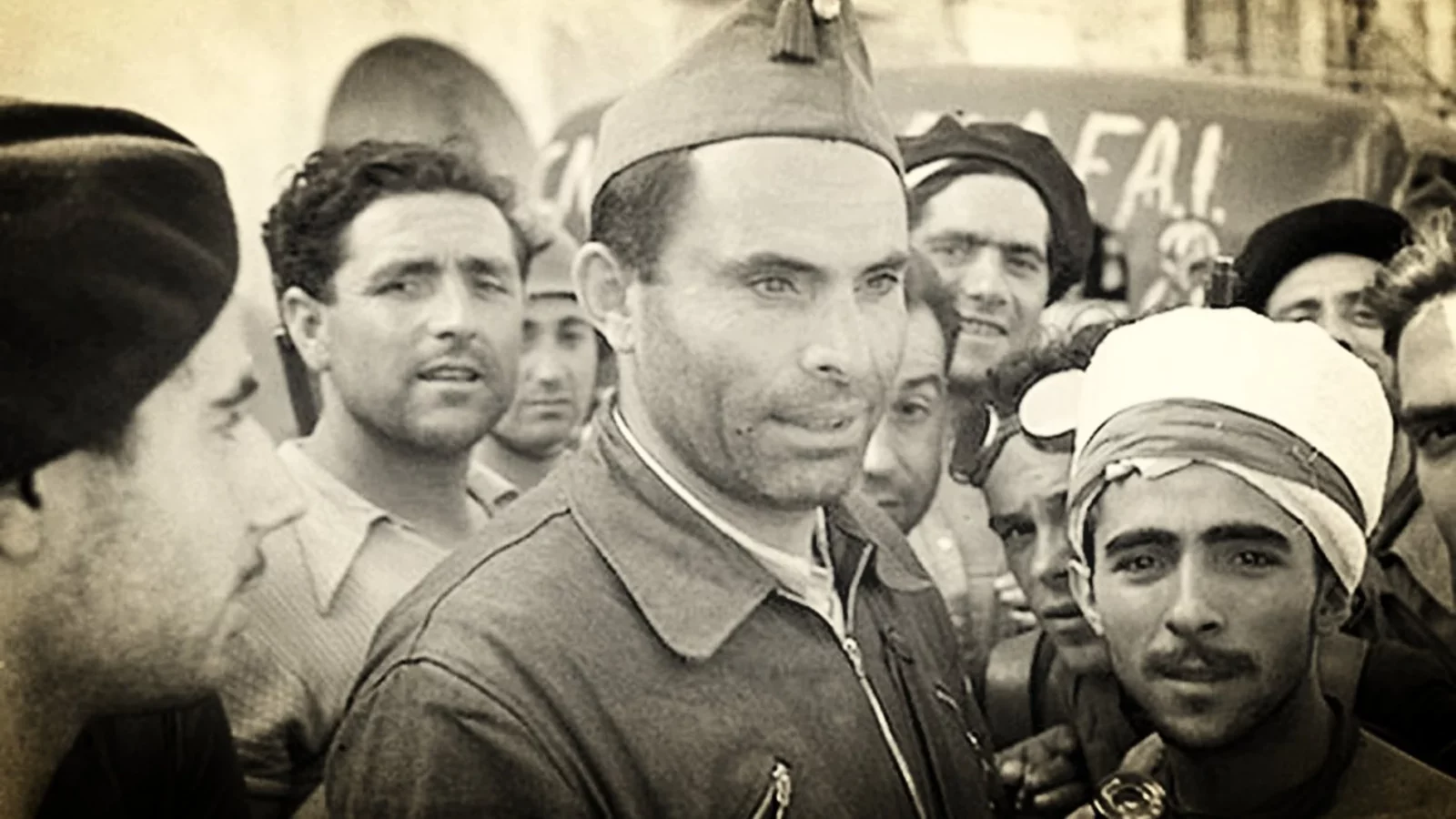
To commemorate the 90th anniversary of the Civil War, José Ángel Mañas recreates in Zenda, day by day in this section, what happened in 1936, perhaps the most pivotal year in all the recent history of Spain.
Saturday, November 14, 1936: Durruti Arrives
Who is Durruti? —asked Ángel Navarrete.
—The first man to have stepped out of the car. That one!
A black Packard had just passed through the arch of the courtyard at the Administration Building of the Modelo Prison on Martín de los Heros. There, the column’s leaders and local CNT figures awaited.
Durruti was a day behind his men. The others had traveled from Barcelona to Valencia by train, and from there by bus. They had initially gathered at the orphanage school of Correos y Telégrafos in Hortaleza, then in a building on Miguel Ángel Street. Afterward, they joined the rest of the anarcho-syndicalists at the Modelo prison. This facility, emptied of inmates, served as the Catalan headquarters. Meanwhile, Durruti had flown in a small plane from El Prat de Llobregat and had taken a car from Valencia.
As soon as they reached the capital, after presenting himself at the Ministry of War before the General Miaja, the anarchist leader moved on to Moncloa. For days the Kléber brigades had been occupying the Ciudad Universitaria and harassing the Varela army, which was stuck inside the Casa de Campo, squeezing it toward the Puerta de Hierro, toward Aravaca. The confederal militias aimed to plug the hole opened by the enemy in their main assault, which stretched from the Oeste Park to the Northern Station and posed a continuous threat. Besides, it was a demonishly cold day. The dampness went to the bone.
—Where are the men? —Durruti asked, saluting briefly.
—Formed in the main courtyard —said Ángel Navarrete.
—Let’s go with them.
The Barcelona column consisted of four thousand volunteers. In Catalonia, propaganda urging aid to Madrid continued with intensity, and they would soon enter combat, though for the moment they remained at the Modelo prison, the “fan” as it was popularly known. Flags red and black fluttered in their windows. At the gate stood the famous line of Concepción Arenal: HATE CRIME AND PITY THE CRIMINAL.
Durruti stepped out onto the yard. There, the militiamen waited. The wall was covered with decrees from García Oliver. Across the way lay Moret Avenue, separating them from the Oeste Park, where gunfire and the detonation of a shell could be heard. They stood right at the front line. The men, tense, awaited his words.
—You know Madrid places its full trust in your courage —Buenaventura Durruti raised his voice—. And General Miaja, with whom I just met at the Buenavista Palace, has admitted that he would rather rely on you than on the troops of Kléber or the Fifth Regiment —he said, provoking the first jeers. There was a clear rivalry between anarcho-syndicalists and communists. —Therefore, they assign us the defense of the Faculties on this side of the river. While Kléber’s forces stay posted at the San Fernando bridge, we will withstand the push of the Moors who aim to enter tomorrow at the University City.
Ángel Navarrete did not take his eyes off him. It was the first time he saw Durruti. Clad in blue coveralls and wearing a libertarian cap of red and black satin, his height, his athletic build, his powerful torso, and his immense authority were unmistakable when he stood upright. Even in Aragon he had said he would not subordinate himself to Madrid or to Barcelona, or to Azaña or Giral, or even to Companys. That earned him the sympathy of the CNT. Of course, from that moment on, he did not stop adopting increasingly hard-line measures, his enemies claiming they were dictatorial, a charge he defended himself against.
—Here, no one serves out of duty or discipline, but out of a desire for freedom. We are a revolutionary army. I use the authority you have granted me, but I do not command. And now, to defend Madrid! The anarchists have contradictions, and we can give up many things. But there is one thing we will never renounce: victory!
—Long live Durruti! Long live the CNT! Long live Madrid! —the union members shouted.
Todas las entradas de 1936 día a día
Entrevista con José Ángel Mañas sobre 1936 día a día