
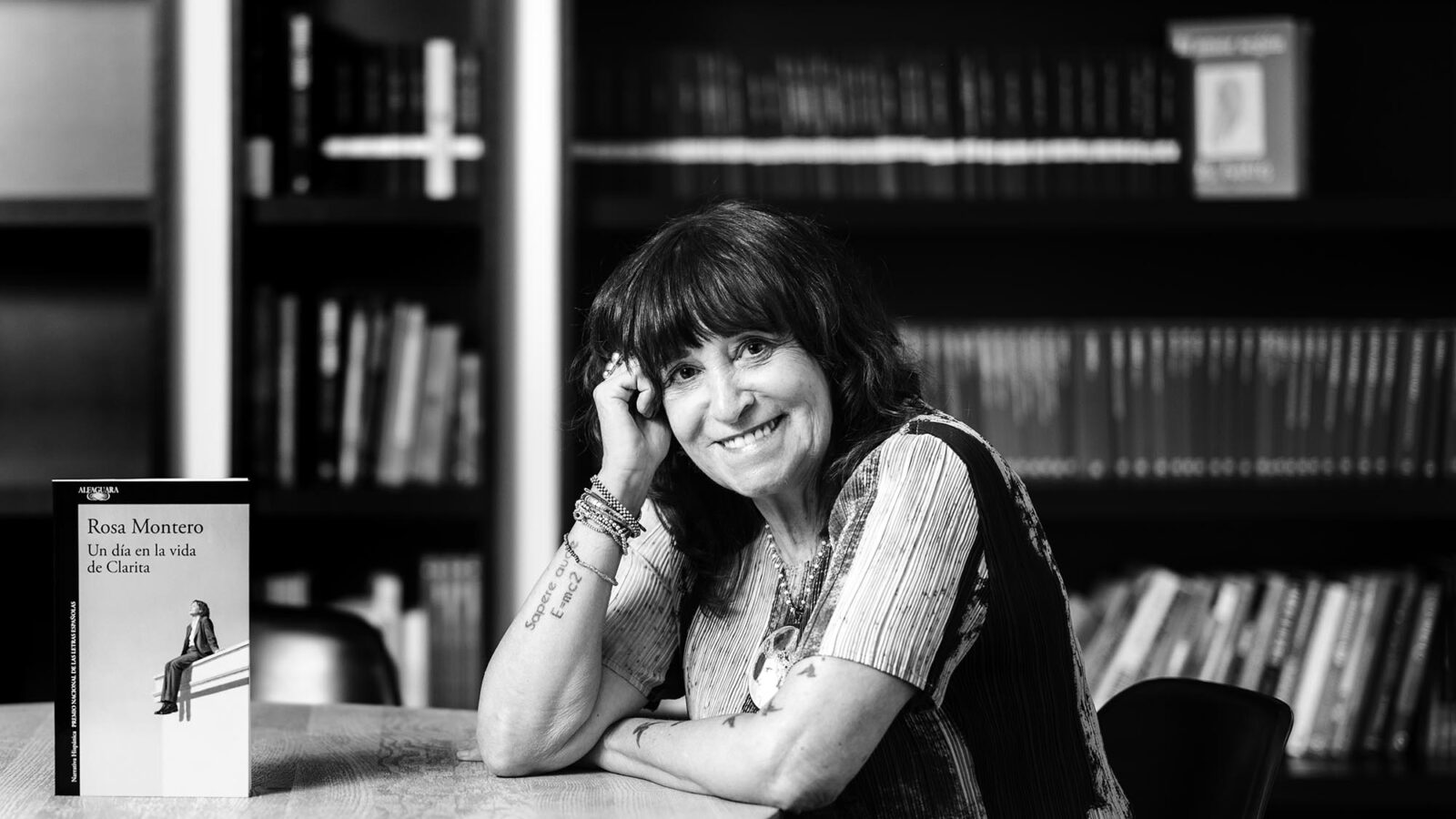
Rosa Montero says that her latest book wasn’t conceived as such. It responded to an exercise proposed by a French residency she ultimately could not attend, but her sense of obligation nevertheless led her to fulfill the objective of the trip: to write the first chapter of a novel in order to create a collaborative book of opening chapters with other authors. Rosa didn’t go, and thus she recovered the writing of a fantasy trilogy, but Clarita, the protagonist of those opening lines, possessed her and forced her to write.
Thus emerges A Day in the Life of Clarita, a book that is fast and slow at the same time as it choreographs the working and social world in which we live. Of Rosa’s commitment we know one thing for sure: her journalism backs her. And her literature, which I feel is at the service of the people, approachable and always fair, is a bright and generous answer to her concerns.

Even the ugliest duckling can become…
Clarita is a woman humiliated and harassed at work who lives the day before her retirement. The peculiarity of the story is that it seems that day will never end, and perhaps that is the point: there are workdays that contain a whole life and are capable of crushing anyone who traverses them. Clarita crosses this last day while her readers watch in real time her thoughts, her concerns, her wounds and her small survival strategies.
There is something very recognizable in her way of fitting into the world so as not to bother too much. We also see it in her ability to bear the unbearable and to anticipate the harm of others. Yet it is also possible to see ourselves in that strength that surfaces when everything is, finally, about to be lost. Clarita is a character born of our time, of a society shaped by individualism and conditioned by work and capital. What remains after that is damage, sometimes irreversible, that is rarely spoken aloud, all of us immersed in the same wheel.
And there appears one of the virtues of Rosa Montero: her capacity to look where we have stopped looking. Literature also shines in ordinary characters whose lives go unnoticed. It is there that the reader sees themselves reflected. We are not great heroes who always survive: we are people who do what we can with what we have, even if it is not enough. Perhaps that is why Rosa did not ignore Clarita. It was not just a commitment to the residency: it was a commitment to all of us.