
To commemorate the 90th anniversary of the Civil War, José Ángel Mañas recreates in Zenda, day by day in this section, what happened in 1936, perhaps the most pivotal year in all recent Spanish history.
Monday, November 16, 1936: The Diplomatic Corps Protests
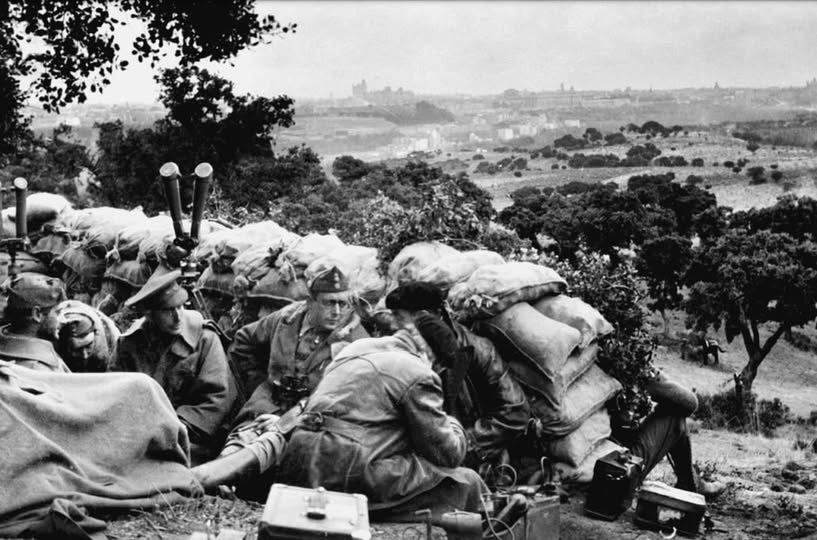
I will try to briefly summarize the latest news from the University City, where the shelling from the Modelo prison does not cease, since the men of Varela know there are no longer any prisoners inside. The enemy occupies Garabitas Hill. From there he attacks the government batteries attached to the prison walls along the Moret promenade. The water conduits have burst. The floods flood the militiamen’s trenches. The Catalan anarchists stab sacks of the parapets to release the water, and this carries away the earth, narrowing the parapet and leaving them exposed at points battered by the enemy. And as they run along the wall, they become easy targets. The syndicalists fall like flies. Today, attempting to repel the enemy on the other side of the Manzanares, Durruti’s column lost sixty percent of its men. A hemorrhage. Many are demoralized. I have heard that the XI International Brigade, composed of Germans and Austrians, moved from the San Fernando bridge in Puerta de Hierro and, together with the tattered remnants of the Durruti column, vainly tries to drive the Moroccans from the Architecture School. Durruti mutters curses at the rifles, moves about like a madman, begging for new weapons. And the civilian population’s situation is dramatic. In addition to the shortage of supplies, there are indiscriminate bombings over Madrid, where the most terrible thing concerns the prisoners. Mr. Schlayer, from the Norwegian embassy, will inform all of us about the mass transfers that have been taking place. Please tell us what you have seen, Mr. Schlayer.
—Thank you very much, Mr. Dean. As you may know, I went to the Modelo prison on the morning of November 7, last week, as chargé d’affaires of the Norwegian diplomatic mission. I was looking for the lawyer De la Cierva. I was accompanied by the head of the Spanish Red Cross. They did not permit us to pass. The prison is surrounded by guards. Inside there were empty two-story buses, waiting to transport prisoners. When I spoke with the drivers, they said they had orders to transfer to Valencia the military so they would not defect to the enemy; the others were going to Alcalá de Henares. In each vehicle there could be about a hundred prisoners. Inquiring, I have learned that none arrived in Alcalá. In the municipality of Paracuellos they forced them to disembark in groups of ten or fifteen and to advance bound hand toward the previously dug graves in a ravine, where they were shot in groups. The bodies were poorly buried. There is a stench of putrefaction, and the neighbors know it. We calculate that a thousand people have been killed. It is the greatest horror since the executions in the Badajoz bullring. I have tried to speak with Santiago Carrillo, the Public Order Councillor, who claims not to know anything. He says that the Junta de Defensa has the best intentions, that it does great efforts to protect the prisoners. It is evident that he lies. Everyone knows that the communists loudly call for the extermination of the fifth column. Unfortunately, I am convinced that there have been more roundups of prisoners. They are being killed in Torrejón, in Paracuellos. And if the executions stop, it is only due to pressure from the Diplomatic Corps. In fact, the Junta has issued a statement titled “Facing an Infamy,” where it asserts that neither the prisoners are victims of mistreatment nor should their lives be feared. The scandal has reached the Government. Tomorrow a commission will travel to Valencia to explain itself to Largo Caballero.
—Many thanks, Mr. Schlayer —said the Chilean ambassador—. In light of the pressure from Franco’s troops, who remain in the University City, the last inmates of the Modelo were transferred to the prisons of Porlier, Ventas and San Antón. The evacuations do not stop, and both I myself, dean of the Diplomatic Corps in Madrid, and the chargé d’affaires of the Argentine embassy, Mr. Pérez Quesada, support the Norwegian representative. We must ensure that the League of Nations sends a commission to Madrid. We need a Geneva delegation to request the Defense Junta provide a list of prisoners taken from Madrid’s prisons, with their respective destinations, and verify that they arrived. Do you agree?
Todas las entradas de 1936 día a día
Entrevista con José Ángel Mañas sobre 1936 día a día