
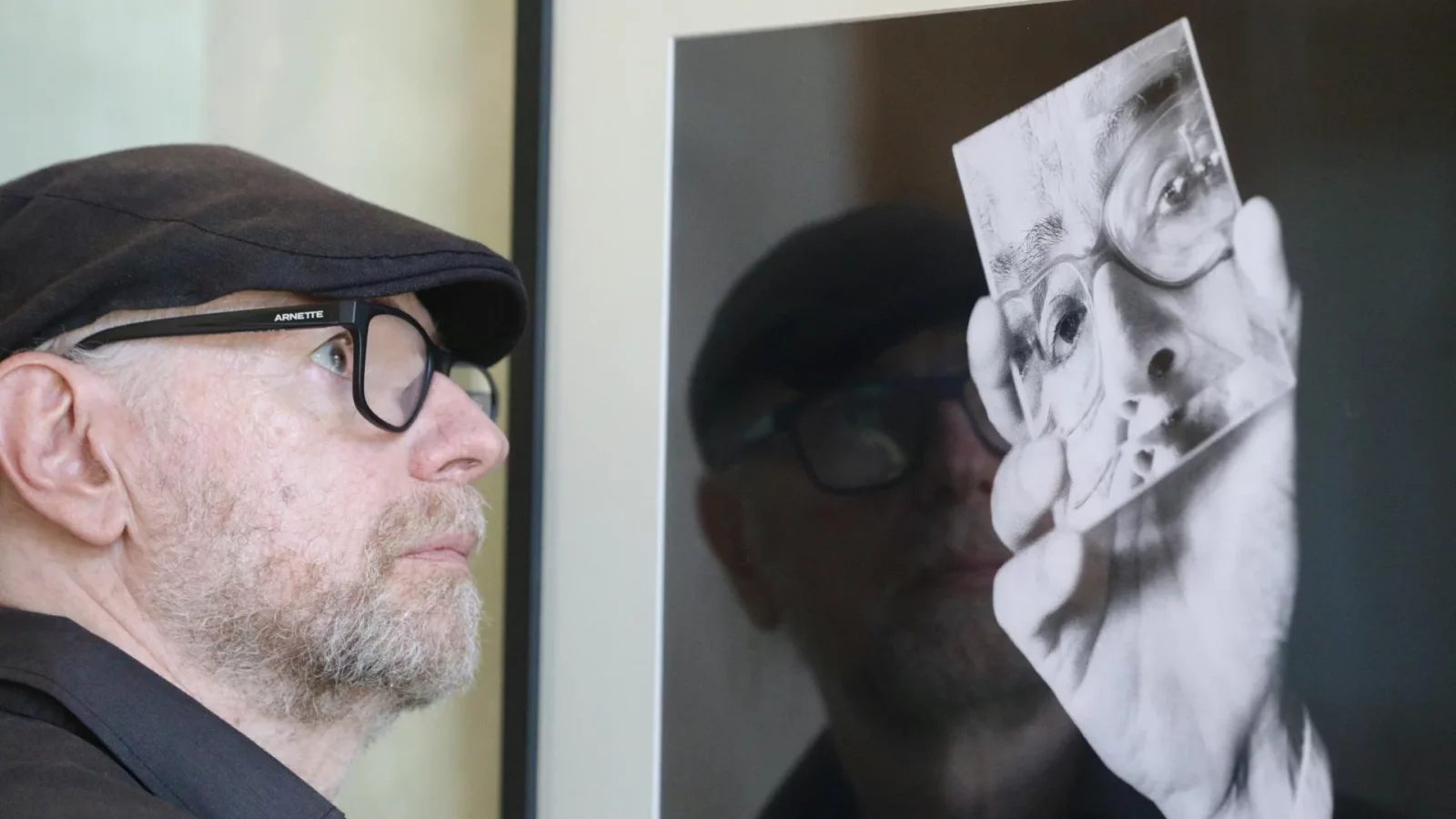
Daniel Mordzinski is the photographer who sees everything before the person he is seeking realizes that they are being watched. Now hundreds of spectators in Madrid turn their gaze toward him, in front of the National Library of Spain, as an extraordinary celebration unfolds along an entire street that reveals his passion for portraits, but above all for expressing, through his photographs, what he has perceived in the artists who populate the world he has traversed. For the road he travels, as if painting, with the fervor of saying as soon as possible what he saw. And he always nails it, with what he perceives.
There they stand, for instance, Gabriel García Márquez or Mario Vargas Llosa, looking from different latitudes, alongside hundreds of subjects from myriad places, but above all from hundreds of positions. All of their characters, who have crossed the world and now gather in Madrid, are each one of them in their own way, as the saying goes. Yet they are all Mordzinski’s subjects, who look at Mordzinski, but above all end up becoming Mordzinskis—not exactly the people themselves but also, equally, the one who captures them in a portrait.
Since I mentioned Gabo, for example: there he stands, on the illustrious Madrid street where the work is exhibited, observing an endless avenue, dressed in his white garments and wearing the yellow shirt that he always wore in his celebrations and in life. And there he is, for example, Ida Vitale, the Uruguayan woman who emerges behind her smile of waiting, with a paper plane that seems to be part of a poem gazing perhaps toward the National Library opposite. For a time the library will belong more to Mordzinski’s characters than to the vast repository of writing and memory that surrounds it.
A group of children, a tired dog, a mother watching—these stand before Mordzinski’s gaze, and I look at them as if they were part of the same street and the same world that he has painted swiftly, lucidly, and fully. An Argentine who looks more acutely at the sea from which he comes.
On that same canvas we also glimpse Borges, his hands raised toward the sky where only he knows, because he does not see, yet there is already the sense of how much Borges looked inward. If you see Borges in a photograph, it is as if his soul is present too, his way of perceiving himself, seeking to discover in Borges the other person somewhere in the world or, for example, in the place where he could find the sky.
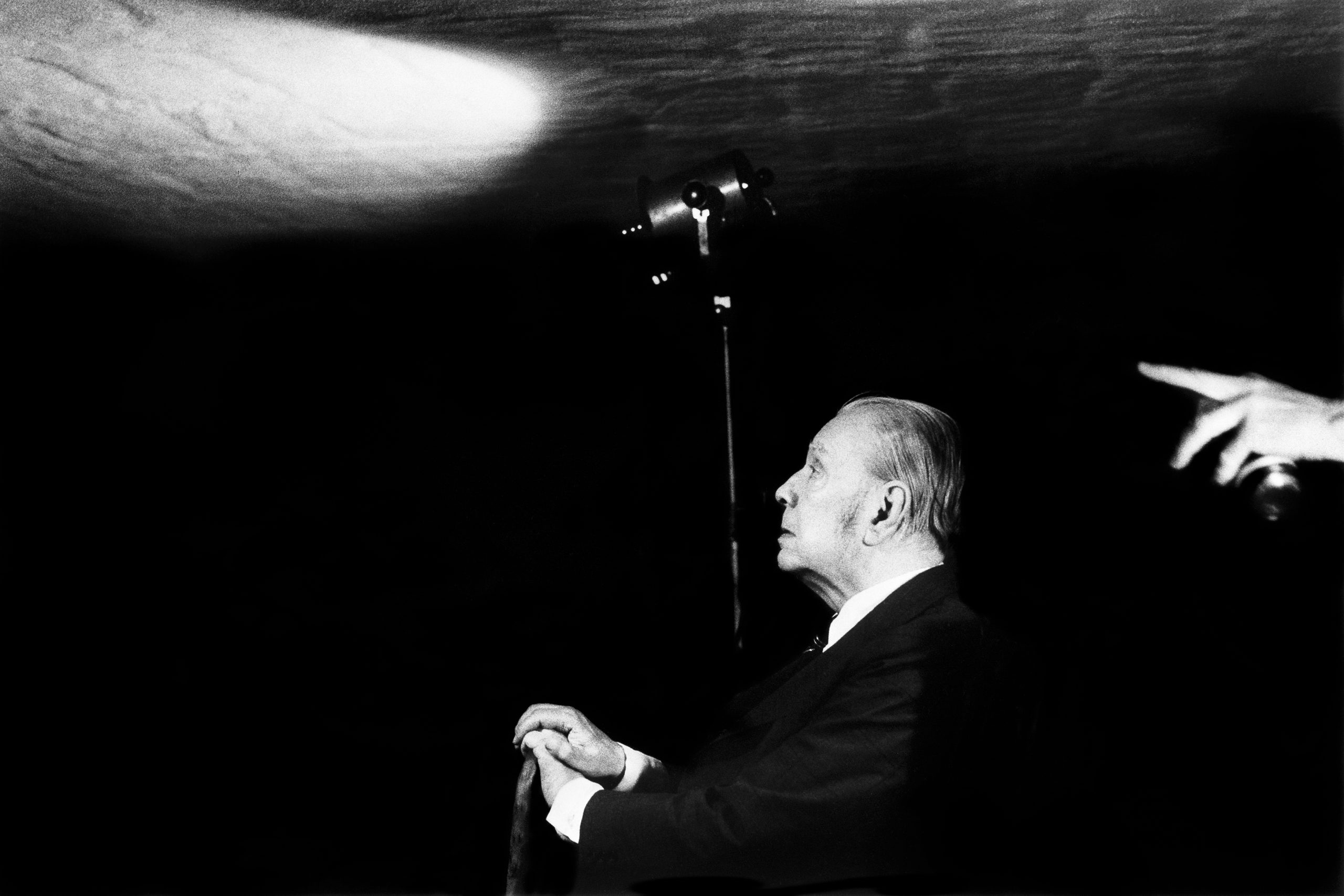
Jorge Luis Borges photographed in Buenos Aires, in 1978. © Daniel Mordzinski
I found him looking toward the sky, precisely nearby, at the Hotel Palace in Madrid. Borges told me, “Could you take me to see the sky? Do you know that the only sky I can see in the world is the one you can glimpse in the dome of this place?” I did as he asked. He looked. Time passes, and I still see Borges there, and it is curious that now, in this Mordzinski photograph, I have re-encountered him as if the old Borges were precisely gazing at the sky he sought back then.
From this singular photographer, who does not just capture but peers inside his subjects, many words have been spoken, some of which I quote here, drawing from the voices of those who have highlighted him, and who are among his portraits: Javier Cercas: “Believe me, I am a serious person, a most ordinary person, but the guy behind the camera isn’t; the fault lies with Daniel Mordzinski, who first extracts your soul from your guts and then photographs you.” José Manuel Fajardo: “Each one of us embodies in our own flesh the History of the world. We are extremes of a thread of time. Therefore, sinking our gaze into our faces is, in a way, to discover in the present what has already passed, to trace the chronology of all those who, looking at one another, have shaped who we are. Being able to perceive that and translate it into photographs as Mordzinski does is a true gift of intelligence, a source of aesthetic pleasure, and a necessary invitation to collective reflection.”
And the list of those who value him continues: Wendy Guerra: “Daniel Mordzinski has brought light to my writing, and now you can read me in Cuba.” Martin Kohan: “Mordzinski leads the writer to a moment of self-discovery, to a state where the writer no longer recognizes himself, and right there he photographs him.” Andrés Neuman: “Mordzinski does not record moments: he fabricates them.” Santiago Roncagliolo: “I suppose Mordzinski does with writers what they do with the world. He takes a few visible fragments, reassembles them, alters them, and turns them into something else.” Luis Sepúlveda: “Daniel works with three essential elements, namely light, shadow, and respect.” Zoe Valdés: “Why do you ask me to write about Daniel Mordzinski? If it is he who writes about us, within us, the writers he has found with the wonderful melancholy of his pupil.”
And Mario Vargas Llosa, who has been photographed by Daniel many times, once described him thus: “He serves the writers he photographs by striving to imprison their deepest truth and by trying to disappear himself behind his camera.”
In that same vein, his paintings unfold in Madrid now, under the light of a city that welcomes him as if it had been expecting him. In the very place where his works can now be seen stood, during the Spanish Civil War, Octavio Paz, then a youth who came from Valencia to mourn in this city the sorrowful future of a Spain broken by war.
Today, precisely in that spot, Paz returns as the Paz who visited Madrid many times, appearing here with the same joy I recalls from the last days of his Spanish life, years before his death. I remember that last time. Flirtatious as ever, and as Mordzinski portrays him, he approached me at the Palace and spoke of a Mexican girl he had seen years earlier: “And whatever happened to the little Mexican girl?” He was always truly Octavio, and this is how Daniel captured him, who saw so many and who continues to see so many.
In the air of his way of perceiving literati and literature, this artist of a gaze that is both his own and secret, are writers such as Edmundo Paz Soldán, Nélida Piñón, Jorge Amado, Raúl Zurita, Jorge Edwards, Roberto Bolaño, Isabel Allende, Carlos Granés, Daniel Samper, Piedad Bonnett, Laura Restrepo, Antonio Caballero, Tomás González, Vanessa Londoño, Héctor Abad Faciolince, Pilar Quintana, Leonardo Padura, Karla Suárez, María Fernando Ampuero, Elvira Lindo, Almudena Grandes, Adolfo García Ortega, Eduardo Mendoza, David Uclés, Javier Cercas, Francisco Ayala, Rosa Montero, María Dueñas, Manuel Vilas, Elena Poniatowska, Gonzalo Celorio, Juan Villoro, Carlos Fuentes, Ángeles Mastretta, Gioconda Belli, Claribel Alegría, Ernesto Cardenal, Sergio Ramírez, Augusto Roa Bastos, Jeremías Gamboa, Alfredo Bryce, José Saramago, Mario Benedetti, Cristina Peri Rosi, Alberto Barrera Tyszka, Rafael Cárdenas, Karina Sainz Borgo, Julio Cortázar, Irene Vallejo, María Enríquez, Claudia Piñeiro, Samantha Schweblin, Selva Almada, Leila Guerriero…
And so a whole world to which Daniel has given, and will continue to give, the passion of watching them, to leave the history of literature with a memory worth more than a million words. This is the testimony of an artist who knows the way the air of his painting travels.
—————————
0/5