
A small bulb that lit up for twenty-something years, or even more than thirty, the refrigerators manufactured in the old USSR was one of those examples that lingered longest in articles or documentaries about planned obsolescence. That is: the ruse of designing products with a limited lifespan, to force people to buy another, to drive consumption. European or American lamps of that era did not endure so long.
Analysts knew the phenomenon was not due to a superior Soviet technology, duplicating state factories with no market competition, but to a crucial difference in the Western system of economy and production. Apparently, the Russians made the filaments in their bulbs thicker and operated at a lower temperature. That is why they produced a warmer light—inside the cold refrigerator, even—and less brightness. And with that technique—and through the “economy of scarcity,” the rationing of supplies—the wear was drastically reduced. Or its life was extended. However you look at it. It’s like the scarcity of life or, more precisely, the decline of purchasing power that still invades us today. The double perspective. Not settling for half.
By contrast, the Phoebus cartel, founded in Switzerland at Christmas in 1924, brought together the world’s leading lamp manufacturers. The alliance united Philips, Osram, and General Electric and, among others, the Spanish Lámparas Z. They deliberately reduced the lifespans of light bulbs: from 2,500 hours to a mere 1,000. That stratagem guaranteed a continuous, unbroken stream of sales. Profit. A century.
A diamond will last forever but not a car or any appliance. Purchased piecemeal to assemble at home in spare moments, a utilitarian car—as it was called in Spain years ago—would cost roughly twelve times as much.
The literature that tells decadence with art and humanity has given us great templates. For example, the first novel of a twenty-something Thomas Mann, The Buddenbrooks (1901), carried the subtitle The Decline of a Family. Other surnames inherit the rot of their lineage, such as the Compsons, the Sutpens, the McCaslins — except Isaac “Ike” McCaslin in The Bear — in Faulkner, immortal. The Leopard, by Giuseppe Tomasi di Lampedusa, a feline that appears on the coat of arms of the Salina Sicilian family, and masterfully adapted to film by Visconti in 1963. Or the decline of the Vidal Olmos, symbol of Argentina, in the magnificent Sobre héroes y tumbas (1961) by Sabato, where Martín Castillo finally finds meaning in living, in his “exodus to the south” with truck driver Bucich, in hopeful contrast with the persecution and death of General Lavalle.
The Mexican writer Jaime Muñoz Vargas (1964), journalist, teacher, editor, columnist, researcher… A prolific and awarded author. Born in the state of Durango, in Gómez Palacio—where he was unanimously recognized with the dignity of “distinguished citizen”—, he has lived since 1977 in Torreón, Coahuila. He worked, until recently retiring, at the Universidad Ibero Torreón. He maintains a blog, Ruta Norte Laguna, where you can learn about the author’s profile and creative and scholarly work.
From his broad body of published work I have focused on “Cacharro”, one of the earliest micro-stories of his I read. It is included in his book Grava suelta, which gathers “one hundred vertiginous tales,” each in a single paragraph.
The story the narrator tells does not begin exactly at the beginning. That retrospective tale is sparked by a clean yet friendly phone call. And it reopens events that were thought definitively closed. Literature and things are more than creatures made of time. It seems as if the unknown interlocutor’s closeness provides a channel of cooperation, a confidant tone. And everything, except for two brands, stays anonymous from the moment of “They called” and the “unidentified bureaucrat” of the first line. Yet, despite only Mexican local names appearing—Matamoros, Ejido San Miguel—the story climbs to a degree of confession and discovery. But the beater is treated as if it were someone. That personification achieves a human status and produces a humorous effect: ill, with “aches,” “symptoms” and a need for “therapy.” This personification, as if the protagonist were telling an anecdote to a confidant.
Another quality of this piece is evident in the narrative progression: the reader—almost equated to the patient interlocutor who has just phoned—grows more aware of wear, frustration, and absurdity, until it culminates in the narrator’s decision. The exaggerations and a voice that is almost informal, a tone of trust in the listener—and in us readers—provide the story with the spark of liveliness and comedy.
But life is serious. The final words summarize the dismissive view of the unfavorable experience, yet warm and heartfelt, with that past of years spent relying on the beater.
And after those journeys there remain in the odometer’s keepsakes matters to reflect on and sometimes discard. A critique of this civilization of ours, a victim of mindless consumerism. A critique of how objects and products that complete their useful life—perhaps with some trap that shortens their life—end up becoming a servitude and an obligation. The critique that we grow accustomed to deficiencies in everyday existence. The acknowledgment that there may still be faith in making humanity and administrative bureaucracy compatible. The suggestion that renouncing what binds us is a decision belonging to free people.
In a single paragraph, to urge reflection—festively—on wear and tear, resignation, attachment to things, and the need to free oneself from what has become a burden is a display of talent to be appreciated.
Two more digressions. Pardon me.
The expressive vocabulary of Mexico—the country with the most Spanish speakers on the planet—leads us to admire verbs like cascabelear, referring to those engines with irregular rhythms, suspicious noises, and hesitant jolts. And to envy fruits and colors like mamey, of an orange-tinged hue, a bit earthy, coppery almost.
And rereading “Cacharro” makes the time-doubt more relevant in the early stages of recollection: “was, or is, I don’t know anymore.” And the next word rolls perfectly: “mine.” All true literature is ours. To share. By telephone or even in writing.
Cacharro
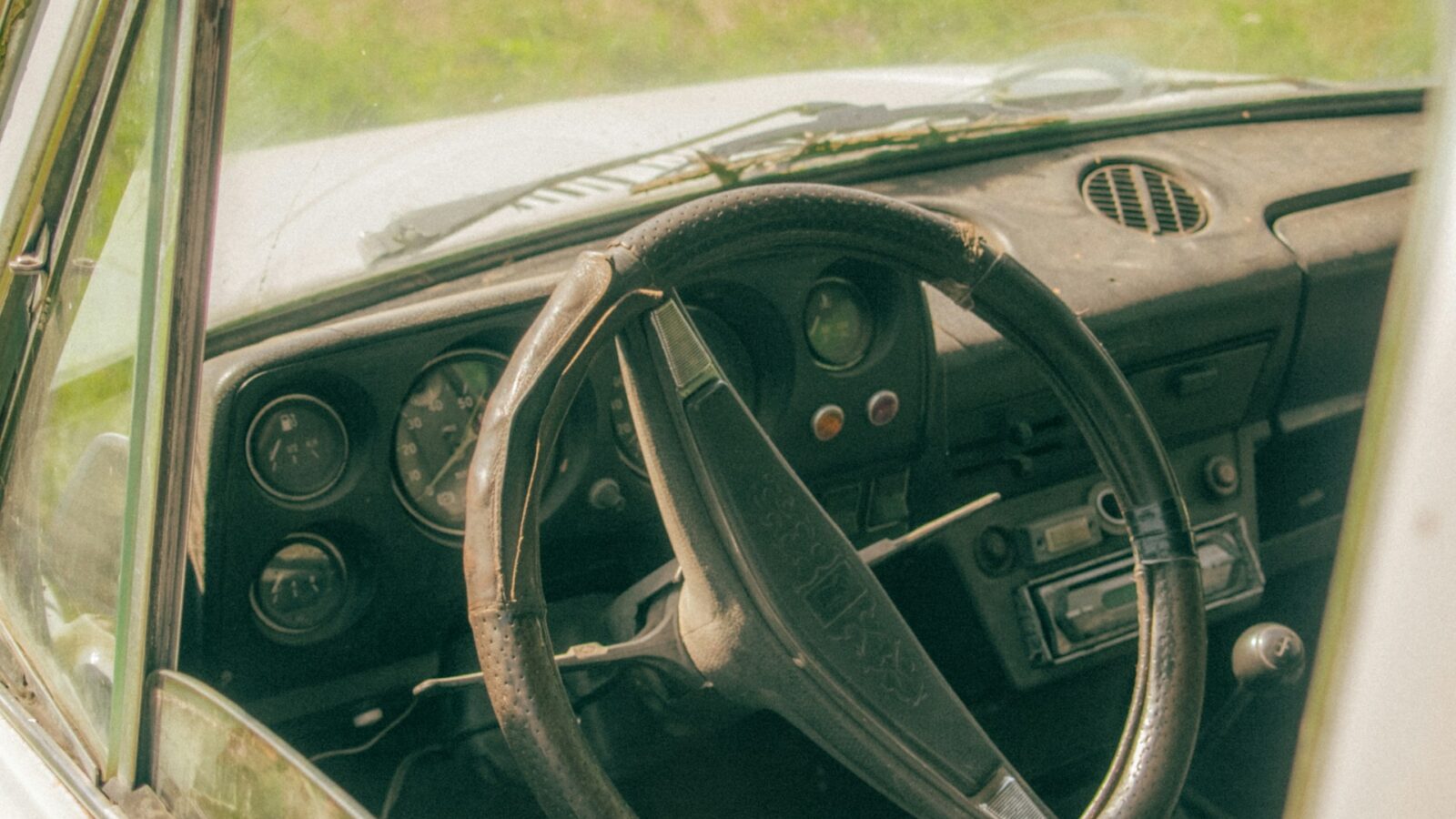
Three days later they called. An unidentified bureaucrat asked whether I owned the Nissan from 1997 in a mamey color. He added the plate and the place where it had been found. I confirmed that the vehicle was, or is, mine—not sure anymore. The bureaucrat asked if it had been stolen, for it had sat for a couple of days with the key left in the shoulder of the road toward Matamoros, near the Ejido San Miguel. It was odd, but the question was so polite that it gave me confidence to tell him the story. I had bought that jalopy ten years ago. It already had a decade of use at that moment, but it ran well for a while. How many? Six, maybe seven. Then it began to clack, to break down a week on and another one the same. From year to year it became a distinguished guest at neighborhood workshops, crowded and greasy. One day it began having transmission problems; it took almost a month to fix, and after three days of operation it failed again at the same point. It spent two more weeks in therapy. When at last it was ready, it ran with some normality for fifteen days. Then another ailment appeared: it overheated. A two-liter bottle of Fanta with water became indispensable for the car to function with minimal decency, so water came to be an input perhaps more important than gasoline. You had to pour it into the radiator before every trip, because otherwise the thermometer needle would reach the red zone, nearly the engine on fire. I don’t remember how long I drove like that, resigned to that thirsty car. One day, however, the fault was repaired to the point that the dreaded thermostat needle miraculous conserved from those infernal heights. It ran well for forty-some weeks, until the brakes failed. One day it almost went off into infinity (the infinity of death and beyond). And so, after any repair new ailments or revivals of known ones would appear. Then I grew used to driving by ear, i.e., keeping the wheel but listening closely to the engine’s breath and its wheezes (the radio was then impossible to hear). That lasted two years, two long years, until the moment came. I was on a heavy-traffic lane and the car literally stalled on top of a speed bump; it had, miraculously again, just enough takeoff for the downhill. There I made the decision: while the trailers roared, threatening, on my side, I left the keys in the ignition and walked away, without fear, without hope, but with a faint and delicious sense of freedom. ■
—————————
In Loose Gravel (One Hundred Vertiginous Tales), Monterrey, Universidad Autónoma de Nuevo León, 2017, pp. 39-40.