
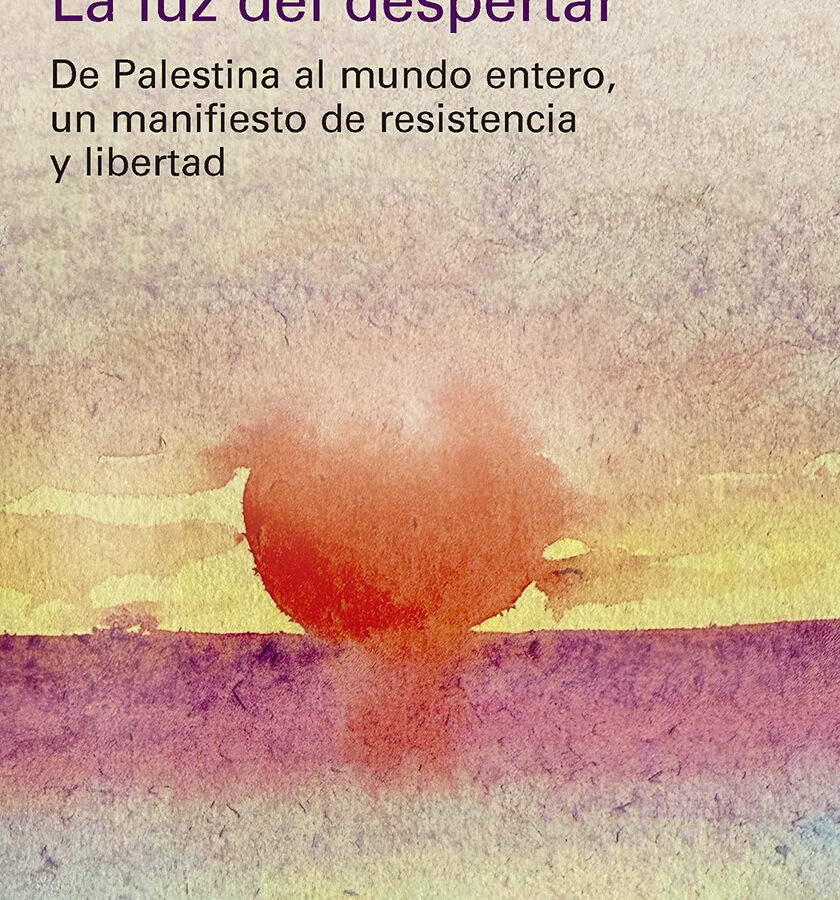
The UN Special Rapporteur on the human rights situation in the Palestinian territories occupied by Israel since 1967 publishes a book that calls us to exercise the rights for which those who came before us fought so hard and to build tools for collective emancipation.
At Zenda we present the opening pages of The Light of Awakening: From Palestine to the Whole World, a Manifesto of Resistance and Freedom (Galaxia Gutenberg), by Francesca Albanese.
***
Introduction
There is only one place where today and yesterday meet,
are recognized and embraced, and that place is tomorrow.Eduardo Galeano, The Book of Embraces
It has been a year since the publication of When the World Sleeps. A year of horror, cruelty, and lies that have devastated Palestine, but also a year of a great awakening, deep and generalized, for many people around the world. When at the book presentations I met readers, I found warmth, a desire to understand, and above all, an unwavering willingness not to stand idly by, to act, to contribute, each according to their possibilities.
When four years ago I assumed the role of the UN Special Rapporteur on the human rights situation in the Palestinian territories occupied by Israel since 1967, it was difficult to speak about Palestine. In Italy, as in other places, despite the violations committed by Israel for decades, there were few words to define them, few coordinates to orient oneself. Today, something has changed. Yes, it took a genocide for this to happen. But now many people see it. They recognize colonialism and the crimes committed in the name of an ideology. They recognize the dehumanization that allows killing and torturing human beings, reduced to abstract entities, faceless, which can be eliminated without remorse. This awakening brings suffering and a sense of impotence.
“What can I do for Palestine?” many have asked me. “What actions make sense, beyond boycotting the companies that we now know participated in the Gaza massacre?” Or: “How is it possible that international law does nothing about this?”
For months I have been questioning these questions, as well as many reflections. I believe that the suffering of Palestine, the darkness that envelops the present and the near future of its people, although paradoxical, sheds light on the world—the light of knowledge, of unity, of shared pain, of a sense of responsibility. The revival of a simple and forgotten idea: that humanity is a whole, an organic unity like a body; therefore, you cannot inflict pain on one part without causing pain to the rest. This awakening has set in motion a kind of “decolonization” of the mind: a painstaking task of removing many superstructures we have internalized without realizing it and that confront us before our very eyes. It is a practice of deconstructing what we think we know in order to start understanding what we see, without filters or prejudices. In fact, at times this process requires radical self-learning: we must learn to read even what we do not see, because it has been deliberately set apart from our field of vision or covered with lies and words that were used cleverly precisely to divert attention and neutralize judgment. In this case, we must train our gaze and, accordingly, our capacity to see and understand. It is somewhat like optical illusions, where one must focus to transcend the image the mind constructs first; and only if one observes with careful attention can one grasp another figure less obvious but more meaningful. For me, and for many others, Palestine has been precisely the opportunity to understand, to learn to trust our eyes and our minds, and to achieve not only to avert the gaze but to keep it fixed to observe more deeply. Once you have seen, you can no longer stop seeing. Once you have understood what Palestine has to teach you, you will not forget.
To undertake this task of decolonization, perhaps each of us must, little by little, topple a piece of the walls of certain convictions and, in some sense, shed them. What remains is a great liberation, a new way of looking at the world, in which, suddenly, so many stories resonate with one another. This has a particularly deep meaning for those of us who, like me, were born and are children of what we call “the West.”
For too long, this part of the world—primarily Europe, followed by its colonial articulations, such as the United States—has occupied a position of cultural hegemony that has allowed it to choose its own moral stance and its own memory, to acknowledge some crimes and to hide others, as well as to rank suffering with ease. This has triggered a selective and asymmetric notion of rights and justice in which universality has been proclaimed and displayed more than practiced. This colonial amnesia comes at a price. And Palestine is paying the bill.
But despite what is often said, it is not law itself that has failed. Law is a powerful tool when applied. However, when it is suspended or made intermittent for political convenience, it shifts to the realm of judgment, dispute, and fracture. This is precisely what is happening in the face of Israel’s impunity and the protection guaranteed by the United States and many other states, especially in Europe. Therefore, this is not about a lack or “failure” of the law, but about its unilateral application. This distinction is fundamental: the tools exist, the norms also, and, consequently, the political and legal struggle cannot be separated.
In this struggle of resistance, there are thousands of individual and collective stories. So many voices, in different languages, tell their dream of freedom and emancipation, their right to self-determination, and the nightmare of it being denied. So many voices are calling us to be an active part of a collective dream of liberation from any form of oppression. Respect for human dignity as a universal value, today, seems a utopia; yet after so much struggle and suffering in the past it should be a right already acquired—as it is in legal terms—for all the peoples of the world.
How, then, can we reconcile the pain of the present nightmare with the longing for the shared dream of a future of peace and serenity that we would wish to arrive as soon as possible?
As I spoke with others, it increasingly became evident that the only bridge between the nightmare and the dream, between the apocalypse and the light of awakening, could be the actions of people—people from all nations and of all ages—called to act as healthy antibodies of a sick society.
[…]
—————————————
Author: Francesca Albanese. Title: The Light of Awakening: From Palestine to the Whole World, a Manifesto of Resistance and Freedom. Translation: Mónica Monteys. Publisher: Galaxia Gutenberg. Retail: Todos tus Libros.