
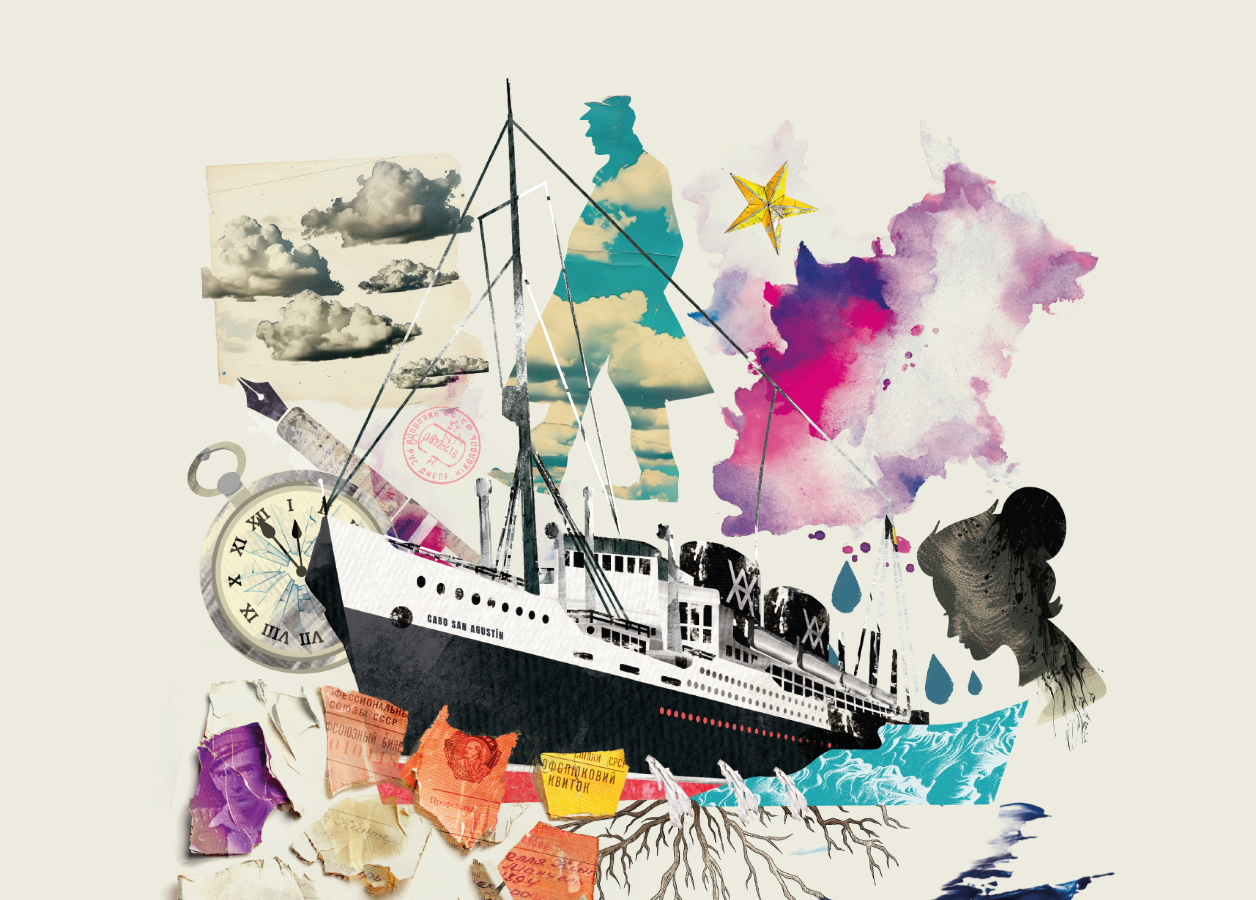
The Lines of Silence (Libros de la Herida, 2025) tells an odyssey that unfolds across different countries through several generations of two families. Its protagonists face a multitude of misadventures, dangers, challenges, and temptations; they find unexpected refuges and must make difficult decisions in their tireless struggle for survival and dignity.
In the plot, Isabel González bids farewell at the port of Cadiz to her husband, Juan Pellegrini, a sailor aboard the Cabo San Agustín, a grand vessel that maintains a regular line with several American ports. It is Saturday, July 11, 1936. The voyage Juan embarks on will change his life and that of his family forever.
I think the starting point for this novel was when I decided to tackle family memories that weighed like a silent lie over previous generations, silences that cried out from the earth and that were hard to scratch and unearth without causing more pain than the harm that had occurred. Easy answers no longer served me. Perhaps I would not have written this novel if my father were alive. It is something I tell myself, without knowing why. Probably because he lived with everything that happened in his life without seeking blame but choked by silences.
There is a group of Spaniards whose memory is buried, forgotten, Republicans who lived a second exile and upon whom the oblivion and repression of their own people, of their own comrades, fell. One of them was my grandfather Manuel. His tragedy dragged his entire family into the most shattering silences for decades.
At first I wrote a short essay, purely historical, titled The Memory of the Tree, in the manner of a university professor, with quotes, bibliography, archival notes… I felt that I had to keep digging into what had happened over all those years. I needed more, I had to find the most suitable format to convey it.
In 2010, shortly before my father’s death, I traveled to Ukraine. It was then already a country independent from what had been the Soviet Union. There I felt the country’s reality up close, but above all I visited the places where my grandfather spent so many years and I understood better how his life had been in that Nikopol factory. Returning from that experience, I began to process the material I had written years before. It wasn’t enough to write a story as credible as real; literature had to be made. I had the best schooling for writing, that of being a good reader, but even that wasn’t enough.
Years passed, a pandemic occurred, and a university job kept me from continuing to dig into memory. When I began to put down what I felt, what I wanted and what I thought, I didn’t have the precise time. The urgent outweighed the necessary, as so often happens. I was immersed in my administrative work as rector of the University of Cádiz. I needed free time. To have all the historical information required.
In a novel, what matters least is whether the narrative is based on real events; what matters is that it moves you, that the characters are ‘real’. In my case there was that deeply personal motivation, to unsettle the past in order to vindicate the future. To finish a story that was an open wound. I needed to tell it, so that what happened would see the light.
An important step in the novel’s process was documentation. My training and experience as a merchant marine pilot for nearly nine years helped me to be precise in nautical language. I also wanted to be meticulous with the historical setting so that real and fictional characters would fit well, and so that I could understand the facts. Thus, I read abundant bibliography to better shape the historical frame.

Cabo San Agustín (Naviera Ybarra)
To delve into life in the Soviet Union, it was important to read the classics of the so-called socialist realism, especially Maxim Gorky, the supreme exponent of that literature, with a work for me heartbreakingly powerful, The Mother (1907). A neutral and curious view of that same era was that of the Mexican Luis Lara Pardo, in The Russia I Saw (1928). For what the Great Patriotic War represented, I found indispensable the reading of Vasily Grossman and his colossal work Life and Fate (1980). And, to close, I found the stories gathered by Svetlana Aleksiévích in The End of the “Soviet Man” (2015) to be striking.
The discipline of my academic work helped me design a writing plan. Hours, days, months had to be spent. In a couple of years I was able to deliver the first manuscript. In it I built a puzzle, avoided a straight line, a simple chronology of what happened. I grouped the chapters for geometric reasons: jagged lines for the first part, parallel lines for the second, and concentric lines for the last part of the book. The work traverses the history of the 20th century and includes wars and exiles, utopias and disappointments, loves and losses.
Then came my esteemed “beta readers,” with their reading reports. Libros de la Herida showed interest in publishing it. One Sevillian morning I personally met with David Eloy Rodríguez, a person who welcomes you with the same sweetness with which he writes his poems, responsible for the publishing house together with José María Gómez Valero, and everything then flowed. Revisions, corrections, polishing tasks. Four writers I respect and admire, María Dueñas, Ramón Pérez Montero, Benito Olmo and Daniel Heredia, generously gave us a few words with their reading impressions, comments that I am very happy accompany the novel. I am immensely grateful to them. And at last the creature saw the light. I was captivated by the edition, so carefully crafted, by the exquisite cover illustrated by Rebombo Studio. Everything was exactly as I had dreamed, only waiting for the reader’s embrace. And thus The Lines of Silence was born.
One of my greatest satisfactions is when people say: “I had an uncle who went through the same thing”, “In my family it happened that…”. Because deep down stories like this have repeated in so many people… Perhaps the best thing is that the characters now come alive again every time the book is opened to its first page. That the wound is healed and the silences are only memories of the past.
—————————————
Author: Francisco Piniella. Title: The Lines of Silence. Publisher: Libros de la Herida, 2025. Sales: Todostuslibros.