
To commemorate the 90th anniversary of the Civil War, José Ángel Mañas recreates in Zenda, day by day in this section, what happened in 1936, perhaps the most momentous year in Spain’s recent history.
Friday, November 20, 1936: The Execution of José Antonio
A few years later, a malicious version would spread, popularized by the memoirs of Serrano Suñer. The brother-in-law recounts how a mature Franco confided in him: “What an obsession people have with that boy! If the poor fellow is to be taken to the firing squad, I know there had to be an injection to get him to walk to the wall, because he could hardly stand.” The anecdote reveals Franco’s rancor.
The traditional version appears more plausible, judging by José Antonio Primo de Rivera’s conduct throughout his life. It is known that the trial lasted several days. They tried to give it an air of legality. There was a judge, a prosecutor, a popular jury, and José Antonio—being a lawyer—set about preparing his own defense. How much he believed in it remains hard to tell. Seeing that he had been imprisoned on the pretext of pistols found in his home, and given the obvious procedural tricks, he would not have placed much faith in the process. The same went for his brother Miguel, who was detained in Cuenca, again without justification. In Miguel’s case the prosecution did not demand the death penalty, only life imprisonment.
It is easy to imagine the oscillations José Antonio endured, the swings between hope that external efforts to save him might succeed—there were political attempts at a rescue—and the inescapable pessimism.
José Antonio denied again and again having participated in the conspiracy against the Government. It was of little consequence. Soon the sentence arrived: he was condemned to death for conspiring against the Republic. It was hard to prove otherwise, as José Antonio argued that he had always opposed the right.
As the eve of the scheduled date approached, José Antonio arranged his papers, had a hearty lunch of garlic soup, eggs, and a steak, and wrote in a calm manner about twenty letters to family and friends. He spent a bad night, the night from the nineteenth to the twentieth, though sustained by his religious convictions. He waited, lying on his bed, for the fateful hour.
At last he heard the steps of the guards arriving. He stood up. Seven in the morning. One can imagine him trying to restrain the fury and disbelief. It could not be true that he, José Antonio Primo de Rivera, a man with so much life left in him, who had so much left to say, would simply disappear…
The tension grew as he crossed the gallery.
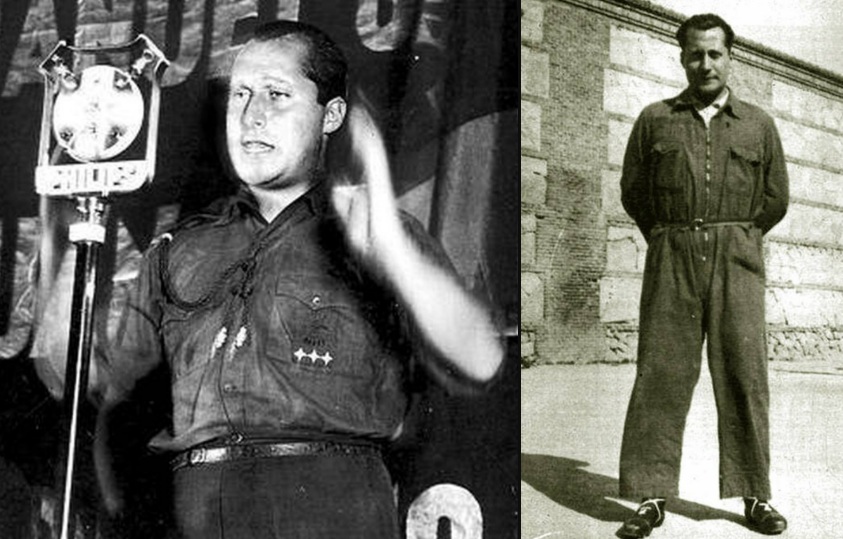
In the courtyard waited the guard detail. He was lined up with more prisoners who were bound. The firing squad was made up of militiamen from the CNT. Around them stood about forty republican gentlemen in suits, watching in silence. José Antonio wore a blue jumpsuit and espadrilles, like a militiaman. With his hands tied behind his back, he faced his executioners head-on.
“When you are going to die, you do not lie. That is why I tell you, before you break my chest with your bullets, that I have never been your enemy. Why do you want me to die? Cowards! Fire, but aim well at the heart, and there will be no need to finish me off! Up Spain! Long live Spain!”
That was his last biblical burst of anger. His eyes flared as the first volley rang out. More shots followed, fired haphazardly, without any order. In total, eighty bullets were fired from a distance of about three meters, and most of them found their mark.
All the entries of 1936 Day by Day
Interview with José Ángel Mañas about 1936 Day by Day