
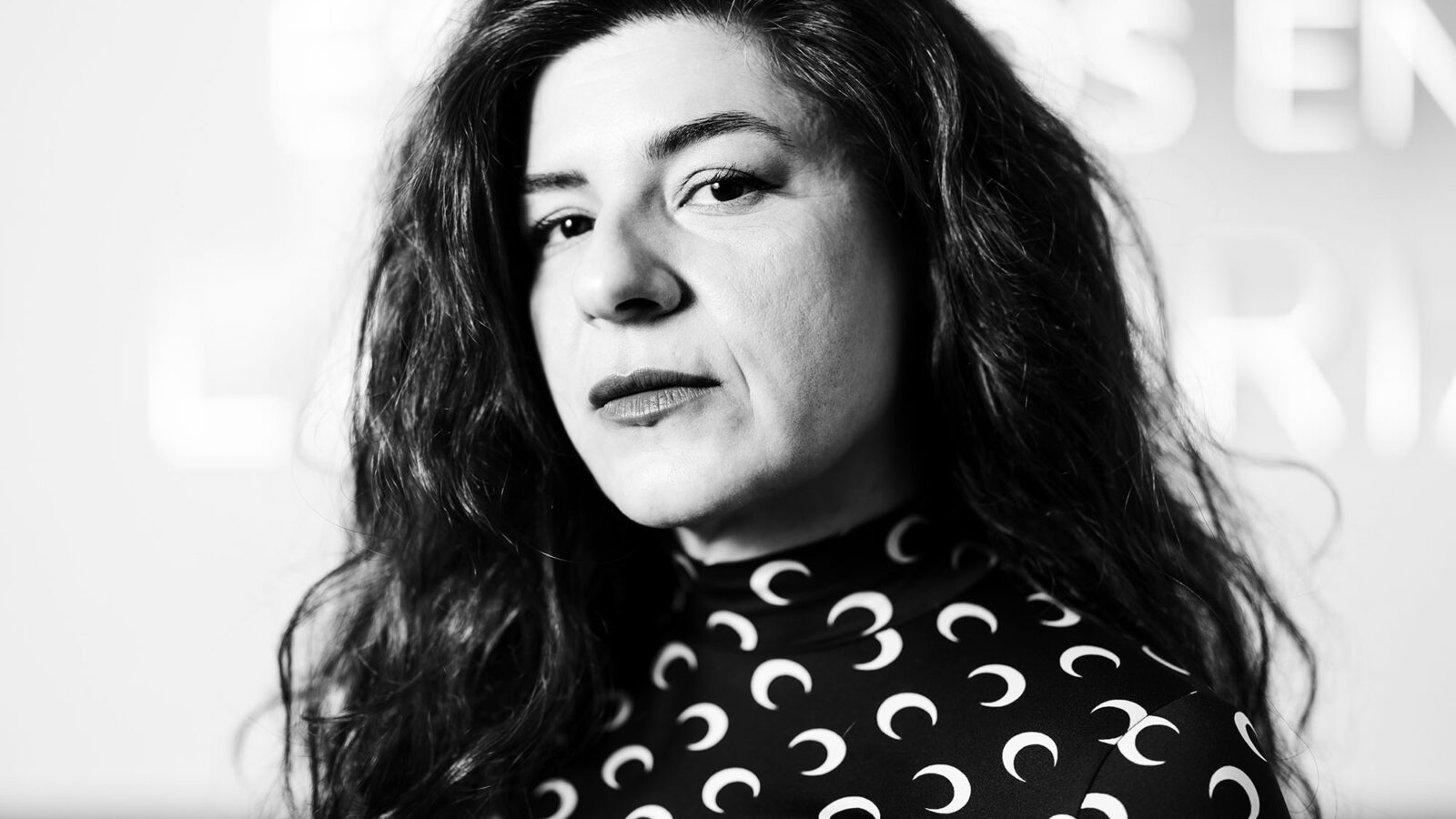
Literature, at times, is this. In Ghost (Alfaguara), Nerea Pérez de las Heras recounts the terrible accident she suffered at sea that cost her a leg. From there, she builds a vibrant, profound book that stays true to her reality. Pérez de las Heras shakes off melodrama with humor, and she achieves it because she masters emotions and timing, and she writes well, avoiding therapy and self-help. A strange sensation after reading it: it doesn’t seem to have a beginning or an end, as if you’re immersed in something that absorbs you.
*****
—I ask you the pivotal question that appears in the book: “What happened to you?”.
—What happened to me was that I had an accident at sea and I almost died. The most important thing: I saved my life that day because the wound was evidently very serious. I knew from the first second that the leg was gone. It was a quick intuition: I saw it and I knew it was hanging. I sort of hid it there a little, I gave myself a tourniquet when they carried me out, I held onto it, but I knew the leg was gone. What I had in mind was: “Let’s get out of this, gorgeous.” So the thing that happened to me most that day is that I saved my life. I’m also a cheerful pathological person. It happened the other day that I was walking downtown with two friends and the valve that keeps my artificial leg in place came loose: it unscrewed and flew off. Then the leg fell off. And anyway, I picked it up, with them worried, and screwed it back on. “Damn, girl, what a drag,” and so on. And I think of every time one of these crap moments with the leg happens and I’m not in Teotihuacán, or walking my mother in the retirement home, or doing a job with a floor-length dress in Barcelona without anyone helping me, or without crutches at hand in a hotel. Well, that is a joy, you know, a wonder.
—What is it like to have a living body and a part of the body that is dead?
—As if I were enchanted. My perception to the eye is very evident: one half of the body is always there, very present, like ghosts: there’s a tickle, there’s a presence, there are sensations that are new and strange.

—Do the canons of the phantom limb apply to you?
—The mystery of the phantom: whether there is a phantom or not. Then, telling whether there is a phantom is a bit of a spoiler, but what’s clear is that the phantom is what interests everyone the most. All the horror-film devices that work for ghosts work for the dead limb as well. There are eerie photographs, nostalgia, torment, nights of fear, sensations of things that are alive yet dead…
—And how do you manage a normal life at 95%?
—I think there isn’t a 100% life that a doctor prescribes. It exists in our fantasies. There are some days when you feel fifteen again and others when you don’t. But everyone is missing pieces. Some are more evident and others less, but everyone is missing pieces.
—How did you incorporate the automatic aspects of daily life into your new situation? For instance, among thousands, sterilizing a menstrual cup.
—It was clearly like a full-year cycle. You realize that we are like little animals or like crops. It took a full year to pass and to get through the first Christmas, the first summer, the first taxi ride, the first business trip, the first day at the beach, for it to settle. And each of those first times confronting life with my body as it is now was a shock. It was a huge upheaval. For me and the people around me. For my wife as well. So each of those first times involved a kind of shock, because it was a discovery, because it is completely unpredictable. The first shower in a hotel, when you have to request a stool, all those new mental burdens and all that is not yet automated. So, the first feeling is this tremendous shock. You have to anticipate it in order to approach the automation of all these things.
—The book, despite telling something terrible, was a joy for me because it defends things I think are not ordinarily defended and which you defend, such as “how much something hurts depends on how our country or our family expresses it.” I mean, that approach, albeit pedantic, is contextual.
—I had a few variables in my environment that were as privileged as possible in every sense. And I believe Ghost is about that. About how pain lands in a place of well-being, with a person who is aware that she has such well-being, how a loss occurs when there is a strong affective network, when there is a partner and a family, when there is feminism… When the person who suffered the harm, who is me, was equipped with a worldview that ended up being not only fair but useful. This is something I’ve said many times: for me, feminism was like going to therapy for three years and thinking it’s useless, and one day arguing with your father and saying, “This is what therapy has been for.” The same happened with my awareness of public health, with how hard it is to access due to waiting lists, how fortunate I am to know Spanish and to have a savings fund, how fortunate I am to have feminist awareness, to look in the mirror and see my body as acceptable, beautiful, functional, and interesting. Then the pain lands on all those mattresses and it is carried better. It still hurts, but it lands in a family like mine where, like many people born in the eighties, we were taught that complaining is rude and that being vulnerable cannot be. You carry it all with dignity.
—In my last conversation at Zenda with the biochemist López Otín we spoke about the exposome, the positive external variables that influence your body. You speak about something very similar with a funnier name: cheerful pragmatism.
—The main users and beneficiaries of this cheerful pragmatism are my sisters, who have acted as if they were my parents. I have struggled a lot to define these people with whom I’ve lived since birth and who have watched me face truly terrifying things with cheerful pragmatism. I had to define them. It’s difficult, and it’s quite embarrassing later, because your family will read this. But this is what we were taught at home, what we absorbed there. My friends call it “the tyranny of well-being.” Let me tell you. My mother remained after an accident, wrecked, with severe cognitive deterioration, almost no memory, almost no sight, no balance, and yet with the remaining eye that could see she would say: “Poor my friends, what ugly grandchildren they have.” (we laugh) She was a person with a stubborn insistence that things be beautiful. I think she loaded this attitude into our heads spoonful by spoonful.
—Cheerful pragmatism, but also long live the medications!
—I think, Edu, that medications are part of cheerful pragmatism. They are fundamental. All crutches, as long as you know how to handle them with method, as Lola Flores used to say, are fine: I am a staunch advocate of substances used with method. All the aids you have to live better, go ahead. The only drugs I respect are the ones I have prescribed to myself.

—In the book appear medical concepts that linguistically fascinate me, such as “second-intention closure.”
—The doctor tells you things you don’t understand and you tell the doctor things he has to figure out, and you access your body through language. So, that doctor-patient relationship is very textual. And there are also precious moments, like second-intention closure: when a wound becomes infected and it is stapled, you can’t staple it again. Imagine if this isn’t Lorca-esque: when a wound gets infected and is stapled, you can’t staple it again. Then you have to let it close from within. That means you have to watch all those tissues day after day, observe them like someone watching grass grow, merging with one another, healing, changing color, changing texture. And you’re there observing your insides, because your life depends on it. I felt sad, as I describe in the book, when all that healing that my leg did on its own, that second-intention closure, which took a month and a half, two months, a surgeon in one of the surgeries took away all that scar tissue and showed me a photo. And it was like: “Damn, after all I went through.” Fuck.
—Like José Hierro’s line: “So much for everything.”
—So much for everything. I mean, all those plates of effort I was placing there by hand. And all those sleepless nights and this watching, and you took it away and you re-stapled it there.
—There are Eureka moments in Ghost. For instance, how many times you had to come out of the closet: as a lesbian, as, if you’ll allow me, disabled…
—I came out as a lesbian, which I’ve never told before, because my mother asked for explanations about the rumors that a very close friend of mine, who remains one of my best childhood friends, was a lesbian. So I said: “Now or never.” It was a coming out of opportunity: when you speak with gay people there are many of those. That one was relatively easy. I was a kid, eighteen years old, though it didn’t hit as I hoped. By contrast, this coming out to my parents about my leg was devastating. It was one of the worst moments of my life, and that’s saying something because I was prepared, I was choreographed, my sisters were there, my wife, I was medicated… One of the worst moments of my life. It makes you feel you’re giving my parents the biggest disappointment you could.
—For the reader that stretch is very hard. It’s appreciated that you later recount how your father was coming to terms with it.
—Honestly: that scene is tremendeous. The writing of that scene took a long time and many back-and-forths. The writing of that scene came out in a psychosomatic way, Edu. My sensations while writing were that the body didn’t know whether we were in therapy, whether we were in the hospital, whether it was tense, trembling, tired or disoriented. Still, my book has nothing therapeutic about it. I’ve said it sixty times, nothing therapeutic, it’s a very thought-out, very calculated book, but of course, some people can read it that way, like many books. Well, that is precisely the moment that has cost me the most to write and that everyone talks to me about, people of all ages. For me, above all men over fifty. I don’t know if it’s because you connect with my father.
—If I still have four to go before fifty! (he laughs) Seriously. I tell you for me: I think it’s the idea of delivering such terrible news. My relationship with my parents I understand isn’t as close as yours, but delivering such terrible news all at once to two elderly people frightens me, perhaps because of the false notion that parents assume they will die or suffer misfortunes before their children. You made me feel the fragility of two elderly people facing the unfaceable.
—Moreover, two very protected elderly people. They are not just any parents: they hadn’t faced bad news before, and that made things harder.

—As I face her new life, I’m very glad you cite Barbara Ehrenreich and her book Smile or Die. And the term “championing gaze,” which I loved.
—The “championizing” is a verb I think I invented. It indicates a process of projection and compensation. Projection by others: “My life is systematically better than that of disabled people.” And this is a belief that others heft onto you. And a compensatory process, because you’re praised for some damn lesson you are supposedly teaching merely by existing. For someone like me, someone so difficult to treat with condescension, this situation was completely new. And I felt very uncomfortable with championizing because it is so, so paternalistic, so infantilizing, so preposterous toward me. Suddenly people allowed themselves to be condescending toward me, and I have not experienced this in any other vital circumstance. And it happened at the best moment of my life, personally and professionally. I have the job I want, the recognition I want, credibility, a good profile, good colleagues, financial security. Bam. It lands on you, a “poor thing,” and it relocates you to a place that is obnoxious.
—The book contains small rests. Small, vindicating interludes.
—The book has pamphlet-like parts, and I’m not ashamed to say so, because I am very pamphlet-ish and because it works for me. And when there are people on the other side to whom you’re telling things you think are important, generating a positive response or steering thought toward the places you’re interested in, how could you not be pamphlet-issuing? I think there’s a lack of memory. I don’t know if forgetting is easier or if blindness is more comfortable.
—There is a chapter in the book titled “Limits.” Which limits annoy you the most and which do you say, “Well, I’ll accept them”?
—It annoys me a lot not being able to run to catch the bus. That I can be in a dangerous situation and I can’t run. That makes me sad. And then every time I get up off the ground and put on the prosthesis, which is much more cumbersome on the beach, a part of my soul tightens at the thought: “Damn, if I’m lucky I’ll be seventy, I’ll be eighty, and things will be much more complicated for me.” And these are also small day-to-day things. Not being able to stand for long disrupts things I used to enjoy, such as museums or demonstrations. In museums I always take a wheelchair, even though it’s a pain, because you’re at the level of people’s rear ends. It’s quite cumbersome to maneuver, but it’s what you have to do if you want to see an exhibit. And at demonstrations I sit at bus stops, and my friends know it and that’s that. My comfortable way of existing in the world is either seated or moving very quickly.
—Are you satisfied with the book?
—Yes, I’m happy. I’ve revised it and thought, “All right.” I read it when someone takes photos of a page, posts them on Instagram and underlines them. That gives me a lot of satisfaction. I’ll reread about four consecutive lines and say, “Look, it’s good.” I’m moderately happy with the book, just as I am with everything I do: moderately happy.
—Like Luis Prado’s song, “Moderately Well.”
—Exactly. It has pleased people I respect as well, such as you, or Alana S. Portero, or Rosa Montero, or people I have read for many years and deeply respect, who don’t owe me anything.

—And has your family felt comfortable with the book?
—Yes, they’ve enjoyed it a lot. They’re the ones who least lend an ear to the world; my sisters: I’m always told I’m too fat, too thin, too tousled, that T-shirt doesn’t suit me… But it’s their way of saying “I’m paying attention,” because they adore me. And they’ve told me very beautiful things. They’re included in all those voices that have kept me calm while giving me their opinion. They noticed the macaroni necklace my little sister made. But it’s tough because that macaroni necklace from her sister also has macaroni from her own bowl, you know.
—I’ve really enjoyed talking with you. Thank you.
—Then let’s call Sol (the owner of the amazing bar La Gloria, on Noviciado Street in Madrid, where this interview took place) and have a drink with her.