
To mark the 90th anniversary of the Civil War, José Ángel Mañas recreates in Zenda, day by day in this section, what happened in 1936, perhaps the most pivotal year in all of Spain’s recent history.
Sunday, November 22, 1936: The Burial of Durruti
You’re from Madrid, I suppose?
—Just like everyone else, Lluis, like everyone else.
Companys and García Oliver, the respective representatives of the Generalitat and the Government of the Republic, attended Durruti’s funeral with more than three hundred thousand people gathered in Barcelona to bid farewell to the anarchist. It was the city’s most crowded demonstration ever remembered. The person conspicuously absent was Azaña, who since arriving could not shake off the stigma of cowardice.
—It’s ironic, Garcia Oliver said. “I, who accompanied Durruti to Madrid in life, have now had to accompany him in death from Valencia…”
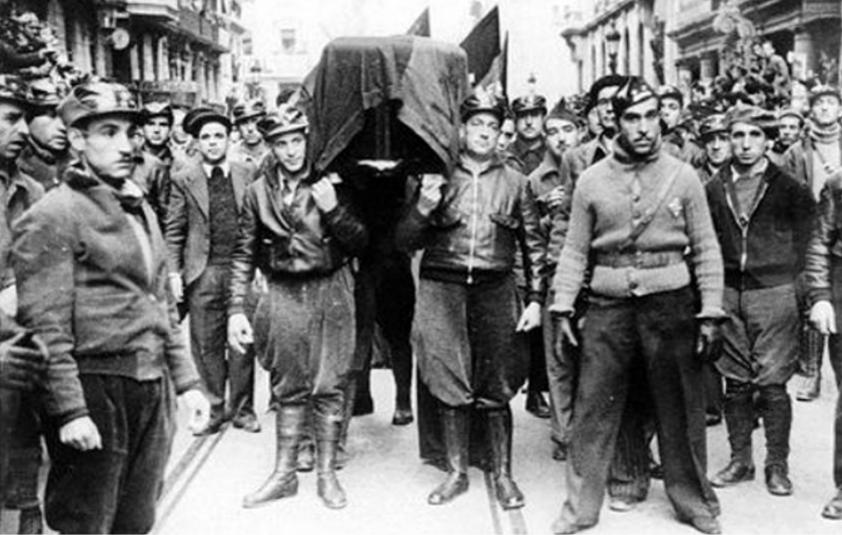
The funeral procession left the CNT building on Via Layetana, soon to be renamed Via Durruti. The coffin was veiled by a red-and-black flag bearing the CNT and the FAI insignias. It was carried on the shoulders of militiamen along the center of the street. They were headed toward the Ferrer y Guardí Square. Three men stood on each side of the coffin and, not far away, six more as reserves. Behind them waved libertarian banners and placards calling for vengeance.
In the midst of an impressive silence, the crowd pressed close to the sidewalks. Children sat atop tram roofs. Some climbed lampposts. Women cried, hugging their children to their chests. García Oliver wore a look of sorrow. And Companys pulled his coat around him.
—We are the ones who must be here, and the ones who should be here are missing —mumbled García Oliver. He was the current Minister of Justice.
“A silent multitude watched the coffin, draped with the red-and-black flag. The solemn faces were lit by the November light. The municipal band played Chopin’s funeral march.”
In the lead of the procession, Sargento Manzana, Durruti’s military advisor, wearing a militiaman’s cap and with his arm in a sling, offered his good arm to the widow, Emiliana, who leaned on the wife of Miguel Yoldi, another trusted associate of Durruti. To the right went the commander of the Mozos de Escuadra, in riding pants and boots with gaiters. The authorities formed a cordon with Companys, president of the Generalitat, who on one side took García Oliver by the arm and on the other Antón Ovseenko, the USSR consul in Barcelona.
—Long live Catalonia! —he cried aloud.
Some echoed him, others gave cheers for the CNT and Durruti, few for the Republic. The procession advanced along Fontanella Street toward Plaça de Catalunya, heading for the Ramblas. The Columbus Monument stood almost swallowed up by the crowd. From there they took the road to the new cemetery on the far side of Montjuïc. In Plaça de Catalunya, with the crowd waiting in suspense, the procession halted.
A silent throng gazed at the coffin, draped with the red-and-black flag. The grave faces were lit by the November light. The municipal band played Chopin’s funeral march. A great many red-and-black scarves could be seen tied around necks. It all resembled the proletarian counterpart of The Burial of the Count of Orgaz. While García Oliver prepared to speak, he heard a non-Catalan say in Castilian the line that many were thinking.
—God, what a good vassal he would be if only he had a good lord…
And what a stupid death, thought the Minister of Justice. But he restrained himself from voicing it.