
To commemorate the 90th anniversary of the Civil War, José Ángel Mañas recreates in Zenda, day by day in this section, what happened in 1936, perhaps the most momentous year in all of modern Spanish history.
Monday, November 23, 1936: In the Faculty of Philosophy and Letters
“You can see that at last humanity has found a use for German idealism,” exclaimed Bernard Knox.
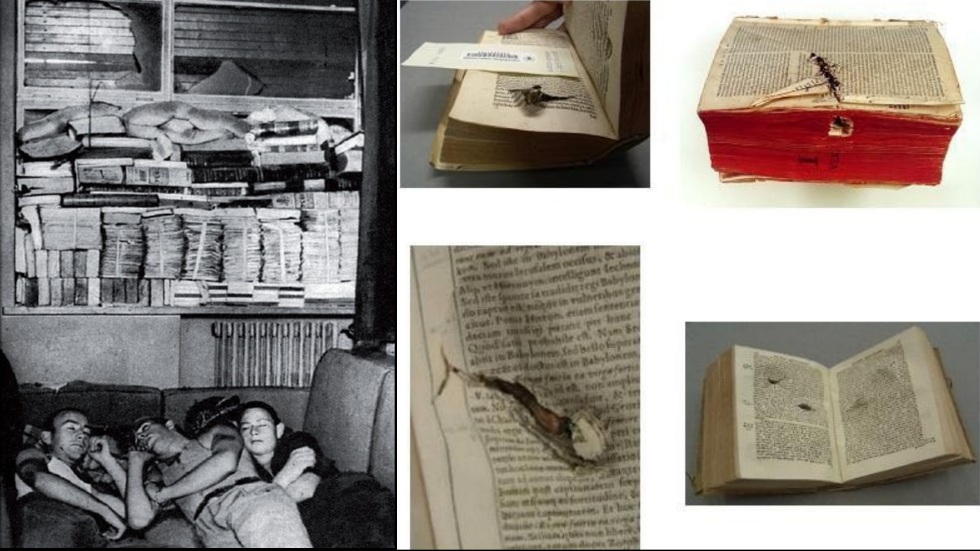
The Belgian brigadists laughed. The Englishmen did too, when Knox, who spoke French, translated their jokes. They had been assigned to defend the Building of Philosophy and Letters. There they were raising barricades with books on metaphysics and German philosophy. They knew from experience that, beginning at page three hundred and fifty, philosophical treatises made excellent parapets.
They also spread carpets across the floor to guard against dampness. On the walls there was the occasional travel poster (“Come to the Sun of Spain”), which, given the cold, invited mockery. The front line had stabilized. The Francoists bombarded daily around eleven. A few shells fell late in the day. But in the intervals there was time to read or to play chess.
Skirmishes between patrols continued, but less frequently. And though clashes could be heard in the Casa de Campo, they did not reach their position.
In the library, in the large reading room, they mounted two cannons. The important books had disappeared, but many others remained. They had discovered a collection of classics from Everyman’s Library, and the two Johns and Bernard Knox read them, each curled up on his own carpet. Sommerfield was gnawing at Memoirs of the Lake Poets, by De Quincey, Cornford to Shakespeare’s sonnets, and Knox to a second-rate French writer.
In the morning, enemy artillery had bombarded the building. Then they put the reading aside to fire at the fascists who appeared after the blast of several shells. Opposite, there was a small ravine through which the enemies retreated after about an hour of firing. Also a few Spaniards passed by to distribute steel helmets, gas masks, extra underwear, khaki trousers, and jars of jam among the brigadists.
When it grew dark, they established watch shifts. Almost they had forgotten what a bed was. When Sommerfield’s turn came, he did not feel well. His throat was swollen and his back hurt terribly. Between the lack of sleep, wet clothes, and exhaustion, he felt unhappy. He was sick and did not want to admit it.
He heard the clatter of his teeth. Their lives depended on the whims of the shells that hunted them blindly, like the gardener’s spade piercing the earth to kill worms, and a mounting sense of anxiety began to creep in…
The shots around the building did not stop him from closing his eyes for a few moments. In the end, the sound of a shell mixed with feverish dreams startled him. With the roar of the planes, the others woke up, and they all took up positions by the windows.
All the entries of 1936 Day by Day
Interview with José Ángel Mañas about 1936 Day by Day