
1584. In the Convent of the Martyrs of Granada, Saint John of the Cross brought to an end the prose articulation of his Spiritual Canticle at the request of Mother Ana of Jesus, then a mystic, prioress of the Discalced Carmelites of that city and a friend and companion of Saint Teresa. It was to her, a barefoot woman, that the saint left a written warning that today serves as the gateway to Ernesto Pérez Zúñiga’s latest poetry book: “There is only one thing: that even if it is inside you, it is hidden.”
No creo que sea casualidad. Tampoco lo es que el poeta que se formó en esa misma Granada, la de nuestras lecturas y andanzas compartidas de juventud, haya regresado a ella cuatro siglos después para dirigir a otra mujer descalza —más cercana a él y vecina de su propia ermita— un conjunto de cartas, sutras y salmos que es posible que constituyan el libro más arriesgado de su trayectoria en el que, lejos de cerrarse en un círculo, ha tomado la vía de la ascensión, elevando un peldaño más el valor de su poesía.
When I wrote about Lance, I noted that with that title a third stage was opening up in Pérez Zúiga’s poetry. Lance was a book that did not deceive anyone because it drew from mysticism and, at its outset, quoted one of the divine poems of the saint of Fontiveros. the Hidden (Sonámbulos, 2026) confirms that intuition was correct, and that our author now pushes it to its ultimate consequences in this book. New verses, but belonging to his unmistakable voice and answering a very particular way of understanding poetry, which is both declaration and mode of knowledge. And if in Lance mysticism was one of the great wells that fed the poem, in this work it has become the very channel through which all his writing flows.
“Nine doors” opens the book. It is not a mere prologue, nor a prologue-poem in the classic sense, but a declaration of principles that places us on the same plane from which the poet conceives his poem, and leads us to “Listen to what is hidden. Not the appearance or surface. Yes, what has not yet appeared but beats.” Pérez Zúñiga teaches us to wait in the gloom “until noticing the breath behind the curtain,” and broadens his concept of poetry by naming it “knowledge of fog” and “intuition put into language,” a certain something that oscillates between what is barely discerned and what, at the threshold of speech, becomes word.
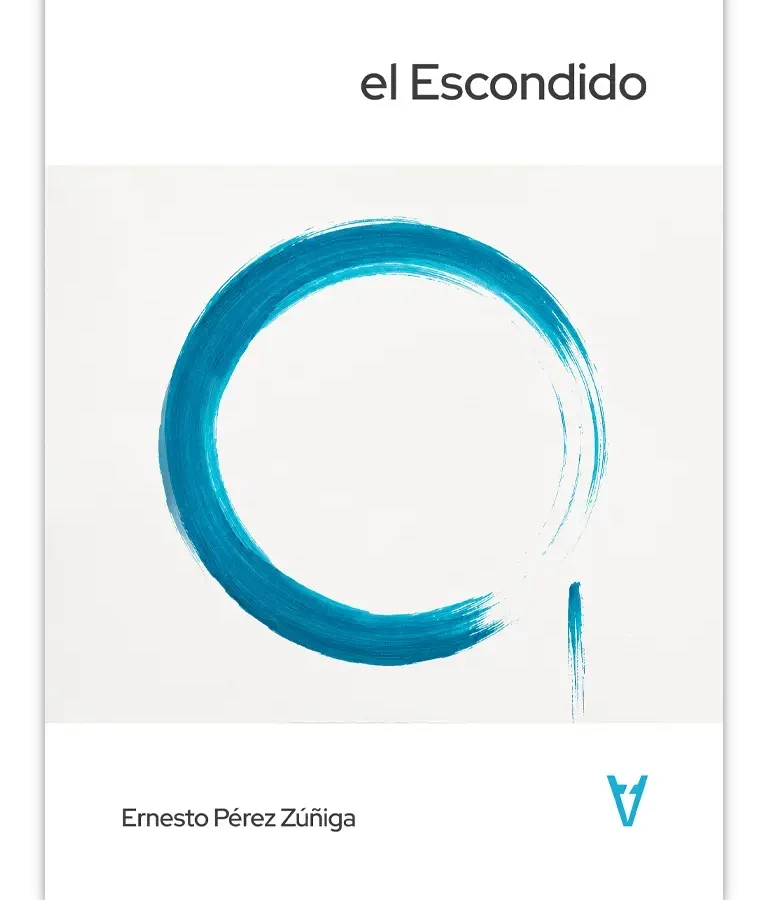
Beyond that porch, we find four chambers: “Letters to the barefooted woman,” “Sutras of the one who cannot return,” “Ethiopians,” and “Hidden psalms,” which close with a final note, again addressed to the barefooted woman. It is a book apparently circular, and Miguel Ángel San José has understood it on the cover, where a single stroke of ink, in the sumi-e fashion, draws a circle inspired by one of the verses of the poem: “But the circle is ours”. Yet this circle is not a perfect, closed thing that ends in itself: it is the space that, by surrounding us, provides us with the limits for an ascent to a spiritual state, for an elevation, for a climb to a personal Carmelite mount.
Returning to the matter of the book, how it is structured and erected, we must note that each of the parts that trace this circle takes its name from a genre inherited from a different tradition: we encounter the amorous epistle and the sutra of Eastern traditions, the Byzantine novel (the fabulous Ethiopians by Heliodorus, with lovers separated by seas and storms, yet united in a spiritual love that endures despite innumerable trials) and the Biblical psalter, from which that name is taken and whose verse structure appears here and there throughout the poem.
The syncretism is, in truth, the formal thesis of the book and not a mere erudite game: all traditions are distinct beacons that, in the author’s own words, ignite a light that serves “for any navigator of any sea.”
Moving forward in this circle, we arrive at “Letters to the barefooted woman,” which form the heart of the book. In them human love is transformed into the Bethel of the Bible, the gate of heaven through which Jacob entered in his dream. It is no longer a rung that the mystic leaves behind in his ascent toward the divine, as in the old ascetic scala, but the very door through which one accesses, ascends, to the sacred. He expresses it with a clarity that disarms one of the most beautiful poems in the collection:
When you embrace
you go down
from the cross.
The “beloved in the Beloved transformed” of the Night turns here into an “beloved in the lover/consecrated,” and that union of lovers becomes a single bird that glides “over/two mirrors,” in a typographic arrangement that recalls the pen dropping line by line in Lance.
But do not expect canonical mysticism. In “Letter XI” the wounded face of the God of the Good Samaritan transmutes into that of the beloved, into that of the parents, into Joyce, Valle-Inclán and Tórtola Valencia, much admired by Valle, into the face of Thelonious Monk and, going further, into the poet’s own dog, Molly Bloom. And the poem ends with an exhortation that few poets have dared to declare: “Then leave religions behind.”
As a counterpoint, another characteristic that abundantly appears in Pérez Zúiga’s work—the humor, that necessary counterweight against elevation, adversity, or fear—appears here as well: in “Letter V,” the yoga teacher asserts that the poet is a satyr, while the abbot of the monastery is convinced he will be a saint. In this letter lies a medieval root, the medieval debate between flesh and spirit that the Archpriest of Hita carried into the “Battle that Don Carnal had with Doña Cuaresma,” but here our author moves away from the medieval model, for he does not grant victory to either side, and the protagonist, the poet, abandons the forum to sit on the plain like the Buddha and listen to the Earth.
And between one letter and another, between poems alternating prose and verse, the briefest and perhaps most piercing epigram in the book: “It was strange that the world was full of shoes / and our feet were missing.”
On this circle are inserted the tips of a Solomon seal formed by each part of the book (the philosophical-pedagogical prologue of the “Nine Doors,” “Letters to the barefooted woman,” “Sutras of the one who cannot return,” “Ethiopians,” “Hidden psalms,” and “Final note. Dedication to the barefooted woman”). The symbolism of the two triangles that form that seal, read as fire and water, as the union of opposites, as yin and yang, is almost formulaic in “Sutra II”: “The masculine and feminine principles united have the key to the kingdom.” Within that circle, the sutras are the territory of renunciation and stripping away. “I cannot return / for the world I knew is no longer,” writes the man behind the poet who transcribes him. He is the same who one day left the city for the countryside, the one who feigned to make a living “when he was really losing it.” The social conflict that nourished part of Cuadernos del hábito oscuro now resides in man and intertwines with the Sanjuanist nada and the emptiness of the syncretic Buddhism (the syncretic path), which walk hand in hand in litanys like that of “Sutra IV,” where everything empties—cathedrals and caves, libraries and armor—until reaching “the full emptiness of being.” We must not forget at this point that our author has spent years studying Valle-Inclán and La lámpara maravillosa, and it is hard not to hear the echo of that aesthetic quietism in verses such as “to sustain eternity / in a fleeting instant.”
It is in this section where we find, in my view, one of the most original and beautiful moments of the book. The “Sutra of the Two Heroes,” written in white hendecasyllables with epic breath, is what best demonstrates Pérez Zúiga’s metrical craft. The poet revives Patroclus’s death in book XVI of the Iliad, when Apollo loosens his armor so that his enemies can wound him. But the one who approaches the fallen hero is not Hector, but Arjuna, the warrior of the Bhagavad Gita, who consoles the Greek with Krishna’s doctrine: “Hades is fallow ground. Someone from you will return.” Homer and the Hindu-reincarnation tradition speak to each other on the same battlefield, and they fit together as if they were pieces of a modular construction made from different mythologies.
Nor do the shadows disappear in this work. Those familiar with Pérez Zúiga’s narrative, from Santo diablo to Veníamos de la noche, know that his world is not unfamiliar with violence or darkness, and the “Sutra of the murdered angel” recalls it in a chilling dryness: an angel violated and killed on a stretcher, and murderers who “sought to make us believe he killed himself.” It is one of the poems where darkness reigns and is present, and yet its presence is necessary, because it prevents light from making us complacent.
Here too reappears the knowledge Pérez Zúiga has of Rafael Alberti’s work, about whom he has written critical pages, and his facility for employing the Albertian angel trope and remaking it. The angels in Sobre los ángeles were forces emanating from within a man in crisis, witnesses to his lost paradise. In el Escondido they retain that inner condition (“Angel in you,” we read in “Letter XII”), but they become heralds of the hidden: the “angel of the quark” who lays honey on the tongue of one who is born, the archangel that rises from the lava in “Letter XXVIII.” Only the murdered angel returns to the open air in Alberti’s sense, as if in him survived the memory of those “angels dead.”
The “Sutra of the Golden Alley” transports us to Prague, with its Golem and Kafka, where a ghostly alchemist (could it be the spirit of Meyerink from The Maestro Tartini’s Escape, with whom Tartini sought to learn the secrets of alchemy?) contemplates the tourists who cannot see him: “That is consciousness: a dark wall. / Only when it becomes transparent / will the gold be discovered.” The invisible and the intuited, which weigh so heavily in his novels, especially in El segundo círculo, find here their most lyrical formulation.
In the initiatory and mystical journey that is el Escondido, there is also room for love lived at a distance. The “Ethiopians” trace the beloved’s journey through Ethiopia and how the poet accompanies her through dream tunnels, making her maritime route explicit, clearing the cyclones and shoals that might put her in danger. The poet ties his bed to hers so that their raft, a raft formed from two subjectivities, crosses the firmament under which those who seek the Hidden sail. We return to that “You in the other land and in me” from Lance, now turned into geography: “Ethiopia is the palm of my hand. / You sleep along the line of destiny.” And at the heart of this section, a wink that the seasoned reader will recognize: “I received from the Sun the sun-stone,” where the circular poem of Octavio Paz beats in the heart.
The “Hidden Psalms” bring us closer to the end of the journey. If the letters spoke to the beloved, the psalms now speak to the Hidden, in a line that leads us to Ernesto Cardenal’s Psalms and the immanent god of the last Juan Ramón. The “Psalm of León Cathedral,” dedicated to Luis Mateo Díez, turns the stained glass into a photosynthesis of light and makes the poet all the figures of sacred history: “I was Moses and Job, / David and Solomon, / Judith: / I have in my hands the blood of Holofernes”. It is in this poem that David and Solomon reappear again, subtly reminding us that the Psalms are another tip of our hexagram. With “Psalm X” we reach the end of the poem, but not the book: it ends with the word that gives the title, in a heart squeezed by darkness that nevertheless “opens, becoming sun / in you, / the Hidden One.”
Formal aspects continue to be worked until exhaustion, with verse that maintains a seemingly free but constant discipline. Heptasyllables with Sanjuanist resonance (“Make silence with me, / the joy of being quiet”); classic-tinged hendecasyllables; octosyllables with a popular air; one-word lines that sketch flight across the page; and prosaic poems with litany cadence, such as the “Letter of the Feet,” which revisits the washing of the Evangelium and, in passing, that Exodus mandate of removing one’s shoes before the sacred earth.
The repetition, which in Lance was already linked to meditation and the mantra, returns with force to be now an exercise offered to the reader.
There will be readers who find the insistence on a vocabulary of light, mystery, silence, and fire—the four elements that compose the spiritual alchemy of this book—excessive, and there are moments when the poem touches the language of spirituality in our time. Yet one must read the clues the author himself offers in his poetics:
“Only what is concrete can be universal in exchange for attentive listening.”
And it is in the concrete, in what a careful gaze reveals, where the book reaches its highest peaks: in the slug that the beloved saves and that reveals itself divine on a mossy wet stone, in the vulture turned into “windshield wipers of silence / over the mountain,” in the trees of the city that announce the old river running beneath the asphalt, in the shoes without feet.
The final note, a prose dedication to the barefooted woman, closes the circle with an appreciation that is also a loving poetics: “Thank you for having gone barefoot and for bringing your feet together with mine.” The beloved who guided the poet in Siete caminos para Beatriz returns to be guide again, but no longer toward an exterior paradise, but toward what was hidden inside.
“Human beings write poems. The Hidden One reads us,” concludes the gateway to the book. Perhaps that is why, when one closes it, the reader feels as if he has been read, as if he has witnessed, once again, that miracle of shared creation that must be, humanly, the reading of a poem.
—————————————
Author: Ernesto Pérez Zúiga. Title: The Hidden One. Publisher: Sonámbulos. Sale: Todos tus libros.