
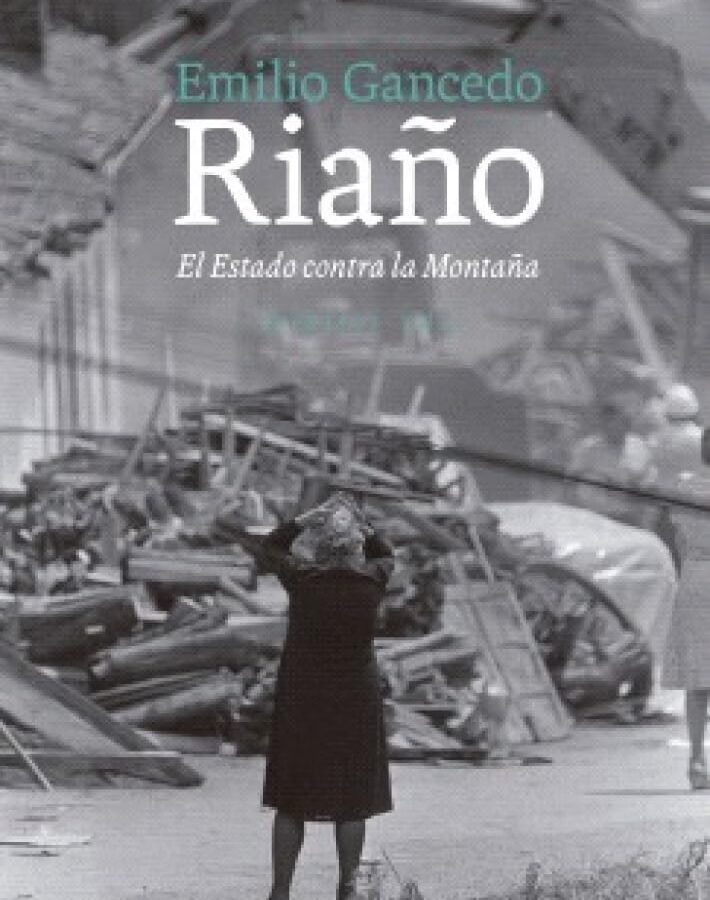
“People began to cry in the middle of the street, hands to their heads, to their mouths, unable to fully grasp what was happening (…).
An old man groaned: “If only they would let me build a shack in the hills to have four cows… just one shack!”
I hold Riaño: The state against the mountain (Pepitas de Calabaza) and my hands tremble. The tremor of the wall of a dam that fractures in our memory. A dam that dammed a valley to flood it in 1987. It was Democracy. Spain had voted for change, had voted for Felipe González. But Felipe, alas, did not vote for change in Riaño. He voted for immobility, for continuity. The dam projected during the Franco era that would inundate one of the richest and most beautiful valleys in the north of León, that would wipe out nine villages, with their history, their past and their future, went ahead. I remember watching the images on television. I remember seeing people standing on rooftops with their dogs, in a desperate attempt to prevent their houses from being torn down. I remember the Civil Guard dragging the neighbours along. I remember beds and chests flying out of the windows. Of the old women crying. I remember thinking: “And the dead, won’t they be taken? Will they be left alone in the cemetery?”
These images are in
Riaño: The state against the mountain.
The poet and writer
Emilio Gancedo
has done great investigative journalism to compose a major work of literary journalism. A story of the all-powerful state against a small valley, in which, of course, the valley loses.
A story, as the author himself writes, “about home, about what each of us calls and considers home”.
A story “about the destruction of beauty.”
And it is thus: the book moves back and forth from beauty to destruction and from destruction to beauty. It tells the valley, that place that was the capital of the mountains, one of the nerve centers of the Cantabrian Range. It tells the carts, it tells the cows, and the praus and the horreos and the stone houses. And the markets, and that budding mountain tourism. And it tells it with a style where the poet’s heart beats, and also the grandson of a valley dweller. There is the joy of living in that landscape of untouched beauty and there is the melancholy of knowing it is doomed.
And it recounts the moment of destruction and the aftermath, the nothing that remained.
What happens when you lose your past, your heritage, the lands that had names, the stones your grandparents raised?
That you drift in nothingness. In that watery nothingness that is a reservoir. In that nothingness which they now call “the Leónese fjords.”
“The Leónese fjords!”, exclaims someone in the book, and the voice resounds with contempt, anger, and sadness in the tone.
That voice, one of the voices that narrate. The voices from Riaño and its valley, the indomitable voices. The women, the men who were there when the Civil Guard arrived, who were there when the water level began to rise above the walls of their houses. Each of those voices unravels its story of struggle and loss. Gancedo lets them speak; Gancedo, in the book’s second part, disappears. His voice as a poet is not necessary. Because what the other voices tell is so powerful that it leaves him alone, so that its echo resounds in our hearts.
And the voices also speak from the offices, those who ordered and instigated that pharaonic project that had been gestating since the early 20th century and was picked up again in the Franco-era ministries. Politicians who had a vision and a mission: bring progress to that rural world, turn all the mountain valleys of northern León into reservoirs, construct a chain of reservoirs to irrigate everything south of the Cordillera up to Portugal. And, not to forget, to produce enormous amounts of electricity. Energy! Kilowatts for the new Spain!
For that new Spain, no sacrifice was too great.
And the sacrifice began with the Barrios de Luna dam (sixteen towns submerged in 1956), continued with the Porma dam (eight, 1968), about which Julio Llamazares has written so much and so beautifully, and followed with Riaño. And there was more, more dams and more sacrifice, but Riaño was such a large wound, left so much pain, that even a democratic state could not help but pause in that valley.
That is there, the grand mission of the state.
There is, among others, the voice of the Agriculture Counselor of the Junta de Castilla y León —socialist— who resurrected the plan —francoist— of 1962: Jaime González González. The author speaks with him or, rather, lets him speak. And he recounts that what happened in Riaño was terribly hard, and he also says:
“Within my capabilities, I am going to try to make Riaño produce, to meet the objectives for which it was planned.”
With that simple, even-handed, bureaucratic line, with that sentence, a valley is sentenced.
Riaño is a devastating book. For the relentless rhythm of the destruction of beauty, for the testimonies, for that truth with which it is written. And because, sadly, it has not lost its relevance. The rural world remains a land of sacrifice. We have moved from reservoirs to wind farms or to solar plants. We continue to drive people from villages and to exploit natural resources without restraint. Forty years have passed and we have learned nothing. Read Riaño, read how the state annihilated a valley in the name of progress and you will understand: desolation, injustice and uprooting.
“31 December [1987]: the dam is sealed and the waters of the Esla and Yuso begin to flood the valley.”
—————————————
Author: Emilio Gancedo. Title: Riaño. Publisher: Pepitas de Calabaza. Sales: Todos tus libros.