
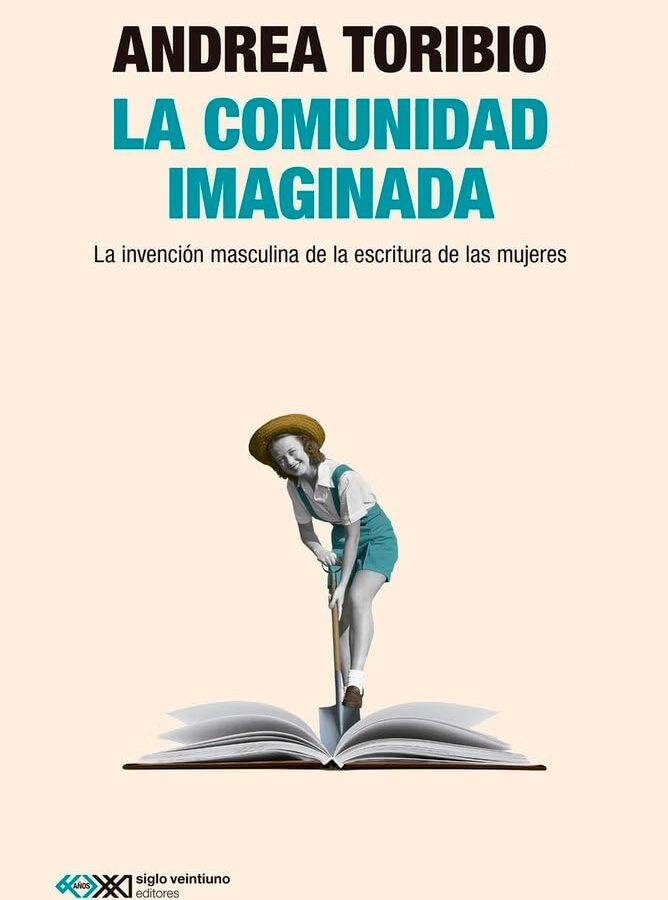
The criticisms of Sappho’s circle and its companions emerged in Classical Greece itself, when comedians, commentators, or philosophers attacked them, accusing her of depravity, prostitution, or homosexuality. Sappho belonged to a female community on the margins of male hegemony, one that escaped normative androcentric ideals. Yet the criticisms, prejudices, and men’s incomprehension determined her fate, perhaps, in this case, for better, because they have made it possible to understand the reception and transmission of her work. There is no doubt that her poetry is timeless and exceptional, and, for that reason, one of the writers of any imagined community. The essay by Andrea Toribio, The Imagined Community. The Male Invention of Women’s Writing (Twenty-First Century Editors, 2026), starts from a question that goes beyond the strictly literary: to what extent does a community of women writers respond to a choice made by the women themselves, or is it a male construction that aims to confine them to a space? What would happen if that imagined community, tolerated by men, escaped its own terms to open an intergenerational dialogue built from women themselves?
La tesis de este ensayo, literario y político, se sostiene en una paradoja: aquello que en apariencia debería favorecer la visibilidad de las escritoras —su pertenencia a una comunidad— se ha convertido en un mecanismo de homogenización y control. La instrumentalización de la sororidad por parte de los hombres en la configuración de dichas comunidades y redes responde a una intencionalidad concreta, en la que lejos de reconocer la singularidad de las autoras y favorecer su acceso a los ámbitos de autoridad cultural, las confina a una identidad colectiva que las aleja de una literatura presentada como universal y cuyo tradición ha estado históricamente dominada por y desde los hombres:
“El sentimiento de camaradería entre mujeres que escriben responde al deseo de desactivar su acceso potencial al poder a través de lo cultural, impidiendo así que se cuestione el discurso totalitarista de la realidad” (p. 24)
The thesis of this essay, both literary and political, rests on a paradox: what should seemingly promote the visibility of women writers—their belonging to a community—has become a mechanism for homogenization and control. The instrumentalization of solidarity among women by men in shaping these communities and networks responds to a specific intent, whereby far from recognizing the individuality of the authors and fostering their access to spheres of cultural authority, they confine them to a collective identity that distances them from a literature presented as universal and whose tradition has historically been dominated by and from men:
“The feeling of camaraderie among women who write responds to the desire to disable their potential access to power through culture, thus preventing the questioning of the totalitarian discourse of reality” (p. 24)
The label, seemingly inclusive, of “women’s literature” creates an artificial reality, a fictitious recognition that reproduces a peripheral position relative to a literature deemed general, whose authority has traditionally been male, because “Women do not form a collective” (p. 60). Andrea Toribio points out that the discrimination faced by writers does not arise from a supposed minority condition, but from systemic inequality that transcends the literary and manifests in diverse ways. The literature that women write is not a subsidiary literature, nor does it require a category of exceptionalism to gain legitimacy. One of the many aspects the author highlights is biographies: while the work of male writers is typically studied for its aesthetic, intellectual, or historical contribution, that of women writers is often approached through their personal relationships, their emotional circumstances, and their private life. Intimacy ends up becoming an explanation of the work and, at times, a mechanism to strip it of autonomy and quality, because women’s writing must be an end in itself, independent of the male intentionality that powers it. Only from that freedom can the writer be.
Perhaps all of this explains why the literary structures that produce, distribute, and legitimize literary prestige—from historiography, criticism, or the canon to publishers, prizes, the market, or sales—do not always recognize the value of women writers and their works in themselves. Three areas are meaningful and partly organize this essay: the canon, the literary market, and female authority. The challenge to the canon proposed by Toribio is not new, but its formulation is, because its constant questions invite us to unravel the illusion from which the system operates:
“Does the work of a woman author occupy centrality within literary historiography so as to be considered the main exponent of some movement? Does the work written by any particular woman author single out a moment in our literature, explain it, surpass it, and contextualize it? Is women’s literature a minor matter?” (p. 38)
This idea connects with other questions that run through the essay, where it is not so much the answer as the contradiction it reveals that reaches us: what happens when a canon includes women? Does this create a feminist historiography that questions its mechanisms, or is it a matter of completing what is incomplete? Is it an inclusive task or does it create a ghetto? Literature and art, in general, are sexless, that is true, but the heteropatriarchal dynamic has deliberately concealed female figures of authority. The canon guarantees presences and absences. And this is an outstanding task. It is not only about who enters the canon but who remains in it. Posterity is not a neutral mechanism that always preserves the most important works. The survival of an author also depends on transmission networks, on reissues, on research that recovers voices forgotten, and on institutions that decide what deserves to circulate. What has arrived is often confused with everything that deserved to arrive; for this reason it is essential to review both inclusion criteria and the mechanisms that have determined cultural memory.
The presence of women in the publishing market and their commercial success are not indicators of recognition of their writing, because: “There are countless completely ephemeral female debuts that feed and structure the publishing market and its trends” (p. 39). The author analyzes a publishing market conditioned by capitalist interests—an arena not untouched by the precarious work and economic standing of women in this field—which results in the cultural industry turning women’s writing into a commercial trend without guaranteeing recognition or lasting presence over time. The examples of Carmen Laforet and Carmen Martín Gaite are revealing in how this machinery operated during Francoism and how the visibility of certain writers could contribute to legitimizing a literary system that continued to grant fundamental authority to men. Poverty, however, does not only affect publication or professionalization: it also constrains creative freedom. Writing requires time, resources, and autonomy—material conditions that are often left out of accounts of vocation and artistic independence. Cultural economy is therefore not something external to literature; it intervenes in the very possibilities of creation and in the authors’ ability to detach themselves from market demands. I miss Yolanda Castaño’s essay, Economics and Poetry.
Nevertheless, this essay not only seeks to dismantle the exclusion mechanisms that have operated, but Andrea Toribio proposes shedding an imposed genealogy to choose one of her own. Her proposal consists in breaking the barrier of time and space through an intergenerational association, because the imagined community is a no-place where each woman determines who is part of it and where all have a place. The construction of a genealogy cannot simply consist of reversing the terms of the traditional canon or replacing one authority with another. It requires, rather, transforming the relations of recognition and legitimation: making horizontal what historically has been vertical. It is not about creating a separate space for women, but about modifying the conditions that determine who can occupy the center of culture and exercise authority over it. This community must not become a new normative identity, with its own requirements of membership and adhesion. The experience of writers is not homogeneous, nor do their trajectories have to respond to a single ideological or biographical position. The possibility to disagree, contradict oneself, or change one’s mind is part of the autonomy that this community aspires to recover.
For this reason, The Imagined Community is structured around a balance between scholarly rigor, supported by a solid, abundant, and complex web of bibliographic references that widen the discussion, and a colloquial, direct, intimate, and ironic tone that brings the reading closer without diminishing its depth. Allusions to everyday aspects, the exercises, the asides, and the addresses to the readers form part of a writing that seeks to establish a direct relationship with the reader. It also includes references to millennial digital culture (XOXO, X, Substack), placing the essay in contemporary language and context. All of this reinforces the need to legitimize women’s writing from our own convictions, apart from male-dominated channels of recognition that historically determined what deserves to be considered knowledge and who is authorized to produce it.
Many centuries have passed since Sappho composed her poetry, yet little seems to have changed regarding who institutionalizes and authorizes a voice. Andrea Toribio questions, in this enlightening, convincing, and daring essay, the externally invented community in order to give women themselves back the possibility to construct it, without reproducing the inherited machinery. It relocates the debate: it is not about asking where the women are and what place they occupy, but who decided that they should occupy that place. Because there is no universal literature to which women must join as an exception. There is literature. And women do not have to ask permission to become part of its history.
—————————————
Author: Andrea Toribio. Title: The Imagined Community. The Male Invention of Women’s Writing. Publisher: Siglo XXI. Availability: Todos tus libros.