
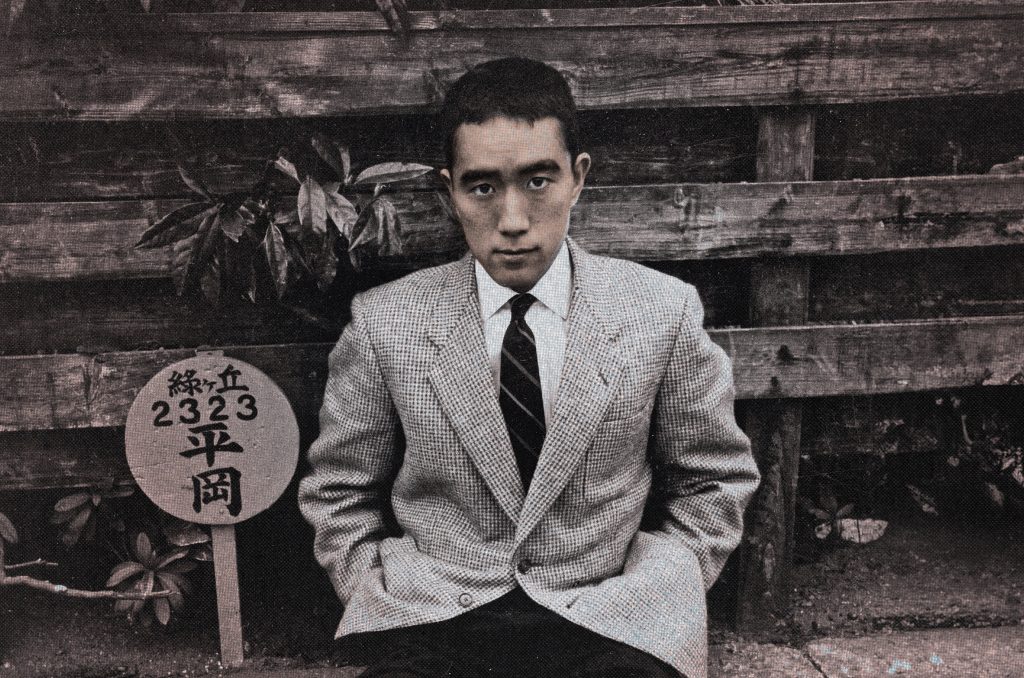
Spain in 1970 did not eat sushi, did not drink matcha tea, and anime — which had arrived with Heidi, Isao Takahata’s 1974 series based on Swiss author Johanna Spyri’s novel — did not air on the homeland’s television until May 1975. In that late-70s Spain, things Japanese mainly meant judo, karate, and little else. The children of that era, at children’s screenings, watched Godzilla films with obvious delight and excitement. But we did not yet know them as belonging to a genre called kaiju eiga. The interest, as far as the Land of the Rising Sun was concerned, was very limited and superficial.
Yet Yukio Mishima’s suicide, the most celebrated Japanese author of those days, deserved a rarely given space in the press of a country that did not normally report on self-killers: that Spain was a Catholic state and suicide is a sin — “Thou shalt not kill,” as the fifth commandment of God’s Law proclaims.
Even so, reference papers such as ABC and La Vanguardia — La Vanguardia Española in that era —, along with now-legendary outlets like Pueblo or Informaciones, and the forgotten Ya, carried the news the following day through international agency teletype, highlighting the raid on the garrison and the kidnapping of General Kanetoshi Mashita. But fascism’s era had already passed. Facing the failure of the coup Mishima had tried to lead, obeying the ancient codes of honor in Japan, on November 25, 1970, the author of The Temple of the Golden Pavilion (1956) performed harakiri — seppuku in Japanese — a self-dissecting act not seen since 1873. Yes indeed, Mishima disemboweled himself before the army’s chief of staff to protest the demilitarization of his country.
There was an immense minority of readers who followed him passionately from a legendary translation of The Temple of the Golden Pavilion by Juan Marsé.
Because he was a writer of international renown — one of those perennial Nobel candidates — and because the event unfolded like a drama in sequence, Spanish media covered it both in its international and culture sections, with particular interest. For in that sushi-free Spain, some strata of the political elite viewed Mishima, nationalist, defender of imperial tradition, founder of a private militia (Tatenokai), and protagonist of a ritual suicide (seppuku), as a figure of fascination and almost heroic stature against modern materialism.
All was romanticism in that act of self-dismemberment. Until Mishima’s novels ran into the censors of the Ministry of Information and Tourism. Because, in addition to those regime sectors that sympathized with him, there was a vast minority of readers who followed them avidly from a legendary translation of The Temple of the Golden Pavilion by Juan Marsé. It was issued in 1963 by Seix Barral. A French edition — since few Spaniards in 1970 could have spoken Japanese — that stood as a milestone preceding Últimas tardes con Teresa (1966) in the Barcelona writer’s career.
The first of Mishima’s many biographical contradictions is that, while the main concern of his life and work was preserving Japan’s traditional values, pre-Westernization, Mishima simultaneously felt the same pull toward the West that the West felt toward him. Indeed, scholars of Japanese literature place his work within the frame of Western influence.
It will be the shadow of his grandmother, Natsu, who tutored him in his early years, that will project across all the singularities of this author. It is said that Natsu, crippled by sciatica, became a dark woman who instilled in her grandson a cult of death and violence. Before seeing him on the street, playing with other children or under the sun, Natsu — who spoke French and German correctly and was a great aficionado of kabuki — forbade Kimitake (the “Warrior Prince,” as she called her favorite grandson) from interacting with other children and from playing in the sun. She preferred to have him amuse himself with his female cousins’ dolls. These details may explain Mishima’s contradictory Westernization, his idealization of beauty linked to violence, and his homosexuality. It could even be argued that the Japanese author’s fascist leanings have the same origin as those of Howard Phillips Lovecraft: the contempt for others nurtured in the first home, not the paternal one. Both the Japanese and the Providence outsider, each in his own way, were deprived of the father figure. Mishima himself would write in Confessions of a Mask, his landmark work and the one that met Francoist censorship most starkly, referring to his own childhood, which unfolded with him “always shut in, with the air filled with the scents of illness and old age.”
Even as a university student, when Mishima began to publish his early stories, Japanese literature witnessed an explosion of romantic nationalist exaltation, which helped pave the way for World War II. Before that confrontation ended, Mishima would publish his first tale, The Forest in Bloom (1941), and the army would assign him to a suicidal mission, from which he would ultimately be relieved. Some claim he was never mobilized due to tuberculosis that incapacitated him for service. There is no doubt that it is in this inability to sacrifice himself for the nation that we must search for another key to his life.
Written in the first person, in Confessions of a Mask, Kochan, the protagonist who, from his earliest years, has felt drawn to masculine vigor, openly proclaims his homosexuality. Yet his ardor remains repressed: “In what I have awaited with excessive longing, in what I have over-embellished in my previous dreams, the only thing I can do is flee.” Marginalized by his sexual orientation, in adolescence Kochan discovers masturbation—not only through masculine imagery but also — and this is far more telling — through masochistic imagery. Thus, he aligns with — or even precedes — Derek Jarman’s Sebastiane (1976) in the ecstasy produced by contemplating Guido Reni’s 1614 painting The Martyrdom of Saint Sebastian.
Scholars say that it is based on the martyr’s torture that Mishima begins to conceive his own death as that of a hero who must perish amid a torment worthy of the saint’s end.
Written in the first person, Confessions of a Mask marks the novel that catapulted Mishima to the pinnacle of Japanese letters. It was followed, among others, by Death in Midsummer (1953), The Sound of the Waves (1954), and The Temple of the Golden Pavilion (1956). The five modern nō dramas published in 1956 were conceived as imitations of the ancient Japanese stage.
Aching before a newly Westernized Japan, longing for times that will not return, in 1968 he wrote On the Path of the Samurai and In Defense of Culture. Both works are among his most nationalist. When those same ideas led him to deliver university lectures, he was hissed by students. Nevertheless, he managed to found among some of them — and among those who had followed him in his military training — a far-right organization, the Shield Society. The title of a play also dated 1968 — My Friend Hitler — makes Mishima’s sentiment unmistakable.
But, it bears repeating, the works should not be judged by the authors’ ideology.