
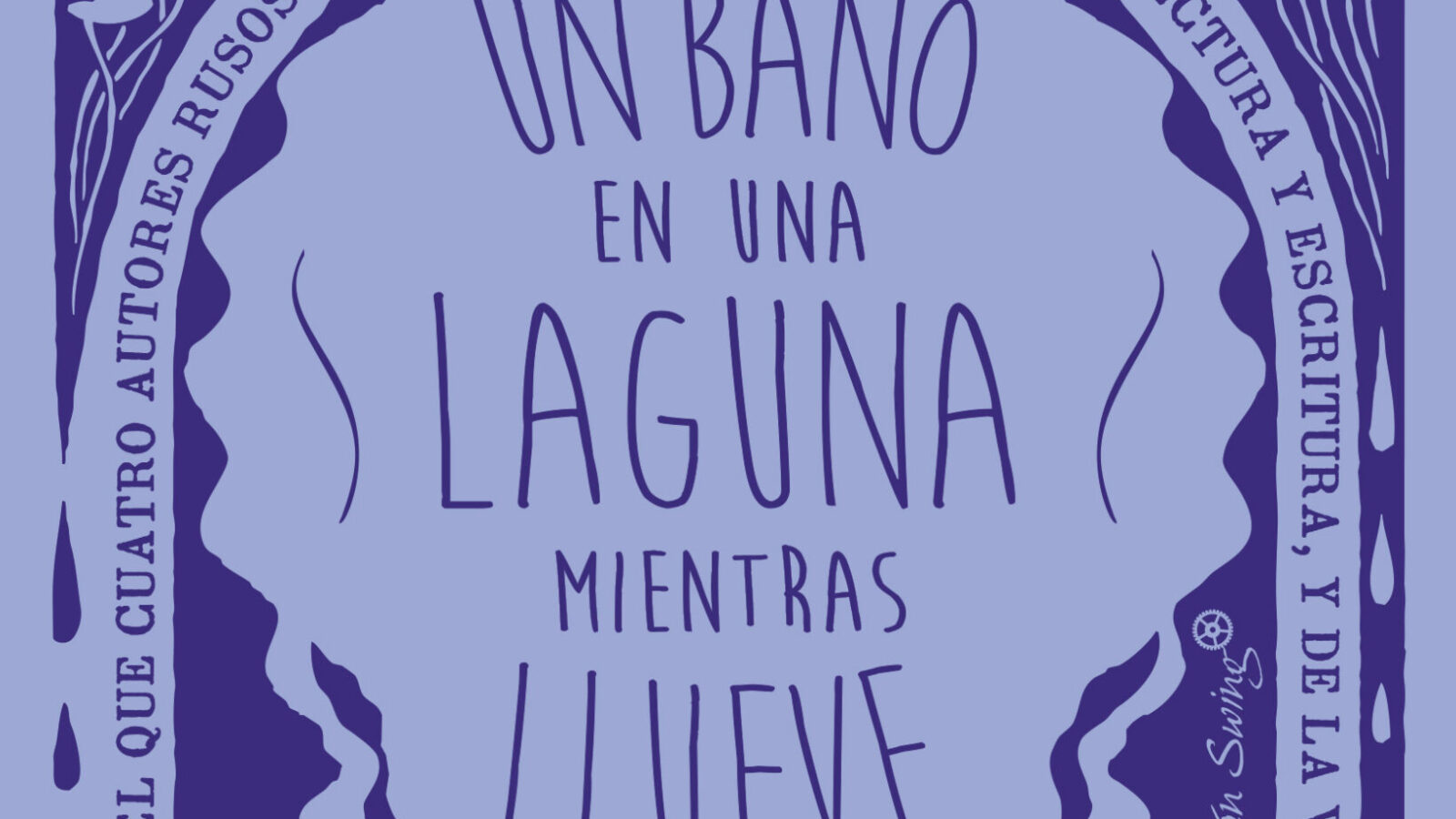
Accompanied by stories from Chekhov, Turgenev, Tolstoy, and Gogol, the seven essays in this volume are aimed at anyone curious about how fiction works and why it remains more relevant than ever in these turbulent times. One of the best books of the year for The Washington Post, NPR, Time, and Esquire.
At Zenda we reproduce the opening pages of A Bath in a Lagoon While It Rains (Capitán Swing), by George Saunders.
***
LET’S BEGIN
I have spent twenty years teaching creative writing at Syracuse University, directing a workshop on nineteenth‑century Russian short fiction in translation. My students rank among the finest young writers in the United States. (Each year we select six new students from among six hundred to seven hundred applicants). By the time they arrive in the course, they already write wonderfully. Then, over three years, we strive to help them discover what we call their “signature place”: a space to tell stories that only they can tell using resources that only they possess—virtues, weaknesses, obsessions, quirks, the whole package. At that level, good writing goes without saying. Our aim is to equip them with the technical means to be, with joy and perhaps a touch of insolence, exactly who they are.
In my “Russian class,” as I call it, hoping to understand the physics of form (“But why does this story work?”), we focus on a handful of great writers and examine how they craft their sentences. Sometimes I joke (though I am completely serious) that we read the Russians to see what we can borrow from them.
A few years ago, after a class (chalk dust drifting in the autumn air, an old radiator rattling in a corner, a band practicing in the distance, let’s say), I had an epiphany: some of the finest moments of my life, those moments when you feel you are offering the world something truly valuable, had happened in my Russian class. The stories I teach in this class stay with me as I work; they are the yardstick by which I measure myself. (I would want my own stories to move and transform a reader as much as the stories of my Russian authors move and transform me.) After so many years, the texts I teach feel like old friends I introduce to a group of bright, young writers every time a new term begins.
That is why I decided to write this book, to lay out in black and white what my students and I have learned over the years, and thus offer readers a modest, classroom‑based version of our sessions.
In a single semester we can read as many as thirty stories (two or three per class), but in this book we limit ourselves to seven. I chose them not because they represent a broad spectrum of Russian authors (there are only four: Chekhov, Turgenev, Tolstoy, and Gogol) nor because they are the best of their authors. They are simply seven tales I love, and after so many years of teaching, I find them extraordinarily instructional. If my aim were to make an occasional reader fall in love with the genre, I would choose precisely these stories. The seven tell grand, compelling tales and were written in what I believe was the genre’s most glorious era. Yet they aren’t all equally superb. Some shine in spite of their flaws. Others because of them. I may have to persuade you of the greatness of some (I have no problem with that at all). What I truly want to discuss is the short story as a form, and these pieces fully advance that purpose by being simple, clear, essential.
For a young writer just starting out, reading the Russian short stories from that period is akin to a young composer studying Bach’s music. They perfectly embody the core principles of the form. They tell simple, moving stories that matter to us and affect us. They are written to confront us, to disturb us, to provoke our outrage. And, at heart, to console us as well.
From the moment you begin reading them, you’ll notice that most of them tell straightforward, everyday, apolitical stories, and that idea may strike you as odd; but they are pure literature of resistance, authored by reform‑minded writers who were victims of an oppressive culture and lived under the constant threat of censorship in an era when, for their political beliefs, a writer could end up in exile, or worse, in prison or at the gallows. The stories we discuss in this book are serene, indirect acts of resistance, perhaps derived from the most radical idea: that every human being deserves attention and that the roots of our universal capacity to do good or evil can be traced to all people, no matter how humble, and in the ceaseless fluctuations of their minds.
[…]
—————————————
Author: George Saunders. Title: A Bath in a Lagoon While It Rains. Translator: Amado Diéguez. Publisher: Capitán Swing. Available from: Todos tus libros.