
For much of my life I believed that my world of memory was complete and that I remembered in full what I was, which makes me who I think I am today. I pictured my memory as a vast trunk full of boxes where, in precise detail, everything I lived should be. On their covers were written the names of each episode of my past: my childhood, my family, Madrid, my lovers… But when I opened them I was stunned to find they were almost empty. There were only the faintest glints, like opening one’s eyes and closing them again immediately. Nothing was complete. All that remained was the notion that the named event had occurred. And today I cannot fully restore even a single one of those stories.
Memories possess that quantum mystery of Schrödinger’s cat, dead and alive at once while no one looks inside. They exist in a superposition of two states: they exist and do not exist until observed, while they rest in a strange limbo closed to the exterior.
The memory functions as an index of subjects.
It is like a book written on the paper of an old thermal fax machine whose words are gradually erased. Even so, after its almost total fading, we know it existed, we remember the gist of the story, but not the words with which it was written. Each attempt to recover the details alters the existence of the memory, shapes it, updates it and today, every today, becomes a different restoration of the original. Although memories work as images, our memory is essentially narrative. Yet, upon that changing and incomplete file we build our identity, our certainties.
That is why I am struck by the meticulousness of Ramírez de Lucas in detailing a story so distant. There is little questioning of what he remembers and of the limitations of any autobiographical writing. The author insists on the fidelity of his memory, but that conviction also constitutes one of the critical problems of testimony. Remembering intensely does not necessarily mean remembering with exactness. The two versions of his memories contain discrepancies and contradictions that reveal the instability of memories. The detail is utterly inconsequential; it affects the chance encounter of the author with Federico that will mark the most important moment of his life: in the 2005 version it is Juan who goes down Alcalá Street toward Cibeles while Federico goes up, but in the 2001 version it is Federico who goes down and Juan who goes up. His writing reveals precisely the indispensable need to turn into certainty something that time has inevitably made insecure. We hear the voice of someone who wants to preserve his past at all costs and shield it from other interpretations that might take it away from him. This is what he has achieved: the boy in love at nineteen continues writing inside the old man seven decades later, reproducing that preserved affectionate language. That is why the true historical contribution of the book does not lie in Lorca’s figure; it is the portrait of a sentimental man, sometimes moving, who wants to convince us that three months of his youth must explain his entire existence and assign meaning to it. His experiences, his convictions, his romantic relationships, his losses—and the growing fame of the man he loved—necessarily form part of the present from which that memory is approached. The author himself notes in a preface that when he began writing the latest version he did not remember that he had already produced another in 2001.
Although both versions belong to the twenty-first century, the author’s style is anchored in late Romantic sentimentality. A nearly adolescent exaltation runs through his lovers’ memoirs. Juan Ramírez moves, without interruption, from finding Lorca physically unappealing and not wanting anything to do with him (“a head somewhat oversized, a plump and even flabby body, some peculiar and laborious gait,” “not very tall, … I was not attracted”) to an “absolute surrender,” to being utterly dazzled, to having his will and thoughts seized and only later understanding what the word LOVE meant. Another curious detail of the memory mode is that in the 2001 version the exaggerated forehead, described later as a defect, is part of his few attractions: “Physically he wasn’t attractive, except for his very clear forehead and the liveliness of his restless, probing gaze.” The instant falling in love happened during a casual meeting, not during the frequent rehearsals in which Juan attended as an actor in the play So Let Five Years Pass where Lorca was often present. Juan does not remember exactly what they talked about, but he does remember the effect that conversation produced on him. That disproportion between the disappearance of details and the permanence of the emotion has an eloquence that no meticulous restoration could improve. There is an instantaneous psychological transformation that the narrator cannot express. He limits himself to proclaim it through the tropes of confessional literature that confuse the intensity of feeling with the intensity of language. This leap from anecdote to emotional outburst that repeats itself again and again says a lot about the identity he wants to fix: a life whose importance seems to derive from having orbited around another. Something that, given Ramírez de Lucas’s own merits, seems completely unnecessary. Few are the pages where that inexhaustible fountain of declamatory ardor does not overwhelm the emotion it seeks to transmit. The author himself seems to ignore in the final memoirs what he recognized as obvious in his first autobiography (1945): “It is true that memory ennobles everything … granting it its expected cosmetic percentage of reality.”
But even after so much effusion, the author himself has doubts about what Lorca actually felt for him (“I cannot say if it was love that he felt for me”) and it is to be thanked that the memorialist acknowledges certain limits in his knowledge of the other. No one doubts the value of that relationship or the intensity of the suffering caused by its loss, as testified by the letter he wrote to Adolfo Salazar in 1937. The value is not the measure of his feelings; what matters are the mechanisms used to express them and the historical, or not, value of his contributions. The problem is not that Juan Ramírez feels too much, but that his rhetoric has no gradations to express what he feels. He barely establishes differences of intensity or meaning. Everything is portentous, everything is draped in exceptionalism and exaltation. Everything has, in advance, an absolute meaning that writing sets out to proclaim through sentimental inflation, an expressive hypertrophy filled with superlatives and emphatic, grandiose adjectives. He does not let a single emotion pass without crowning it with a dazzling crown. And thus, paradoxically, his prose ends up diminishing that which it seeks to magnify.
This volume brings together three autobiographical texts by Juan Ramírez: one from his youth, written in 1945, nine years after Lorca’s death, and two late versions of his relationship with the poet written between 2001 and 2008, two years before his own death (Ramírez acknowledges that in 1996 he only wrote the “presentation” page). In the first text he only mentions the man who embodied the most transcendent episode of his life in passing, and he does so only as another name among the intellectuals of the moment. Curiously, in this autobiography written in his youth, there is a certain expressive restraint that we will not find in the sentimental memories of his old age.
The story of García Lorca and his relationships with other men had been reconstructed for decades through letters, testimonies, and biographical approaches: from the love fascination with Salvador Dalí, with its ambiguities and its difficult reciprocity, to the relationship with sculptor Emilio Aladrén, the ties with Eduardo Rodríguez Valdivieso and the more substantiated passion for Rafael Rodríguez Rapún. The works of Ian Gibson and other researchers had been restoring the poet to a dimension of affective life that conventional biographies had long kept carefully blurred. In Ramírez’s memory emerges a different Federico from the wounded lover of the Sonnets of the Dark Love. A man who could be affectionate, generous, extraordinarily seductive, capable of turning a conversation into a memorable experience.
There is a curious irony contained in this book. Its author shows us the immense imprint that Federico left in him, but few elements that allow us to know what imprint he left on Federico. Juan believed all his life that if he could have accompanied him to Mexico Lorca would have survived. Maurer adds an essential note between history and what the survivor tells us: that interpretation is too simplistic. Lorca had other reasons to delay that trip: theatrical commitments, pending projects, uncertainty about his stay in America, and other family considerations. This makes Juan’s remorse a purely psychological manifestation within a hypothesis that cannot be proven. On page 111, Juan himself asks: “Was I really his last love? Our personal relationship lasted so briefly (barely three months) that Lorca, in turn, cannot say whether it was love that he felt for me.” Despite his fervor, he does not have full certainty. He presents himself as a relationship strictly enclosed within mutual intimacy. The only letter he receives from the poet seems written more by a very affectionate friend or a brother than by an enthusiastic lover. Although it could also reflect Lorca’s caution in the forms he wanted to keep regarding his homosexuality.
It is worth noting Seix Barral’s beautiful and careful edition, with extensive reproduction of graphic documents, to which is added an admirable commitment to precision in a book whose main subject is so deeply conditioned by the passage of time and the emotional intensity of the one who remembers. Thanks to this work we can distinguish what was already widely known from what now acquires some novelty: access to the different versions of the memories and the supplementary testimonies that make us read the book more as the autobiography of a survivor than as a simple story of Lorca’s last love. The most appreciable merit of the book lies in the careful work of Christopher Maurer and Víctor Fernández. They do not merely present the memories as unquestionable testimony; they provide the reader with the elements necessary to distinguish, as far as possible, between documented facts and retrospective reconstruction; chiefly in a apparatus of notes that goes far beyond the usual identification of names, places, and historical circumstances. Their notes contrast Ramírez de Lucas’s memories with other sources, correct chronological errors, warn of possible confusions, and cast doubt on certain assertions that the memoirist presents with absolute certainty. Their interventions enrich the available information and alter the way this account is read: where the author offers certainties, the notes introduce checks, nuances, and, when necessary, reasoned doubts. The critical apparatus becomes an indispensable counterpoint to the memoirist’s voice. It provides the reader with a distance that the author himself rarely establishes regarding his memories; the book gains a coherence that the autobiographical text alone would not have achieved. Its enormous testimonial value is undeniable and it should be included in Lorca studies, though the truth is that it ends up offering a much broader understanding of the author than of the character, despite many reviews suggesting otherwise. But what else is an autobiography?
These memoirs also hold their sad paradox. In his effort to preserve Federico from oblivion, Ramírez de Lucas ended up buried under the weight of his own devotion. Yet, when we close Memories. A Brief History of a Love, we know much more about Juan than about Lorca. It could not be otherwise. The value of memories does not necessarily lie, or at least not entirely, in the fidelity with which they claim to rehabilitate our past. Perhaps they are more attractive for what they reveal about the person who needed to preserve them. It would be unfair not to recognize the immense humanity contained in these pages and to overlook the silence that the author imposed on them. There was never an attempt to seek notoriety, quite the opposite. Juan kept the material remnants of a happiness that history had brutally interrupted. He chose to wait until his death to share them, perhaps because he understood that memories too need someone to inherit them. He did not manage to return us to the Federico he knew, nor could he. The repeated proclamations of eternal love often end up depriving that love of its singularity. He leaves us something kinder: the testimony of a man who, after living almost a century, still rummaged among the fragments of his memory for those three months in which he believed he had found a happiness—and also a pain—that would endure a lifetime. This is the greatest lesson we take from the book: there are events whose significance cannot be measured by the time they occupied, but by the time they managed to alter afterwards. Three months that remained suspended in a form of perpetual present to which memory returns because there is nowhere else it can live. This leads us to what is, in my view, the book’s true subject: the survival of a love that could not develop, but also could not contradict or wear down with life’s inevitable changes. And that is far more than Lorca’s last love.
—————————————
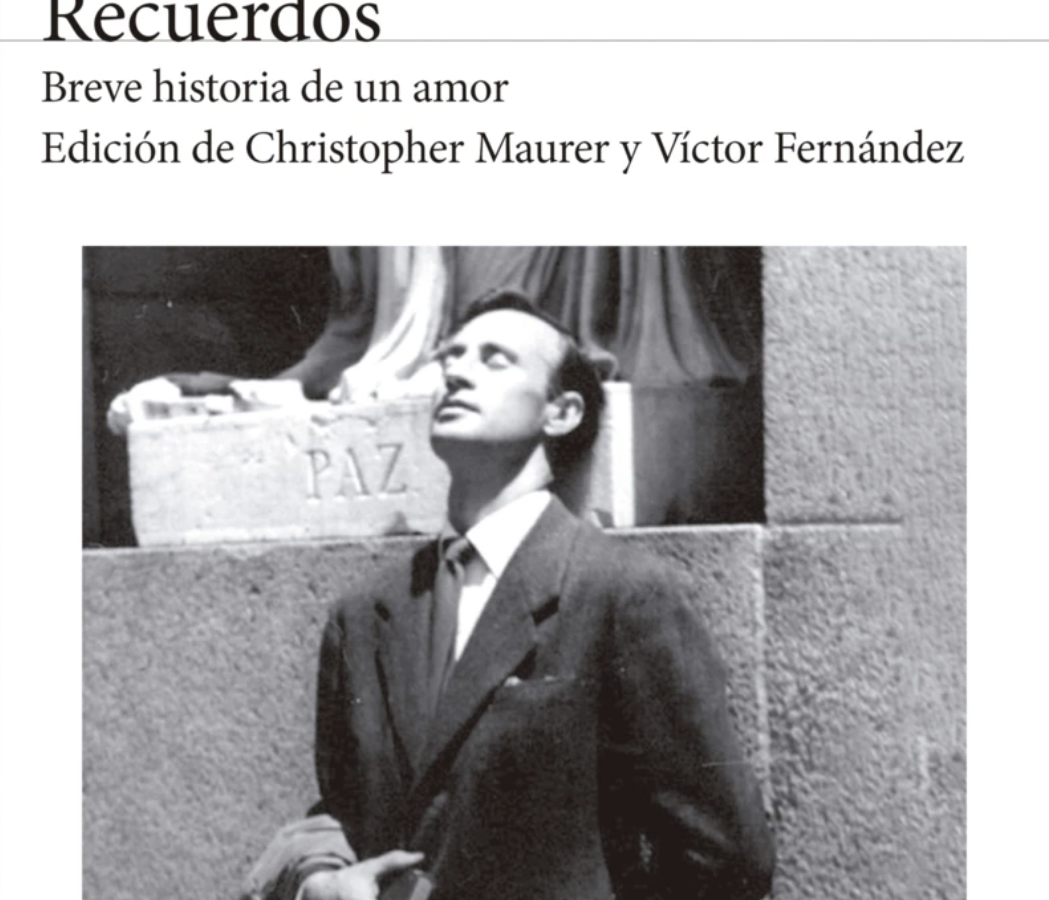
Author: Juan Ramírez de Lucas. Title: Memories. A Brief History of a Love.Publisher: Seix Barral. Seller: Todos tus libros.