
To commemorate the 90th anniversary of the Civil War, José Ángel Mañas recreates in Zenda, day by day in this section, what happened in 1936, perhaps the most pivotal year in all of Spain’s recent history.
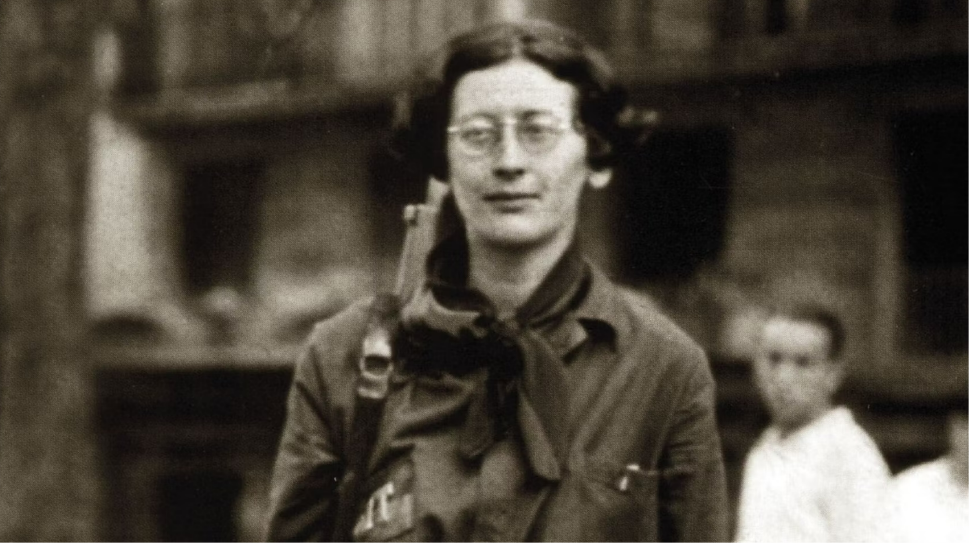
Friday, November 27, 1936: Simone Weil Speaks
I was with the Durruti Column from the start of the war and I met the man himself, Buenaventura, comrade. I lived among their anarchists in Zaragoza. There I heard him recount that after the proclamation of the Republic, one day a beggar approached his table, pulled a pistol from inside his jacket and said: “Here. Go to a bank to get money.” He believed that everyone could be like him.
“I remember that on the Aragón front, since the militiamen had no blankets and were soaked, he returned to the headquarters and forced everyone to remove their leather jackets and sent them to the trenches. A few days later a barrel of wine arrived. Since distributing it was a problem, he fired four shots. “Either for everyone or for none,” he said.
»He had a tremendous sense of social justice, and a blend of sentimentality and endearing good humor. He was large, imposing, not as temperamental and irritable as García Oliver, perhaps not as ambitious, but more generous and loved. He used few metaphors. He was laconic. He thought that the world belonged to the workers, even though a minority had seized it, and he believed that the revolution would lead to the longed-for libertarian communism.
»As a good anarchist, he did not smoke or drink. He believed in strength. He was a man of action, or a man, nothing more. With a chest so developed he looked like a gorilla. With that torso and those arms, no one has the mindset of a Japanese. His philosophy was simple: before abandoning a machine gun, one must lay down one’s life. And he fulfilled it. It’s a pity that he only saw six months of war. But those months were enough to lift him to the highest peak of the revolutionary. He has been a Bakunin without intellect, a giant who never read much, but neither did he need to.
»As for his death, I do not think he was betrayed, but I may be mistaken because, after all, wasn’t Gandhi assassinated by a fanatical Hindu and not by a Muslim?
Todas las entradas de 1936 día a día
Entrevista con José Ángel Mañas sobre 1936 día a día