
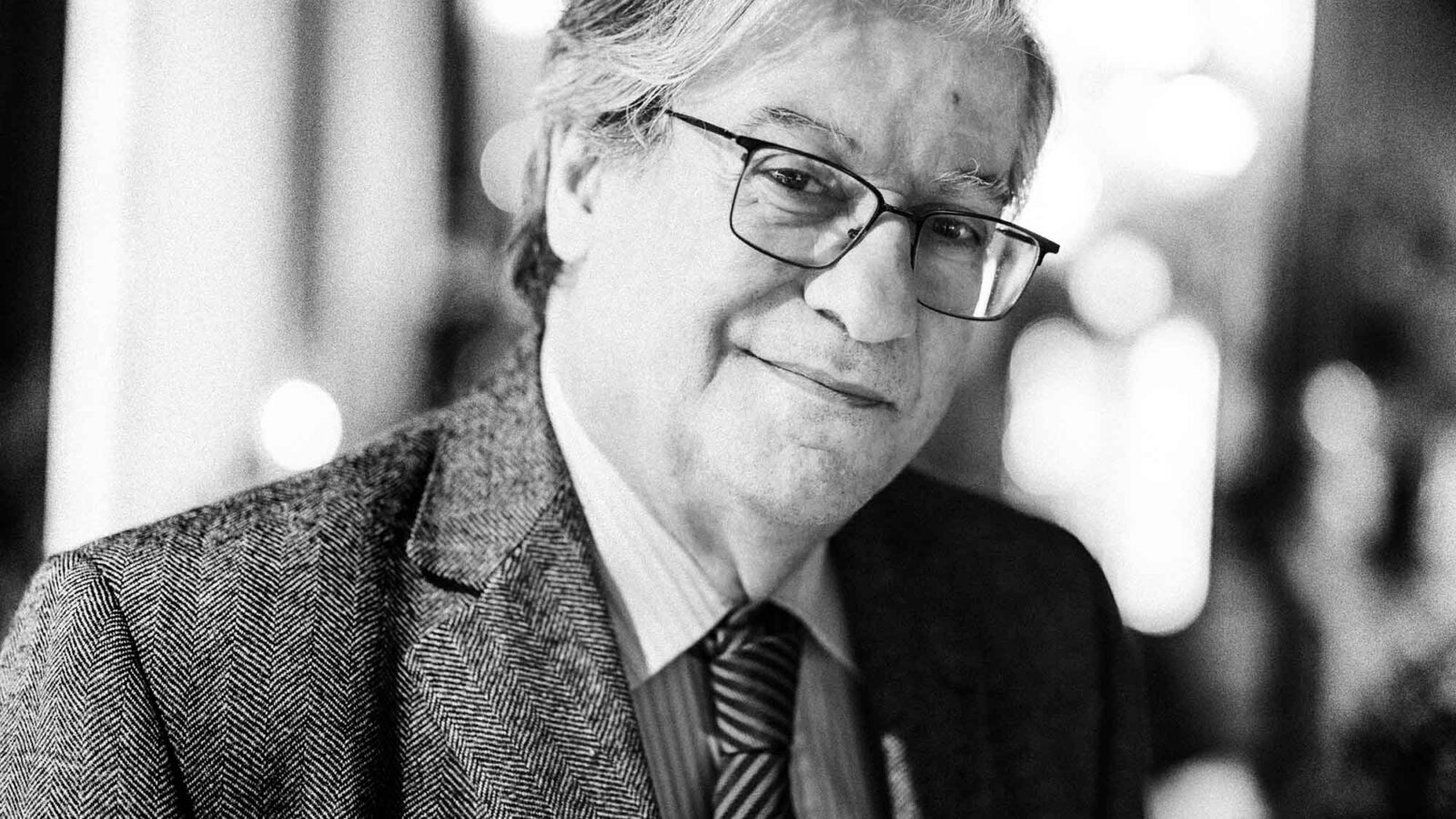
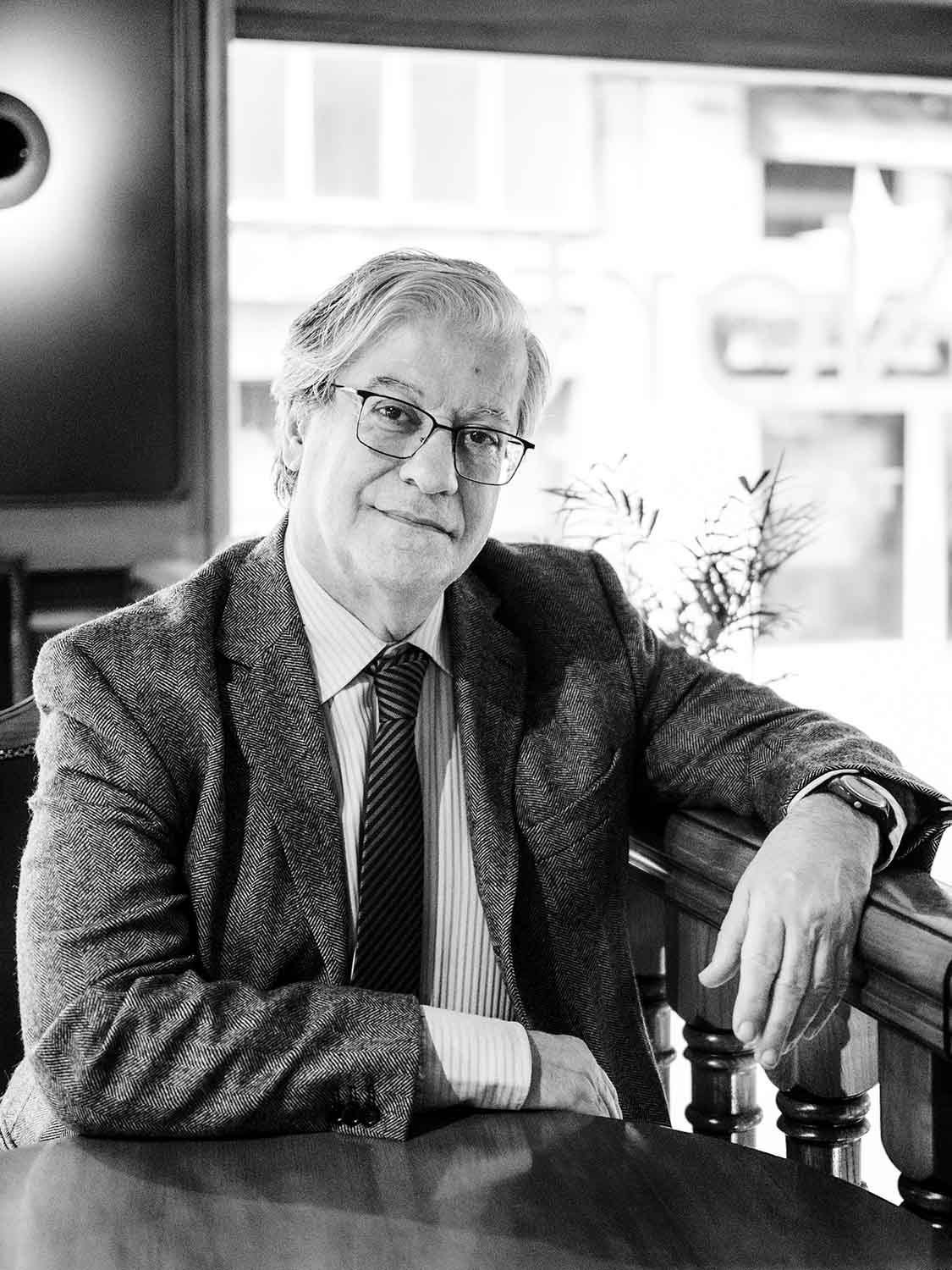
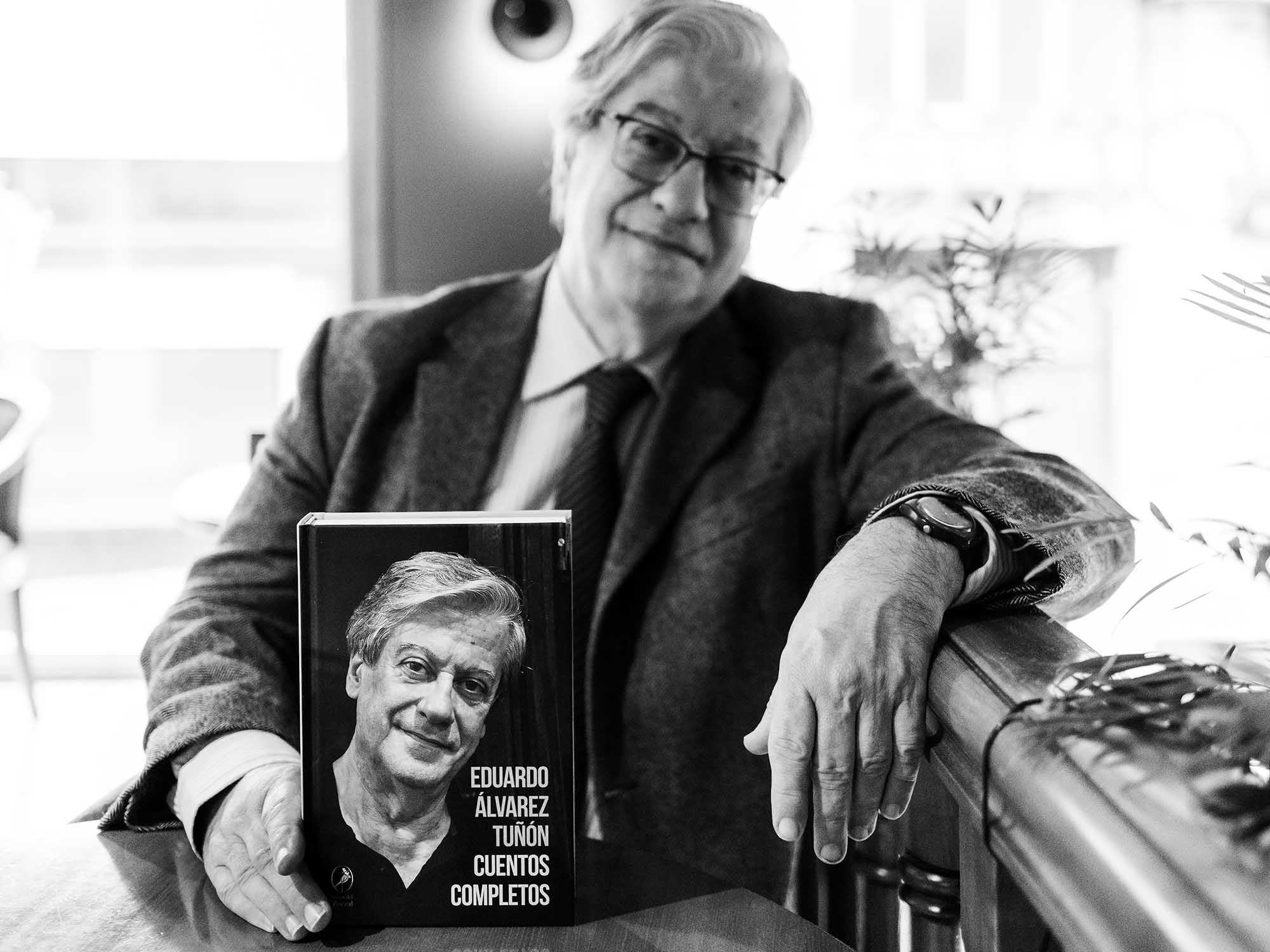
Eduardo Álvarez Tuñón (Buenos Aires, 1957) is the inventor of a subgenre that could only have been born in Argentina – to the point: unbelievable realism, or in other words, stories that have happened, strictly true, that slip away, like a mercury lizard, from the hands of rationality. This storyteller, poet, essayist, full member of the Argentine Academy of Letters and corresponding member of the RAE, roams through Madrid to present his Complete Tales (Libros del Zorzal, 2026), a magnificent literary artifact, brimming with poetry, truth, and absurdity, inhabited by, among others, the fathers of Daniel Barenboim, a pair of bricklayers who killed a friend of his whom they already believed dead, or a bank executive who hunted the trash of the woman who had rejected him. We spoke on Abada Street, where a rhinoceros, in the days of Philip II, escaped after a boy offered him a “mollete abrazando” (Pedro de Répide) and sowed chaos.
*****
—Mr. Álvarez Tuñón, here we are, by the blessed fault of a mutual friend: Jorge Fernández Díaz.
—I know him through the Argentine Academy of Letters. I had known him first as a reader. Mamá seems to me an extraordinary book, especially for all of us who are descendants of immigrants. I, too, am a descendant of Asturian immigrants. It’s a book that makes you cry, right?, with extraordinary emotion and poetry. Moreover, he is a great creator of characters. Remil, the novel The Dagger, Cora… are very good.
—In the beginning was the verse?
—Yes, in the beginning was the verse. I started with poetry. I think we all start with poetry. And this happens a lot with novelists: William Faulkner, Joyce… They are examples I don’t want to compare myself to, but they begin with poetry. From poetry I moved to the novel, and then I realized that between poetry and the novel, there is the short story.

—Poetry comes from family: Raúl González Tuñón, his great-uncle, is defined as “the great poet of Buenos Aires.”
—He was a great poet. He was closely connected to Spain: he actively took part in the Spanish Civil War, on the Republican side. I talked to him a lot, and when I started to write, he encouraged me greatly. He died when I was seventeen, but he shaped me. And, above all, I grew up in his world. My father died when I was very young. My mother went to work, and I was raised with his sisters. Especially with one, his elder sister…
—The one from the short story?
—Her name was María Consuelo González Tuñón, who was Raúl González Tuñón’s elder sister. She formed me in reading, in her library. I grew up a bit in her library.
—It was a poem about generosity. Jorge Cruz, with whom later I shared the Academy, was the director of her cultural supplement. Someone told me: “Take a poem there; he can read it and publish it.” And I took a poem, with much fear because of my surname. We had a tradition, one might say, communist. And La Nación was…
—Liberal.
—Liberal and of very good standing. Publishing in La Nación was almost a rite of passage. I took that poem to Cruz; he promised to read it, asked me what happened to González Tuñón, I told him he was my uncle. And Cruz had a portrait of Pérez Galdós hanging in his office. He was a great Galdós enthusiast. In fact, his email address was “galdosianocruz,” at sign… He was a lover of Pérez Galdós, of his literature, and I also liked Pérez Galdós a lot, because of this aunt who shaped me. He had the Episodios Nacionales in Aguilar’s edition. Then I recognized Galdós and told him: “What a lovely photo of Galdós.” He said: “Did you recognize Galdós? What a strange thing in someone so young.” And that’s where my relationship with Jorge Cruz began.
—Poetry is a kind of extinct in diaries. Do you sense why?
—In the diaries and in the cultural supplements, in general. I think it has to do with poetry being rather difficult, and there is poetry being written that is sometimes too experimental, which drives away the ordinary reader; a poetry that is more concerned with avant-garde than with emotion. That can also influence. But poetry is the common denominator of all the arts. I have tried to inject poetry into everything I have written.
—Your prose, certainly, has music.
—It has music. I continue to frequent poetry. So much so that I keep writing poetry and I run a poetry collection. I run a poetry collection at Libros del Zorzal. Poetry sits above everything. So much so that the word “poetic,” in all languages, is a form of praise. People say: “He is poetic.” They don’t say “he is essayistic,” but “he is poetic.” People remark on how much poetry he carries.
—From poetry to story, does one reach it through a courtroom?
—No. The courtroom gave me stories. I began writing narrative because I have always enjoyed telling stories. I was the son of a very overprotective widowed mother. My father died when I was two years old. My mother, who was a public school teacher, took me to her school. To a coed school… which began to be coed because I went there (laughter), because it was a girls’ school. So, to seduce…
—Ay, trickster.
—When everyone in the school left, they wouldn’t let me out until my mother finished the administrative files, the grade reports… They closed the school and I stayed behind. So, to be liked, the next day I began telling everyone stories from the school at dusk, which was the only thing I could know. And that’s where I began telling stories. I started noticing certain narration techniques to hold the interest of the listener. And I realized that lying with details brings you closer to the truth. Years later, in the judicial duty, I realized that: when a witness I was questioning gave many details, they were lying.
—Is justice a muse?
—A blind muse, and a bit… with a certain sense of failure. But a muse, after all.
—As a writer, what do you learn by exercising justice?
—You come to know a little more about human nature. The lights and the shadows. And you hear stories, some unbelievable.
—What should a short story have to make it work?
—Improbability is an important ingredient with which I have worked a great deal.
—You hold the copyright for unbelievable realism.
—There is magical realism, which is the one of Latin American literature: García Márquez, Carpentier… There is dirty realism, which sometimes appears on crime novels. I became interested in unbelievable realism. They are those stories that happened and that you cannot believe. As if there were a divinity organizing life, with small distractions that generate that unbelievable. And the reader asks: “Did this happen? How can it be?”
—Have you ever thought with someone: “No, this cannot be…”?
—“The Remnants of Love.” We get together with our high school classmates. With those who are surviving (laughter).
—With the others, difficult.
—We get together once every three or four years. One day, we go out to eat at a pizzeria; three of us remain, and one, who is a very important bank executive, a specialist in financial information at a multinational bank, tells us: “I’m going to tell you a story.” And the story goes like this: he was divorced, he had no children. And at a gathering of banking IT specialists, he meets a woman and begins to fall in love. They share things in common: he reads, the woman reads, both of them like Alejo Carpentier… He falls in love. He falls in love a lot. So, he invites the woman to meet at the bar of a hotel, in an act of good faith, with a lot of honesty…
—And he shoots.
—He says to her: “Look, I am madly in love with you, you are the love of my life.” And she says: “I love you…”.
—But “as a friend.”
—“I love you as a friend; I am married and I have two children, I’m very happy with my husband, you seem like a wonderful friend, but…”. She feels very uncomfortable, says she must go, pays, leaves, and he stays alone at the table. When he remains at the table, and this is what he tells me, he sees the lipstick stain on the glass of water. He picks up the glass and presses his lips to the stain. He gives a kiss at a distance. And he feels a certain pleasure.
—Goodbye.
—And he sees the napkin with which she wiped her mouth, grabs it, brings it to his lips, and realizes that it is possible to live a love in accordance with what she leaves behind in the world. He decides not to harass her, nor pursue her, nor speak to her again, except in professional matters whenever they meet. But this idea occurs to him. She lived in a very beautiful, very luxurious building of apartments. He goes to see the doorman, tells him that he is doing a municipal job analyzing the garbage, gives him some money and tells him that he will come to pick up the garbage from seventh B every night. And he goes to fetch the garbage. Then he brings the garbage bag to his home, he opens it in the living room and begins to see the remnants: a cream she discarded, a napkin… and he reconstructs her life by analyzing the garbage. And that is as far as I can tell. This old friend of mine came to the book launch in Buenos Aires. I invite my characters.
—We’re nearing the end, Eduardo. Do you, like Valle, think the truth is overrated?
—Yes. Valle is a writer I love very much. The truth, at times, is overrated. Because I don’t know if an objective truth exists. There are different ways of seeing what happened and what one believes to be the truth. I don’t know if there is a truth. Judges have a Latin phrase from Rome, still used today, that goes: Res iudicata pro veritate accipitur. “The thing adjudicated is the truth.” What judges say is the truth.
—And, to finish, if we started telling the tale of Argentina’s recent history, and began with the proper “once upon a time,” how would you continue it?
—Once upon a time there was a country with a cultural formation deeply rooted in public universities; a country that was very important in the Americas and that, for reasons unknown, save for the existence of evil or the devil, chooses someone who intends to destroy everything that country once was. And this person intends to destroy it without sensitivity: it’s not only about destroying the culture; it is about mistreating the disabled, the elderly. To utter phrases such as: “Why give a subsidy to a disabled person if the subsidy does not make him capable?”