
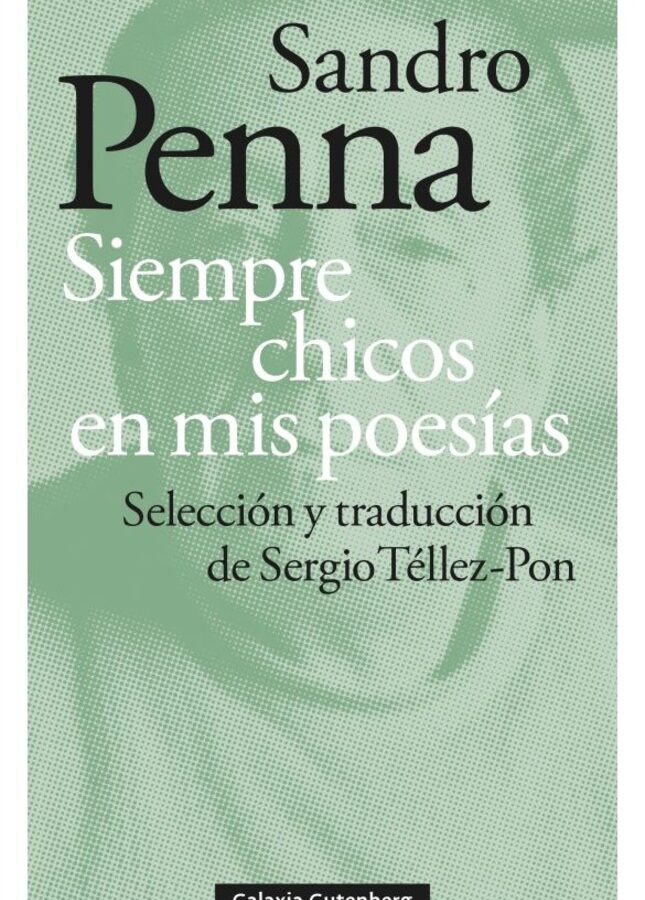
Considered by Pier Paolo Pasolini as the greatest Italian poet of the twentieth century, Sandro Penna is the author of a body of work that is both intense and delicate, marked by emotion and the subtlety with which he treats homoerotic love. As Natalia Ginzburg noted, “his poems are like his steps, light and silent, yet they leave a deep mark on those who read them.”
Here at Zenda we present five poems from Always Boys in My Poems (Galaxia Gutenberg), by Sandro Penna.
***
[Life…]
Life… is the memory of a waking,
sad on a dawn train: having seen
outside the light uncertain: having felt
in the broken body the melancholy
virgin and rough of the piercing air.
But recalling the liberation
unforeseen is sweeter: by my side,
a young sailor: the blue
and the white of his uniform, and outside
a sea all fresh with color.
***
[It rains…]
It rains over the city. It rains over the countryside
where I found, in the sun, the content friend.
He, in the tender age, has an idle heart.
It is clear that he does not think of me. Yet innocent
sins in me the rain awakens.
***
[I will not return…]
I will not return to the town where at dusk
the angel of work descends slowly into the fog.
The light I will see again, the golden light
where the boy shines. And at night
twinkle, dreaming, his flushed cheeks.
***
[In the night…]
In the deep night
the stars burn out.
A pain floods me:
a love of beautiful things.
***
[The day…]
The day has the eyes of a boy. The afternoon seems a
clear, a haughty girl. But the night has my dark color,
the color of a somber splendor.
—————————————
Author: Sandro Penna. Title: Always Boys in My Poems. Translation: Sergio Téllez-Pon. Publisher: Galaxia Gutenberg. Sales: Todos tus libros.
BIO
Sandro Penna was born in Perugia on June 12, 1906, although he never held fond memories of the few years he spent in that city. He spent a very brief period in Milan, where he worked running a secondhand bookshop. At twenty-three he settled in Rome, a city where he spent the rest of his life almost in poverty, for he never had steady employment. Another great Italian poet, Umberto Saba, showed great interest in his writing, and thanks to him he was able to publish his first book of poems, Poesie (1939). This was followed by his most important books, Appunti (1950), Una strana gioia di vivere (1956) and Croce e delicia (1958), and with them came literary prizes that earned him a place of honor in twentieth-century Italian literature: the Viareggio (1957), the Fiuggi (1970), and later the Bagutta Prize (1977). Shortly before his death appeared Stranezze (1976) and then, posthumously, Confuso sogno (1980) and Penna papers (1984). In his final years he lived almost in poverty, which led friends and readers to organize a collection and persuade the Garzanti publishing house to grant him a monthly pension. He died in Rome on January 23, 1977. In 1989 his poetry was published in a collected edition under the title Poesie.