
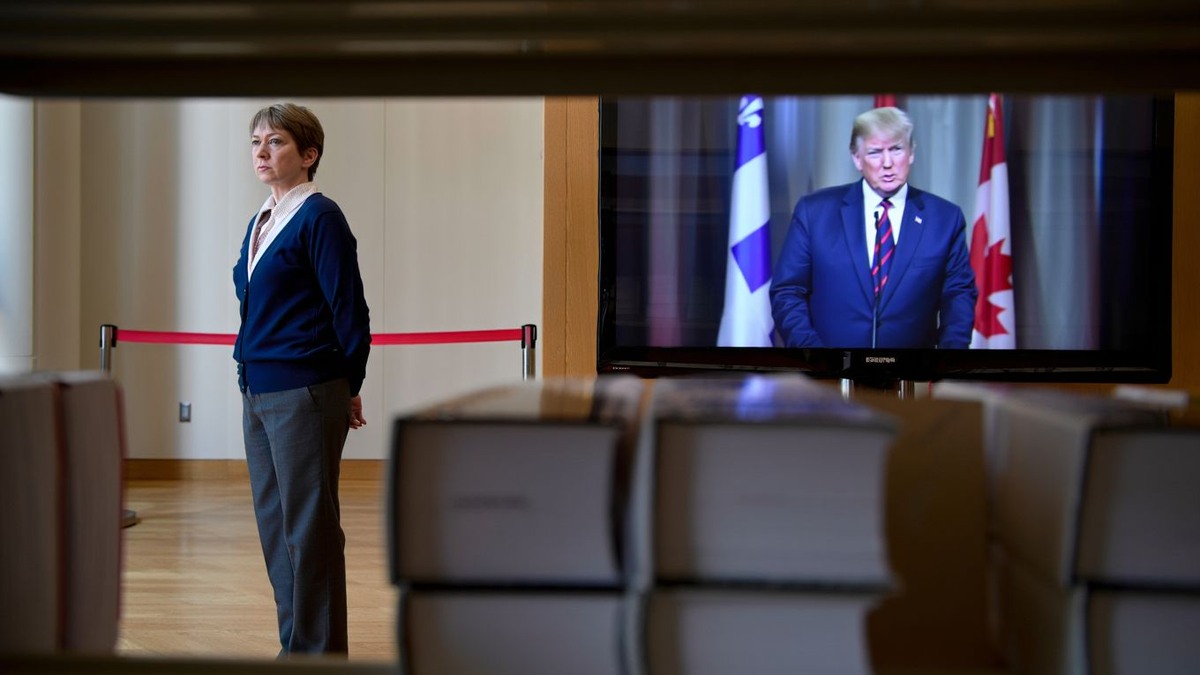
The framing sounds urgent, and it is designed to. It packages three very different stories into one alarming trend line. Before anyone accepts that a single campaign is marching north across the border, it is worth pulling the pieces apart and checking what each one actually says.
What is happening in the United States
In the United States, there has been sustained political pressure on federal cultural and library institutions during the Trump era, along with a broader, largely local movement to remove or restrict certain titles from public and school libraries. Much of this activity plays out at the level of individual school boards, state legislatures, and community complaints rather than as one national decree.
The targets are usually books dealing with race, sexuality, and gender. The mechanism is content-based objection: someone decides a book’s ideas are unacceptable and wants it off the shelf. That is the defining feature of the American story, and it matters for the comparison that follows.
What Quebec’s rules actually govern
Quebec’s language legislation, often referred to by its bill number, strengthens the status of French in public life. Montreal has also seen reported disputes in 2025 involving English-language reading events and book clubs held in municipal spaces.
These controversies concern the language of a service or event, not the ideas inside any book. A rule about which language a municipal program operates in is a different animal from a demand that a title be pulled because of what it argues. Collapsing the two flattens a real distinction.
It is fair to say Quebec’s language framework has created uncertainty for some cultural programming. It is not accurate to describe that framework as a project to censor content, and no verified measure equates protecting a minority language with banning specific books for their viewpoints.
The one thread worth taking seriously
So is the headline simply wrong? Not entirely, and that is the honest part. There is a shared mechanism worth naming, even though the goals differ.
When political rules, complaints, or funding threats hang over an institution, staff tend to become risk-averse. A librarian unsure whether an event complies, or whether a title will draw a formal challenge, may quietly avoid the whole question. That chilling effect can appear under content pressure in one country and under language rules in another.
That structural similarity is real. It is also the only place the two stories genuinely rhyme, and it should be described precisely rather than dramatized.
Reading the claim carefully
A responsible way to weigh a headline like this is to ask what it proves versus what it implies. Here the gap is wide.
- It implies a coordinated, imported policy; the evidence shows separate national debates.
- It implies Quebec is censoring ideas; the disputes concern service language.
- It implies libraries are surrendering; librarians are mostly navigating unclear rules.
Each of those slippages moves the reader toward alarm without adding a verified fact. That is the tell of an overstated frame.
Why the distinction protects everyone
Precision here is not pedantry. People who worry about book removals in the United States have legitimate grounds, and their concern deserves an accurate picture rather than a borrowed panic. People who value French-language protection in Quebec deserve not to be recast as censors when the real issue is service delivery.
Both conversations get worse when they are fused. A genuine debate about whether language rules unintentionally suppress cultural events is a policy question communities can work through. It becomes unwinnable the moment it is treated as a chapter in someone else’s war.
The useful takeaway is narrow and defensible. Watch for the chilling effect wherever rules make staff nervous, and press institutions to state clearly what is and is not permitted. Ask whether a given rule targets ideas or logistics. And be skeptical of any claim that stitches distant events into a single advancing front, because that stitching is where accuracy usually gets lost.
Canadian and American library debates are related in tone and in the pressures they place on frontline staff. They are not the same policy, they do not share a single author, and treating them as one obscures the specific, solvable problems each community actually faces.