
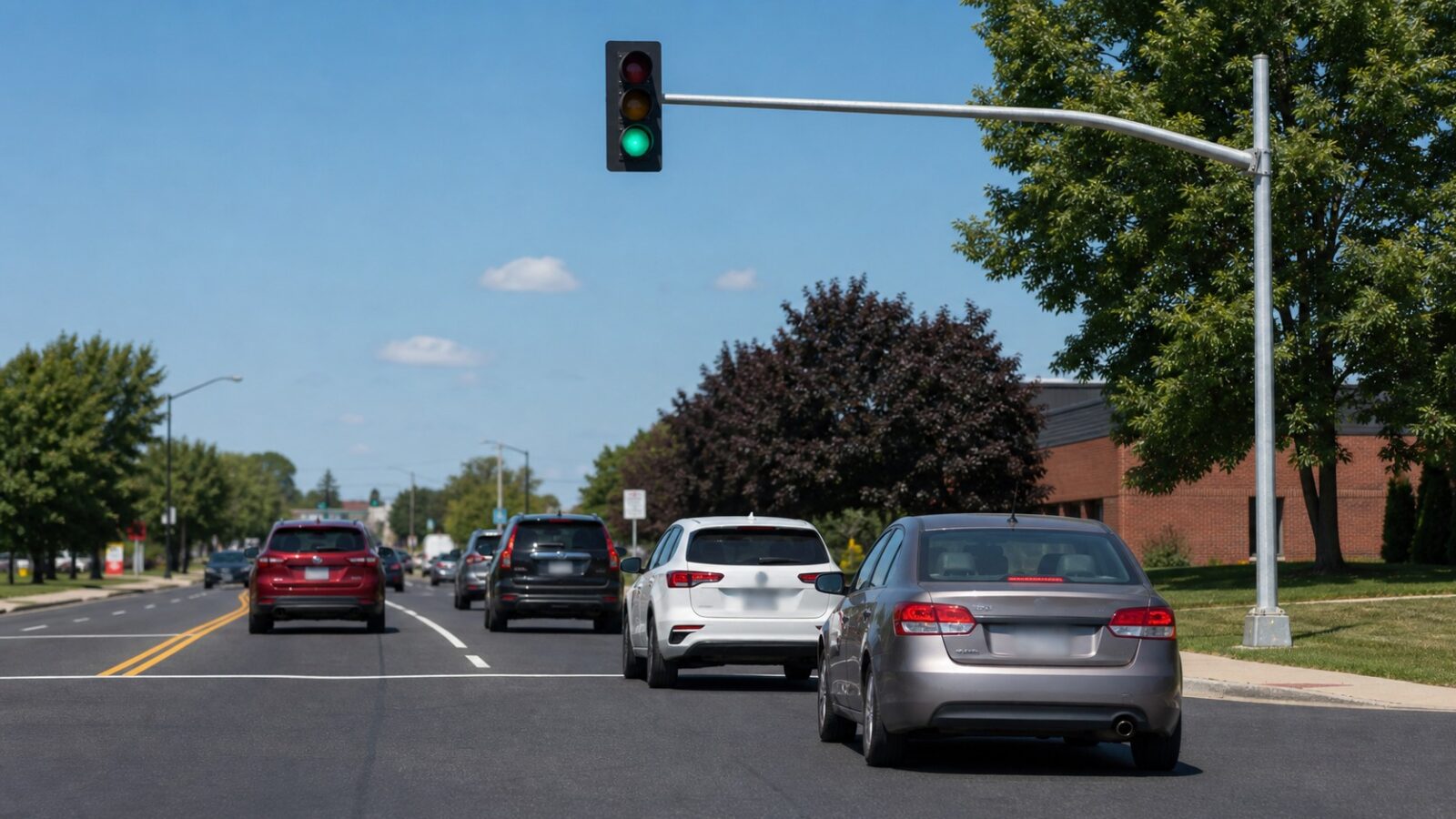
A new traffic light at the intersection of Wood Street and Portland Boulevard in Sherbrooke is supposed to make crossing safer. Yet for many drivers, the signal has exposed a different question: why does the redesign prevent some of the turns they used to make?
The answer is not hidden in the light itself. It lies in the new median configuration, the addition of cycling infrastructure and the City’s attempt to discourage shortcut traffic near a school. Those goals may be clear on a planning map, but motorists approaching the intersection are discovering that the route they expect to take is no longer available.
The traffic light is only one part of a much larger redesign
The signal was introduced as part of major work around Wood Street and Portland Boulevard. The project includes cycling lanes on both sides of the road and changes to the central median. According to reporting by Le Sherbrooke, residents generally agreed that a proper traffic light could improve pedestrian safety at a crossing where the existing arrangement was easy for drivers to overlook.
The controversy concerns what happens immediately after the light changes. Drivers arriving from Wood Street cannot simply turn left toward Jacques-Cartier Boulevard as many expect. They must continue, change lanes and use another route to reverse direction or reach a later signalized intersection.
For an occasional visitor, the restriction can look arbitrary. The green light suggests that the intersection has been opened up, while the median and permitted movements do the opposite for certain approaches.
Why the City does not want every left turn to remain possible
Sherbrooke’s stated objective is to prevent Wood Street from becoming a convenient bypass between Portland Boulevard and King Street West. If the median remained fully open, officials believe some drivers would use the residential street to avoid heavier traffic on Jacques-Cartier Boulevard.
That shortcut would send more vehicles past École Brébeuf and through an area used by children and pedestrians. The new signal could unintentionally make the shortcut more attractive because it removes the difficulty of crossing Portland without a protected light.
Municipal services have also said there is no technically workable way to preserve a left turn for only one Wood Street approach while blocking the corresponding movement from the other side. In practical terms, restricting the median means restricting both directions.
From the City’s perspective, the signal improves the crossing while the turn restriction protects the surrounding neighbourhood. From behind the wheel, however, those two parts of the same project can appear contradictory.
The alternative route is what worries nearby residents
Drivers who cannot turn left are expected to continue toward Routhier Street, where a left-turn lane allows them to make a U-turn, or to reach Fréchette Street through nearby residential roads. Residents have questioned both options.
They argue that the section near Routhier sits on a slope and does not offer the comfortable visibility motorists expect before changing lanes and reversing direction. The City says the available sight line is adequate and that the signal at Fréchette can be seen early enough to anticipate oncoming traffic.
The second option raises a different concern: diversion. If motorists do not want to make a U-turn on Portland, they may pass through streets such as Bretagne and Cécile-Chabot to reach Fréchette. People living there fear that a project designed to reduce traffic on one residential street could simply move it into another neighbourhood, including the area near Mitchell-Montcalm school.
Why drivers are confused even when the signs are technically correct
Road design is easiest to understand when the visual message matches a driver’s expectation. A new signal usually implies that movements have been made more direct. Here, the light makes the crossing safer, but the geometry deliberately limits a familiar turn.
That mismatch explains much of the reaction. A motorist can obey every signal and still find that the route ahead no longer works as anticipated. The confusion is likely to be strongest during the first weeks, before regular users adapt and navigation apps fully reflect the new movements.
Clear advance signs will therefore matter as much as the traffic light. Drivers need to know about the left-turn restriction before entering the intersection, not once they are already committed to the lane.
The real test will come from traffic data
Residents and local elected officials have asked Sherbrooke to monitor the redesigned intersection rather than assume that traffic will follow the model exactly. The questions are measurable: how many vehicles attempt prohibited turns, how many make the U-turn at Routhier, and how much traffic is diverted toward residential streets?
If the results show repeated hesitation, unsafe lane changes or heavier traffic near another school, the City could revisit signs, signal timing or permitted movements. If drivers adapt without those problems, the initial confusion may prove temporary.
For now, the new light is doing what it was installed to do: provide a controlled crossing. What many motorists do not immediately understand is that the same project was also designed to stop the intersection from becoming a shortcut.