
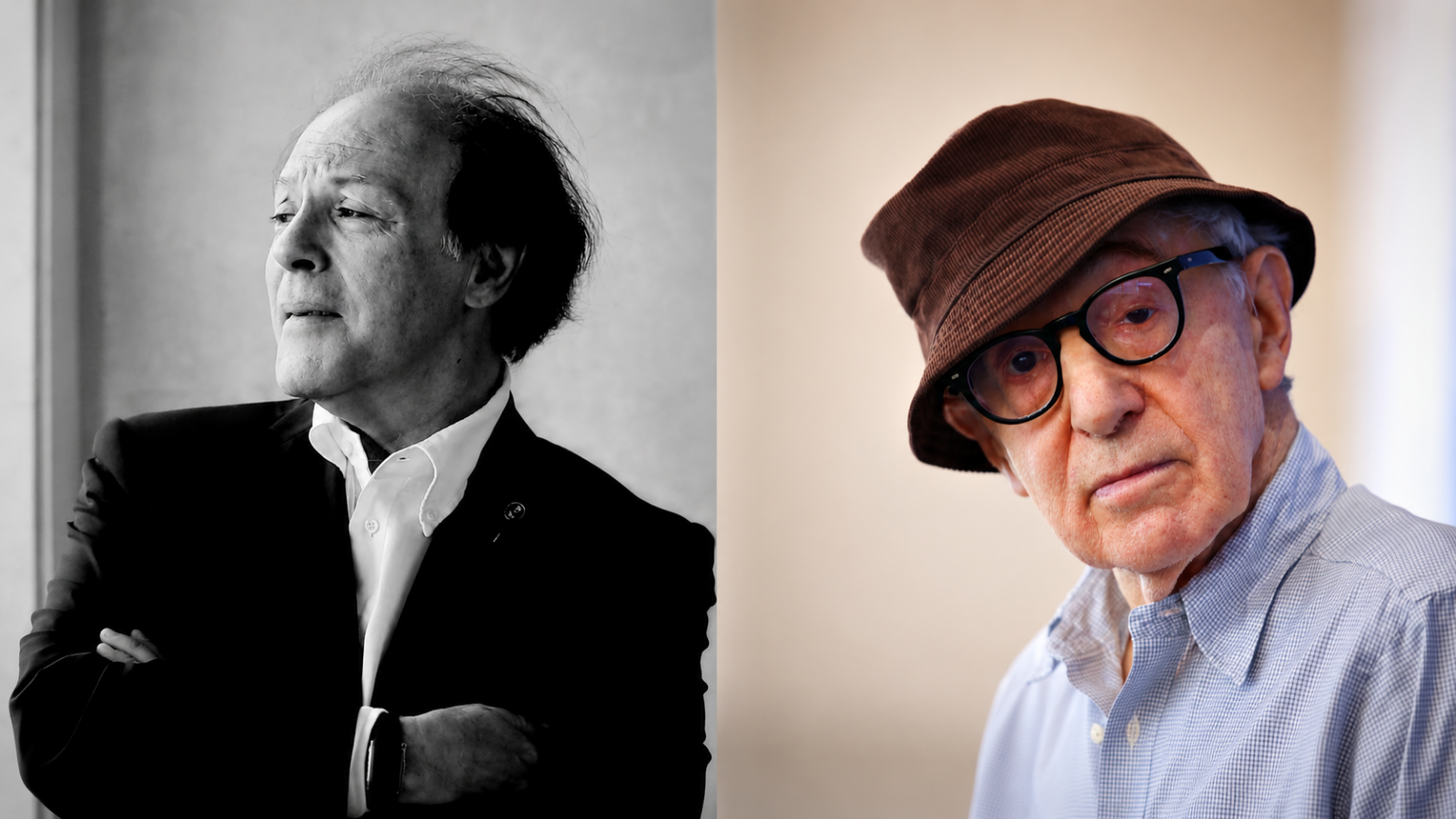
The writer, art curator, and former United Nations diplomat Cristina Carrillo de Albornoz, author of Un beso en Tokio, among other books, brought together in Paris Javier Marías and Woody Allen for a book of conversations commissioned by the German edition of Vogue. So many years ago… A magical encounter that was never forgotten, one that those who, in December 2001, turbulent times in the world, discovered this beautiful and unforgettable conversation, will not forget either. Now I found it again. The one who arranged it, Cristina Carrillo de Albornoz, has helped me remember it.
As if chance were guiding me to meet those two intelligences, rummaging where I keep relics of Marías, of whom I was editor and friend, I found documents that brought me back to the conversation of these two giants summoned by Cristina in a Paris hotel.
Among the notes I found, Marías, always so orderly, would indicate to me succinctly (I imagine also to other friends with whom he corresponded) what was especially interesting. He was always right. Javier Marías was born in 1951 and died on September 11, 2022. Woody Allen remains among us (and in cinema). Cristina Carrillo de Albornoz, the one who brought them together, remains in life, in the universe of art and literature.
Her novel Un beso en Tokio, published in 2023 and now in its fourth edition, deserved this reflection from Elena Foster, one of the most important readers and editors of our times. Foster spoke about Cristina’s novel: “A novelized meditation on the eternal paradox of ephemeral beauty and imperfect love. On the unexpected unease of success. On restlessness and serenity. (…) The unexpected and unfinished story of Kengo Ö, the protagonist of Un beso en Tokio, seduces us and makes us love it.”
Now I asked Cristina to revisit that meeting between the two titans of literature and cinema, which she arranged for Vogue… In addition to that particular one, Cristina gathered in her conversations Mario Vargas Llosa with Fernando Botero, Desmond Tutu with Bono (of U2), Miloš Forman with Mijaíl Barýshnikov, Almodóvar with Geraldine Chaplin… In the gathering that brought Marías and Allen together, Cristina recalls “a brilliant, pleasant, and fluid conversation between two shy charmers” who submitted to a moderation Cristina remembers as extraordinary.
Marías and Allen appeared as they were, “prepared and cosmopolitan, with their thoughts always free, without prejudice, deft in a conversation that moved across a myriad of topics and ideas treated with enviable humor.”
The lightness of both, Cristina recalls, alternated with depth and “the pursuit of beauty also serving as the thread that runs through my novel… It was,” she says, returning to the Paris encounter, “from the beginning to the end a fascinating dialogue in which we celebrate life and question the changes of the newly debuted twenty-first century.”
“When an author withdraws to write a new book, a very good reason is needed to pull him away from his seclusion,” Cristina writes in the introduction to that December 2001 meeting. “With Javier Marías, two words were enough to pull him out of a small town in the Spanish province of Soria and carry him to Paris: Woody Allen. The American director, who like every autumn travels across Europe, wanted to meet with Javier, already a successful writer, for the magazines Vogue and El Cultural in the French capital (“my second homeland”). A discreet setting for their first meeting: a room at the Le Bristol Hotel on Rue du Faubourg Saint-Honoré. Woody Allen wore a beige cashmere sweater, brown trousers, and his inevitable black-rimmed glasses. Javier Marías wore a jacket with a badge featuring the figure of William Shakespeare, his great exemplar. The two took their seats on a sofa.”
And there was no shortage of what they, seated, had to tell each other to be perfectly marked in the history of that meeting. Marías said: “I sit on the left; I am left-handed and, as such, I have that natural habit.” While the American genius explained what the times ahead would bring during the interview and the story: “Perfect. I hear very well with the left ear; with the right I hear poorly. I still remember my work with a Swedish camera operator who worked for Ingmar Bergman. He had problems with his left ear, and I had problems with my right. We spent the entire film turning around, looking for the posture in which we could communicate.”
Those who know Javier Marías well can imagine what followed that initial moment of the conversation between the two shy ones. Javier informed his interlocutor that he was bringing some of his books with him, so Allen could use them “or throw them away,” to which Woody Allen, more given to improvising a joke, exclaimed to his newly minted Spanish friend: “I would never throw away a book! I even promise I will read them all. I read constantly, and since I don’t know French, I don’t watch television here; I spend a lot of time in the room reading. And I still have some trips by plane waiting for me.”
And so these titans of conversation and timidity continued. Marías: “Can you read on planes? I cannot. I used to carry a newspaper when I flew, but then my anxieties began because I could not see what was happening around me.” Allen: “I enjoy reading up above the clouds. On takeoff I grab the book as if it were a lucky charm. In contrast, I get seasick when I read in a car.”
I drank in this conversation, which lasted hours, with the joy of imagining them together with my friend Cristina in Paris, of finding myself in the times of chance that life makes possible when life is otherworldly and all that has happened already becomes part of the life of this moment. I was chills to find them again, Marías in that world of imagination and of search, Woody Allen listening to him as if they had met on a western road of the world, trying to gift each other the mutual universe they would live forever.
For Marías, who was pure cinema and pure literature, it occurred to him at the end to ask Woody Allen about cinema. “What do you think of contemporary cinema?” he asked his counterpart, as the gathering for which Cristina Carrillo de Albornoz had convened them was ending. Woody Allen replied: “[Contemporary cinema is] Absolutely inconsequential. No one is interested anymore in poetry or beauty. The dialogues are either banal, or the characters simply do not converse. Images do not move. Lately the only films I have liked are European or Asian. Hollywood produces only manufactured films: cold, lacking in aesthetics, with a lot of technique. Moreover, now everything can be interpreted virtually; the only alternative left for someone is full of superficial aesthetic points.”
And this is what Marías, the other great admirer of aesthetics who was about to break, told him: “Aesthetics hold enormous importance. When I write, I sometimes break a page five times until I achieve something loving and fitting. A strong reflection loses all depth if expressed in a clumsy and dull way.”
They ended by talking about clothing, appearance, and life. And when I finished reading what they would say to each other, I felt the enormous nostalgia of knowing that these two characters would never see each other again. We now will only dream of what they said to one another, and also of what they perhaps wished to say.
—————————
0/5