
How can we reconcile our compassion for others’ pain with the torment caused by our alienation in the increasingly impulsive behavior of the political class? How can we undermine the mechanisms that perpetuate obedience (the manipulative language or irrational servility toward fanatical leaders)? Are we not losing our sanity in this era of assisted madness in which destruction has become omnipotent?
Vigilant, the writer’s humanism, literary critic and editor Toni Montesinos (Barcelona, 1972) interweaves historical references (Rome, China, Napoleon, totalitarianisms) and literary ones, always at the service of dismantling our illusions about the supposed “neutral” or “progressive” nature of barbarism. His lucid sensibility reads as a warning not only for our unhappy era, but for our uncertain future.
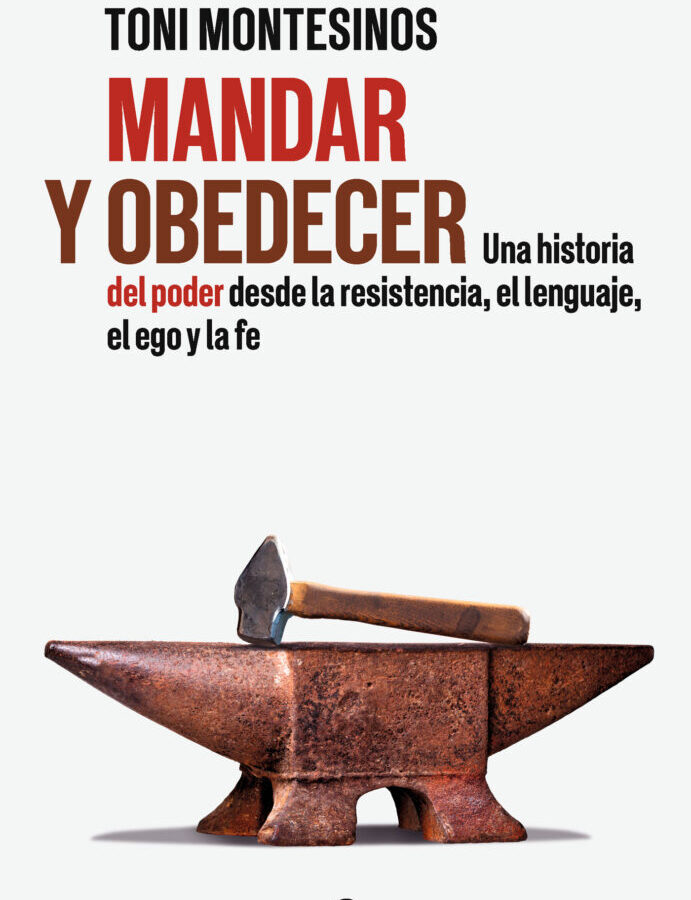
His most recent essay Mandar y obedecer (La Esfera de los Libros, 2026) centers on challenging our preconceptions, exploring the gaps between the personal and the social to undermine our privileges, based on reflections about personality: “Let us speak, then, of identity, yes, but in the proper terms. For no one can expect to win a duel if the other chooses the weapons” (Montesinos, quoting Bernat Castany Prado).
The literary critic in the daily La Razón manages to be, at once, exceedingly respectful and passionately subversive. His procedural cadences combine flexibility and surgical precision to weave an interpretation of reality in a compendium filled with casual and erudite reflections, highly relevant today, that “we have / more than ever / selfish yearnings for power” (Montesinos again, citing Bukowski).
Evidences the editor of the magazine Qué Leer and promotes exercises of resistance while exposing mechanisms of domination. He criticizes pronominal uses (“empower oneself”) as symptoms of narcissistic individualism or rampant anglomania, fleeting fashions, in any case, that impose ideological nomenclatures. A deep affinity with grammar underlies this History of power from resistance, language, ego and faith.
The contributor to Cuadernos Hispanoamericanos, Cultura/s (of La Vanguardia) or El Viajero (of El País) maintains that everything —subject, verb, object— has its place, its correct relation to the elements that surround them, a logic that not only guarantees its functionality but also creates the conditions favorable for thought to occur, confronted with the “power [which] is hierarchy. There lies everything to understand the essence of life in society: a struggle for hegemony and supremacy, interwoven with the imposition of a series of prohibitions and the surrender of certain liberties.”
He posits the XXX Premio de Poesía Ciudad de Alcalá (1999) that, if grammar is mastered, ideas flow; and if it fails, chaos becomes uncontrollable, anarchic, irrecuperable. Against these ungrammatical times rises this skeptical, disenchanted guide, which helps us escape the corrosive power of verbiage. Reading this treatise on the solitude of the dissident, we are not alone, no matter how we may feel at times.
Mandar y obedecer is, for all this, an uncomfortable, irreverent, unabashed handbook, ideal for understanding our era of hyper-vigilant technology: a perceptive, compassionate, and multifaceted treatise of the XI Premio Internacional de Crítica Literaria Amado Alonso (2012/2013), which plays a key role in explaining our vicissitudes, but also manages to remain distant and impassive. As a representative of this reader unfazed by discouragement, it constitutes an ideal ally against setbacks.
————————
Author: Toni Montesinos. Title: Mandar y obedecer: A History of Power from Resistance, Language, Ego, and Faith. Publisher: La Esfera de los Libros. Where to buy: Todostuslibros.