
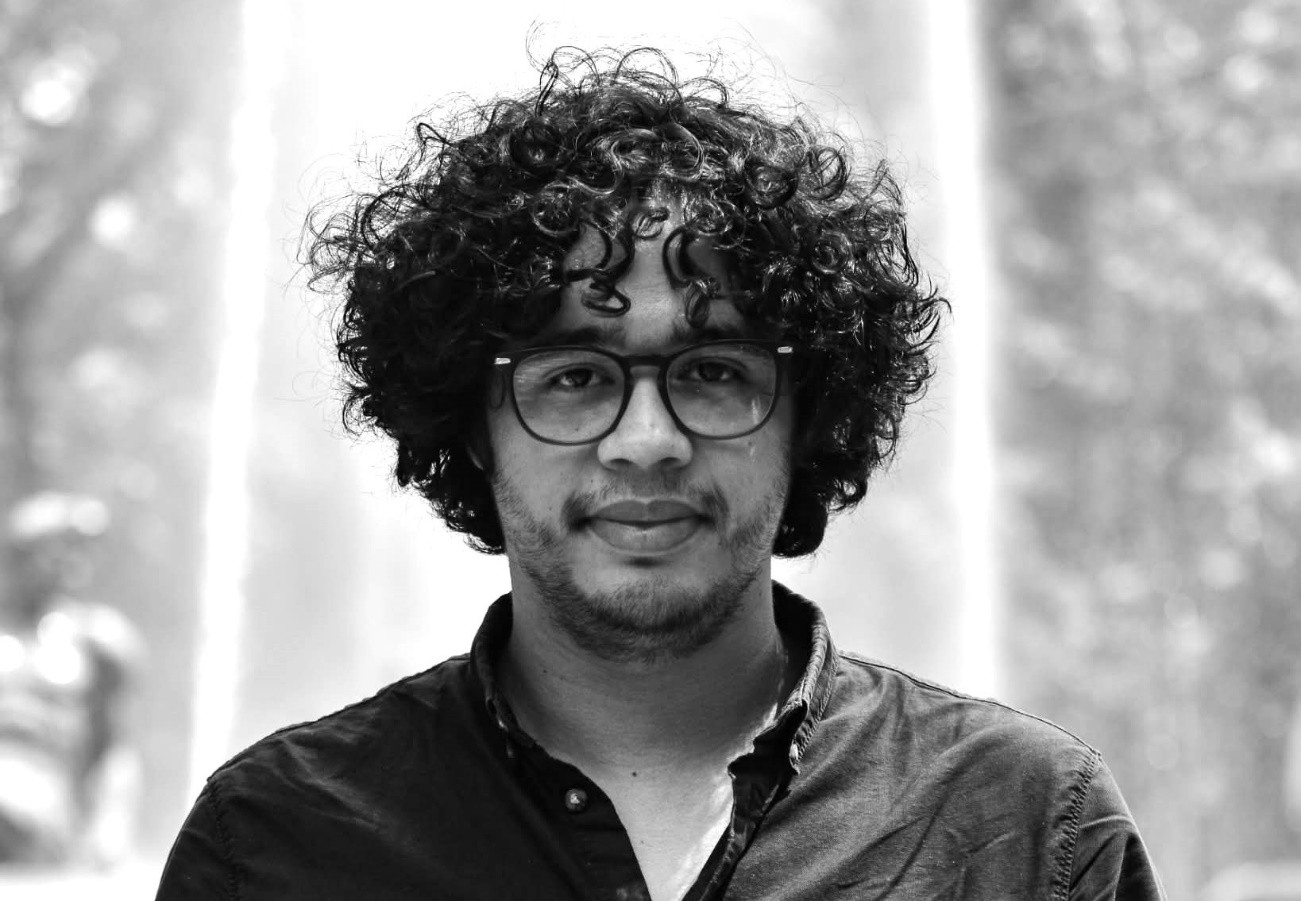
Zorian Ramírez Espinoza is a poet born in Caracas (Venezuela) in 1996. He holds a bachelor’s degree in arts with a focus on music from Arturo Michelena University and is the double bassist with the Caracas Municipal Symphony Orchestra. In 2022 he published Las escuelas de contrabajo en Venezuela, reconstrucción evolutiva 1970-2003 (CIDES) and the plaquette Memoria derramada (Petalurgia). He earned a diploma in reflection and poetic creation from the Fundación La Poeteca in Caracas. He has participated in various national and international anthologies. He is co-editor of the dossier on young Venezuelan poetry Si el río abriese los ojos: Antología de la continuidad and associate editor of the magazine Círculo de Poesía. He coordinates the poetry collection El alba ya no pudo negarme, from the Fundación Editorial Tuqueque, with which in 2026 he publishes his book Inhabit the Form. In July 2026 he won the prize of the VIII Annual Poetry Contest Lugar Comun (USA) with his book The Phantom Limb.
***
The Phantom Limb
I believed I had rid myself of that inexplicable thing. Now I stand in the space that signals its absence. My mother often gets cramps in that invisible place; at times, she asks me to rub there where it hurts.
Years ago I noted in my diary that I had decided to cut my hair, which had grown for five years until it reached the length of the part my mother lacked. I wrote that a leg would sprout from my head and emerge as a long tangle of hair until it developed, became independent, and detached. Fifty-seven years lived with my mother; five years were enough for her to become an adult inside my body and depart again.
It is sad to know of this torment in which a part of the body not meant to think exercised a privilege granted to men.
I saw her a few days ago in a photograph, where my mother was young, so young that I would have liked to be her friend and go dancing with her, climb a mountain, run a marathon.
My mother evokes herself daily, now that most of her time is spent in bed, confined in a house that, due to its realism, dematerializes with the storms. The house, like me, believes in the possibility of salvation through this inner exploration; it opens its skin, tears, disassembles to sing in unison what came before it, that is, when one wall began another and another, then a wall, and so on.
Anthropological gaze alone is not enough; the inexplicable thing haunts my mother and the space that, by fate and not by choice, has had to call home. Like Leg, House turns 18, is an adult and has children, while mother roots herself in the void until she makes appear, in her other leg, the vestiges of the limb she believed lost, the unwanted relative.
***
Note for a Ghost Uncle: and there are several specters, I said, as I listed situations. My uncle was also eaten away by cancer. By that time, my Hands and Feet had sunk into sleep while Heart beat and Eyes watched Ears listen to the call of blood: Primo, tú que sabes de esto, ven por favor, ayúdame—the story grows more complex in convex times—. I cannot —I answer—. I was born a sheep in a wolf’s house. I am an evaporation and I look at you, blood relative, passing from stalk to trunk to then transfigure you into a wolf. You expand, now, you are as large as the forest.
***
The House Is Not Built from Breath
Nothing novel do the messages of the air bring to us
yet we perish
and give space to the immaterial
The afternoon Cruz came by and brought a small guest
made of privations
just like us
visited by extinct birds from an ancient library
Heavy as the light
of those things we deny
And from which we cannot rid ourselves
Cracking Cruz and I
a space for her in the earth
full of worms for the fledglings
***
The storm gave way to dawn, revealing hawk and dove. Seeing them, I thought this had been the work of the night. I approached the scene, the hawk took flight and the dove collapsed to one side. I held her in my hands with the intent to save her. She was lighter than usual, my fingers began to feel the viscosity that surrounded her ribs. I placed her in front of me and observed the hole that lay where her chest would be – inside it, the darkness, the void–.
We stood together in the space of the bones, it was your hands and mine. I, who asked you to give me the burial together with the bird, I who survived even after having abandoned my name.
Leave me in this place of fruit trees and worm pits —I told you—.
You buried the bird but the song survived.
***
Prayer for the Missing Limbs
Father of the scattered toys, I beg you
for the missing pieces of puzzles never completed
I pray you grant me patience to search
in the midst of this uncertain cycle
in which I am unable to discern
I ask you for the dead birds
the domestic accidents
(and life when it was peaceful in the storm)
for my mother and father, voice and body
For the index finger
the scar on my left brow, I often think
that it will reopen when I am in the air
And I will live again
the day I wanted to jump a wall
but it was impossible
because I had not noticed
that it was covered with bottle caps
I inherited my grandfather’s wound
and I learned of it years later
when I could see the landscape that lay beyond
and I knew how to read
and I found in my grandmother’s drawers
the youth of others
There lay my grandfather’s naval ID
where a scar on his left eyebrow was established as a defining feature
God, or as I prefer to write you god,
Rafael is not your fisherman angel,
but the name of my mother’s father
Father
I doubt you from time to time
and when I am among geraniums,
night-blooming jasmine and any other
vegetable paradise
I invoke your name to ease what burns inside me
Father
I pray for the swans
The seagulls I have seen on the rivers
I apologize for never having used postal mail before and, nevertheless, collecting stamps
I apologize for orange trees of loves never gestated
For germinating their seeds in plastic cups
Father, grant me the patience that the parts of my body, which must be gathered like toys and buried as fruits of an impossible tree, deserve.