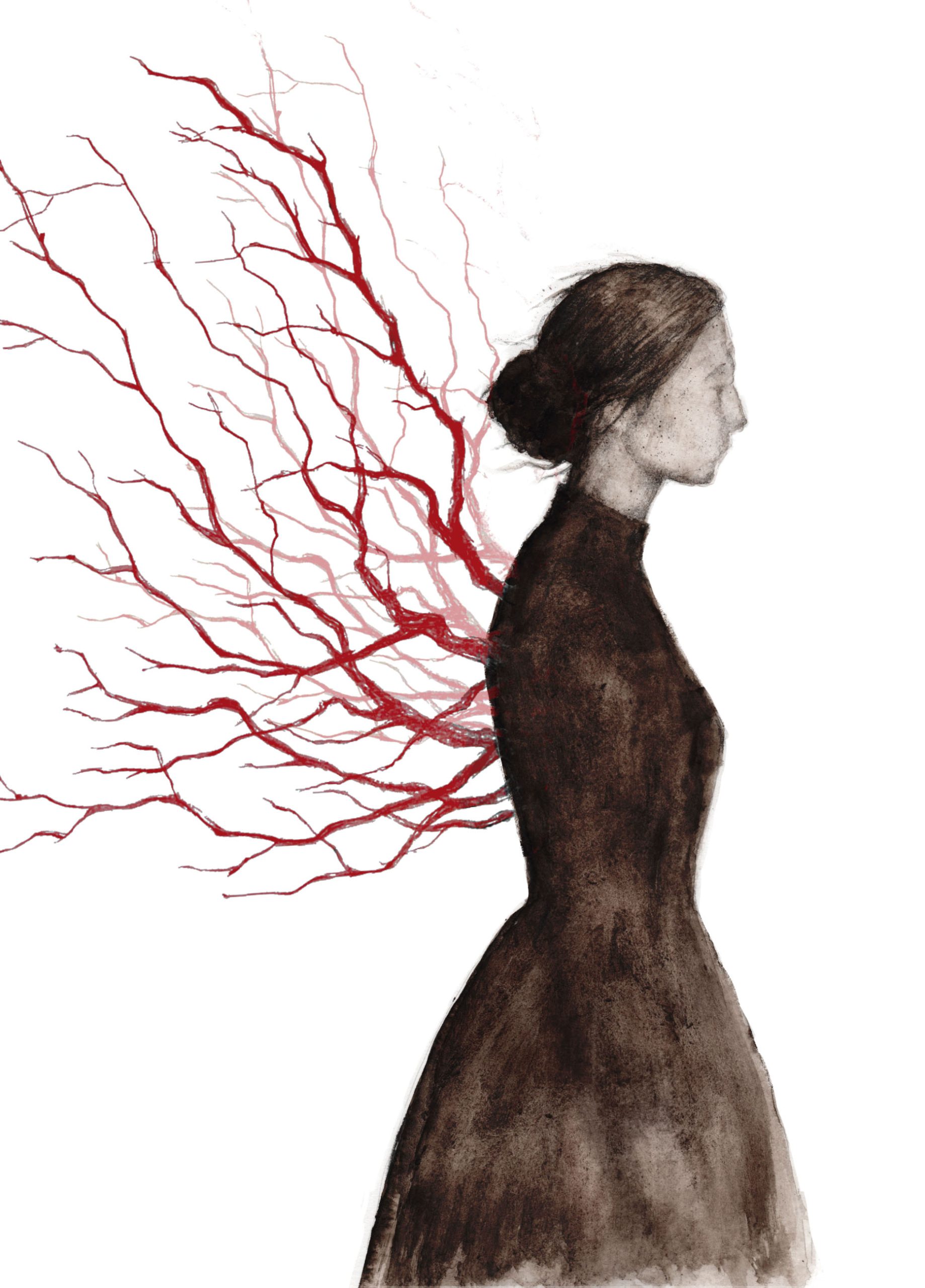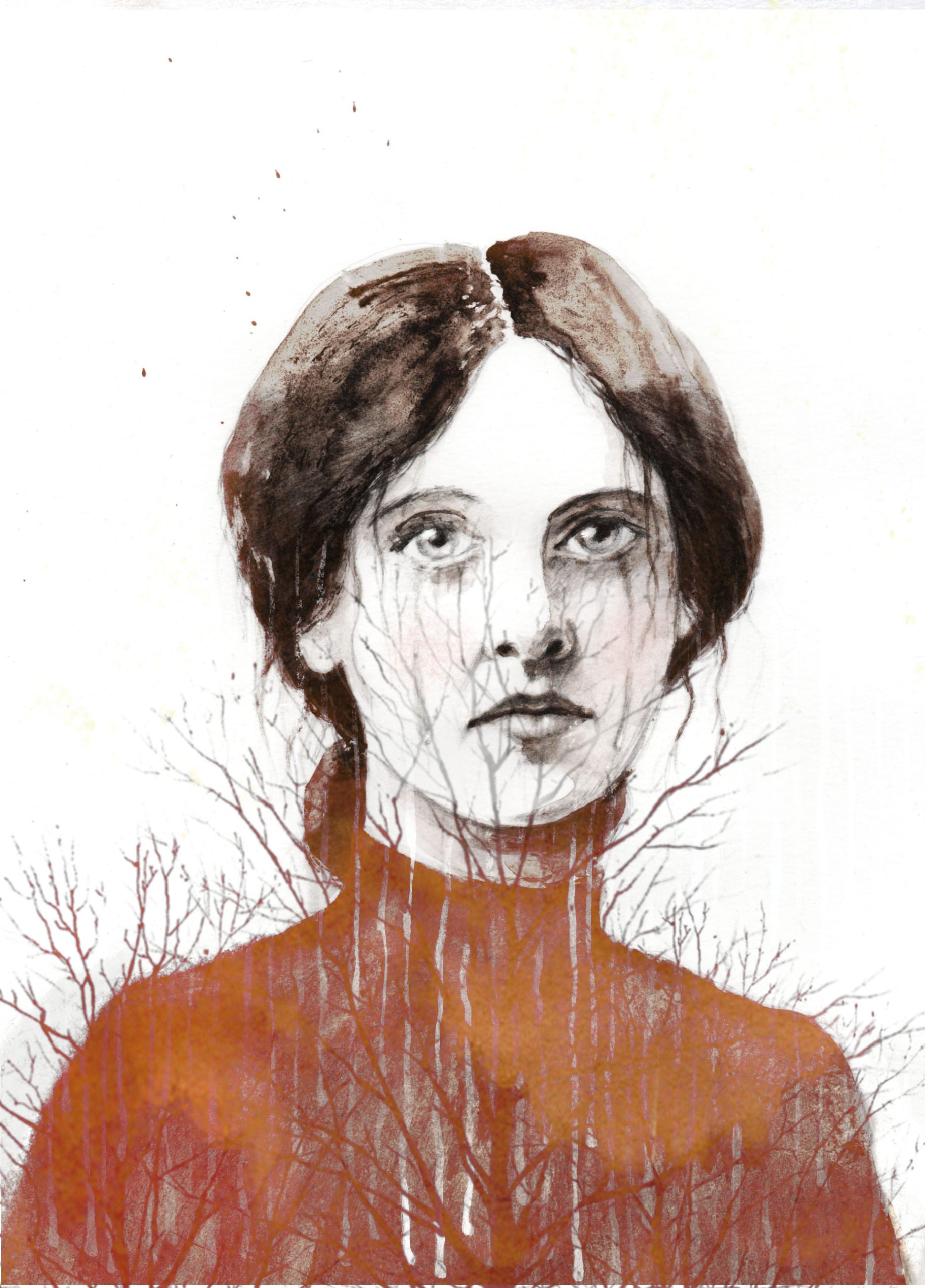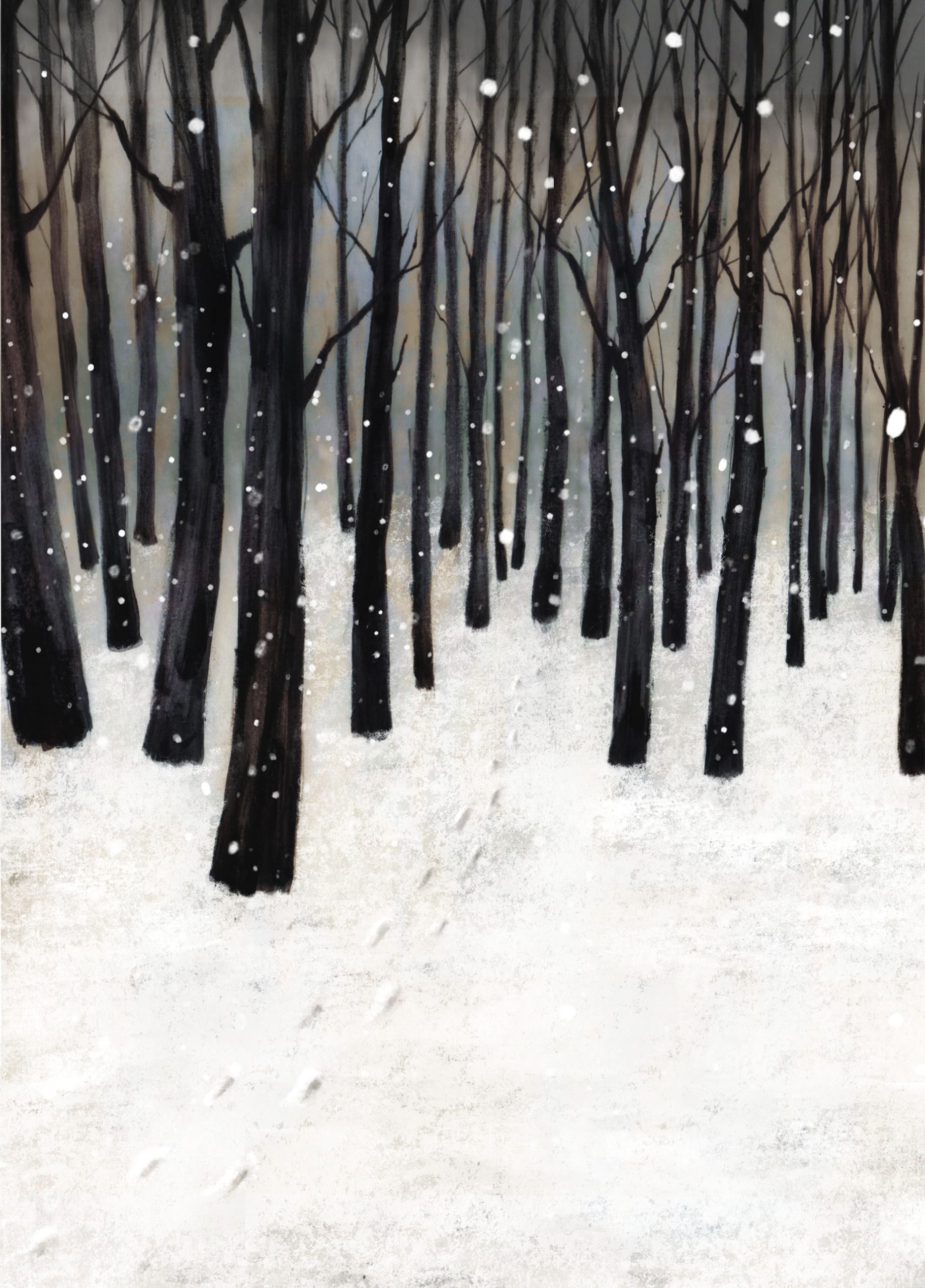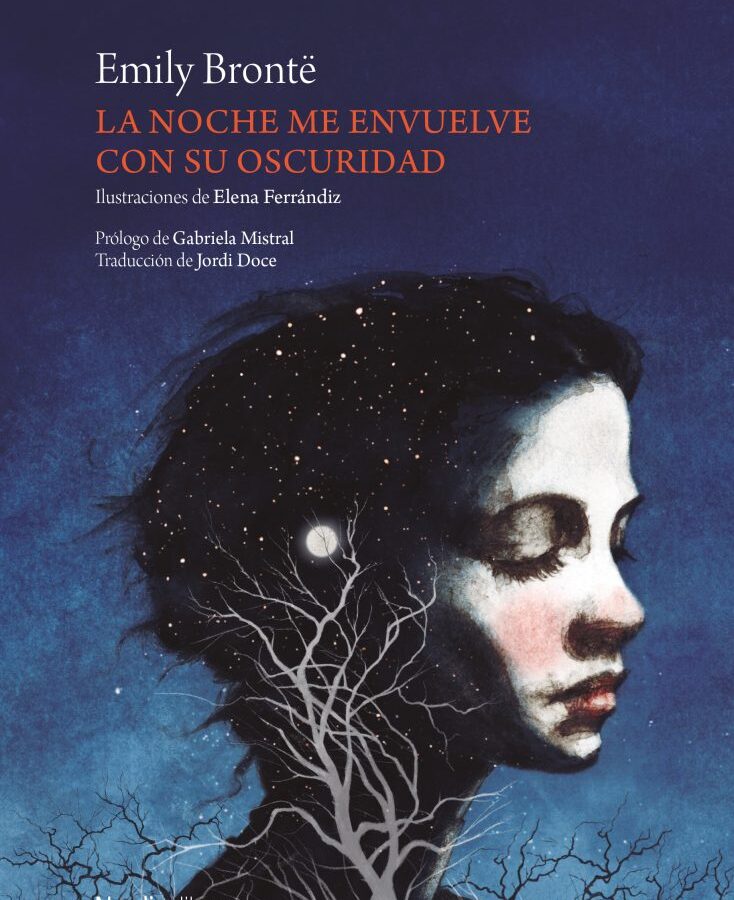
Emily Jane Brontë’s poems are passionate and powerful, conveying the vitality of the human spirit and the natural world. Only twenty-one of her poems were published in life. This volume, in a bilingual edition, gathers those poems and nine more attributed to her, with evocative illustrations by Elena Ferrándiz.
At Zenda we publish five poems from The Night Envelops Me with Its Darkness (Nordic), by Emily Brontë.
***
Faith and Despair
“The wind of winter is strong and wild;
draw near, my child,
set your books and your solitary games aside
and let us spend the hours in thoughtful conversation
as the gray night thickens.”
“Oh, Eire, around the walls of this house
the gusty air of November calls to us
and we answer with no reply;
not a single breath can slip here
to stir your daughter’s hair, and I rejoice to behold the glow of the hearth
springing from your eyes with doubled rays,
and I feel your cheek resting sweetly, calm and happy on my chest.”
“And yet, this stillness
brings bitter and troubled thoughts to me;
and against the bright glow of the flame, red and cheerful,
I think of deep ravines closed by snow,
I dream of the misty hill and the moor
where nightfall rules, dark and cold,
for there in the glacial mountains, solitary,
lie those I have loved for long ago.
And my heart weighs with powerless pain,
tired of lamenting in vain,
for we shall never cross our paths again…”
“Father, even in my early childhood,
when you were far away, beyond the seas,
I was overwhelmed by such thoughts.
In long nights of storm
I often sat for hours, upright against the headboard,
to glimpse the faint moon
struggling in the sky; or, straining my ear, to hear the beat
of the wave against the rock and the rock against the wave;
thus I kept vigil, fearful,
and by listening I never slept.
There is much to fear in life on earth, Father,
but not of the dead.”
“No, they do not deserve our despair.
The tomb is ominous, yet they are not there;
their dust has mingled with the soil,
their joyful souls have departed with God…
You yourself have told me so, yet you still sigh,
muttering that your friends await death.
Oh, my dear father, what is the reason for this? If, truly, your old words held truth,
what a useless sorrow it would be; as foolish as weeping for the seed
that grew from its father’s tree unseen, for it fell to fertile ground
to sprout again and rise, rooting deeply and stretching high
its green branches toward the generous sky.”
“No, I do not fear weeping nor lamenting
for those who sleep beneath the earth;
I know there exists a blessed shore
that opens its harbors for me and mine;
and, as I gaze upon the vast waters of Time,
I long for that divine land
where we were born, where we, upon dying,
shall meet our beloveds free from suffering and corruption,
restored in the Deity.”
“Thus you speak, sweet and trusting girl,
wiser than your father;
and earthly storms, foaming and raging,
shall give impulse to your longing,
your ardent hope, across foam and squall,
through wind and the roar of the ocean,
to finally find the eternal home,
the firm, unalterable shore.”
***
Stars
Did the radiant sun
who brought happiness to our land,
leave you one by one,
leaving a desert where the sky should be?
All night your eyes
glorious to my sight, have watched,
and with a heart wrapped in gratitude I have blessed
your divine guard over me.
I rested in peace; I drank from your lights
as if they were life itself
and dreamt of changing in a thousand ways
like a petrel skimming the waters.
Thought after thought, star after star
moving in unknown confines,
while a sweet influence, near and far,
passed through me, proving we were one.
Why did the morning light shatter
such a grand and pure spell,
burning with fire the gentle cheek
where your fresh radiance would fall?
Drained of blood, my brow rose up, and swiftly like arrows
its merciless rays struck my brow;
the soul of nature leapt with ardor,
but my own soul, alas, sank sorrowful.
My eyelids closed, yet behind their veils
I saw flames flicker unmoving
and gold drown the foggy valley
and glitter upon the hill.
I turned then upon my pillow
to summon you, Night, and see
how your worlds of solemn light
again throb with my blood, with me.
And it was useless: the sheets shone
and the floor and the ceiling shone as well
and the birds sang in the forest
and the door beat with new winds.
The curtains swelled and the awake flies,
murmuring, captive in my room,
waited for me to rise
and grant them leave to drift aimlessly.
Oh, stars, and dreams, and kind night,
return! Night of stars, come back
and shelter me from the hostile light
that warms only to burn,
that drains the hearts of suffering men
and drinks tears instead of dew;
I would ignore, while asleep, their dazzling realm
and awaken only when you arrive!
***
The Philosopher
Enough thinking, philosopher!
You have dreamt too long
in this sad lightless chamber
while the summer sun shines outside.
Soul that you probe the vast expanse, what cursed refrain
ends again your cogitations?
“I long for a time when I can sleep without a self,
no matter if the rain wets me
or the snow covers me.
The promise of a heaven could not fill
these fierce desires,
nor the threat of an endless hell of flames
could subdue this insatiable longing.”
“I have said it and I shall keep saying it;
I shall say it until death: three gods wrestle day and night
inside this small frame;
heaven cannot contain them
and yet they are all within me,
and mine to be until I forget
my present being.
I long for a time when in my chest
their struggle ends, a day of rest comes,
and my suffering ceases.”
“An hour ago I glimpsed a spirit, a man,
standing where you stand,
and around him three rivers flowed,
deep and broad alike:
one ran red with blood, another with gold,
and the third was as blue as sapphire;
and when they joined, they tumbled into a sea of ink.
A dazzling gaze shot the spirit
into the sombre night of the ocean,
and everything flared with sudden fire,
the deep sea gleamed from side to side,
as white as the sun and far more beautiful
than those first rivers, these divided springs.”
“In pursuit of that prophet, in search of that spirit,
I have spent a whole life seeking;
I have sought him in heaven and hell, on earth and in air…
an endless tracking, always misguided.
If I had seen him illuminate the clouds
even once with his glorious eyes,
I would not have cried out in fear to cease being and cease thinking,
nor would I have chosen to bless oblivion
nor would my hands have stretched toward death
imploring to exchange this aware soul, this living breath
for an insensible dream… Ah, let me die! So that their fierce struggle for power and will may end,
and, having conquered good, and thus evil conquering,,
I might sink into a single repose.”
***
Remembrance
Cold on the earth… and above you the vast snow,
far away, hidden, cold in the sad tomb!
Have I forgotten you, my only love,
obliterated by the ruthless tides of time?
Do my thoughts, when I am alone,
not still hover over the mountains, the gray shore,
to spread their wings where heather and fern
watch over your noble heart forever?
Cold on the earth… and fifteen stormy Decembers
have melted into Aprils from these brown hills.
Faithful is the spirit that keeps remembering
after so many years of change and suffering!
Ah, sweet love of youth, forgive me if I forget you,
for the sea of time drags me away with it;
other desires and other hopes await me,
hopes that dazzle, but cannot wound you.
No last light has kindled in my sky,
no other morning has again overwhelmed me with awe;
the happiness of my life was your life with mine,
the entire joy of my life lies with you.
The time when golden dreams fell apart,
when even despair could not harm me,
taught me that life could be beloved,
nourished and strengthened without the aid of joy.
Thus I restrained the useless cry of passion,
deprived my young soul of the eagerness to long for you,
denying with sternness its ardent wish
to descend into that tomb that was already more than mine.
And yet I chose not to let it wither,
nor surrender to the fervent pain of memory.
For I drank freely from that divine anguish,
how could the empty world ever seek you again?
***
A Scene of Death
“No, Day, no; it cannot be that he dies
while you shine so magnificently…
No, Sun, it cannot be that he leaves you,
you who decline so gently.”
“Wake up, Edward, wake up!
The golden, warm, soft sunset along the Arden lake…
Come out of your slumber now!”
“I beg you, my beloved,
on bended knees here by your side…
at least delay your voyage across the eternal sea for one more hour.”
“I hear the roar of his waves,
I see his high foam,
yet not a sign of the opposite shore
has rewarded the sight of my eyes.”
“No, do not believe what they tell you
of the distant Eden’s islands;
avoid the squall and return
to your homeland.”
“Death is not what opposes you, but suffering,
it contends with your chest. Depart, Edward, arise from your sleep and gather your strength,
I must prevent you from continuing to rest.”
I saw his fixed look of reproach
for my uncontrollable pain,
a silent gaze of suffering
that shamed me for my futile prayer.
In an instant I held back
my confounded breath;
and no other sign of mourning
stirred my soul that grim day.
The sweet sun finally set, pale,nthe late afternoon breeze subsided to stillness
and the summer dew, falling gently,
moistened the valley, the meadow, and the silent trees.
His eyes began to cloud,
overcome by a mortal torpor,
and the pupils darkened strangely,
nimbly shading near the tears.
Yet the eyes did not cry,
they did not move or close, no change; they remained unresponsive,
sluggish still, unable to move or be still.
And I knew that he was dying…
Kneeling on the ground, I touched his pale face:
I felt no breath, heard no sigh,
and thus I knew he was gone.
—————————————
Author: Emily Brontë. Title: The Night Envelops Me with Its Darkness. Translation: Jordi Doce. Publisher: Nordic. Availability: Todos tus libros.
BIO
Emily Brontë (Thornton, 1818 – Haworth, 1848) was a British poet and storyteller, author of a single, extraordinary novel that brought her fame: Wuthering Heights (1847), considered one of the finest works in the English language and a masterpiece of Victorian romantic fiction. Emily shared a passion for poetry and reading with her two sisters: Charlotte, more serenely romantic and subtly ironic, and Anne, gentle and sweet. As teenagers, the Brontë sisters wrote verses and fantastical tales (the Angria Legends cycle). In 1842, determined to make a living through teaching, Charlotte and Emily went to study French in Brussels; it was a period of bitter exile for Emily, tormented by nostalgia for her rugged homeland.