
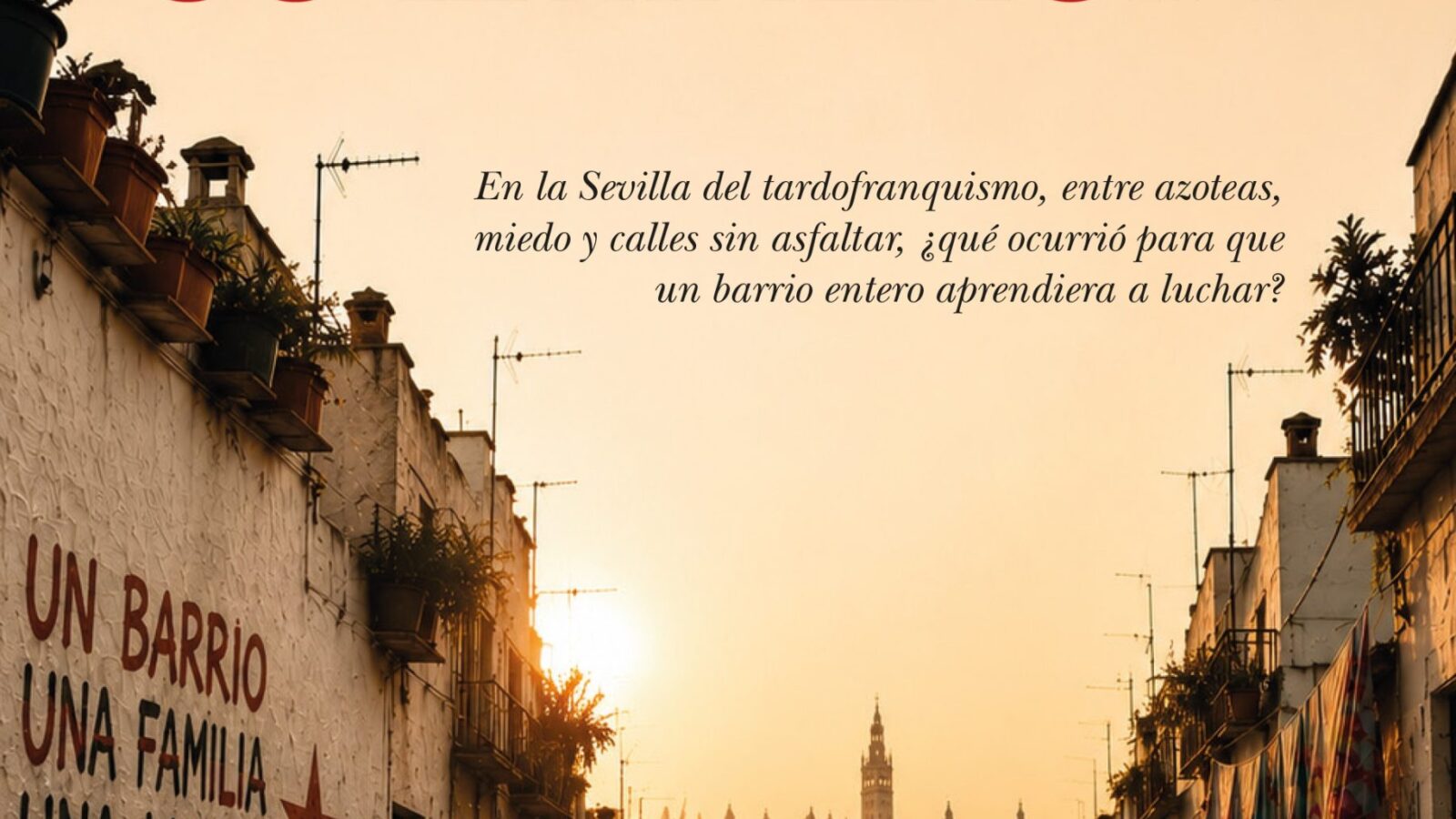
This novel rescues from memory the neighborhood struggle fought by a generation in the 1970s in a district of Seville, where poverty, mud, and a lack of future formed part of its urban landscape.
In this making-of Manuel Bohórquez Casado explains how he wrote Su Eminencia (Almuzara).
***
When I arrived at the Sevillian neighborhood of La Carretera de Su Eminencia, La Plata, I was fifteen and almost illiterate. I had left school at twelve to work as a baker in Coria del Río to help my mother, who had been widowed a little after thirty, and, since my father was a field laborer, he toiled to support us—my two siblings and me, the eldest by four years. He cleaned and washed in the homes of Arahal’s ladies and gentlemen, sometimes for scraps. I wanted to learn to put words together to write someday about it—our family and thousands of other families who left the villages to seek a future in the capital, in a city like Seville, which at the start of the seventies cried out for fresh air to breathe freedom and rights to prosper as human beings. When I told the headmaster of my school, El Cerro de San Juan in Coria, that I wanted to go and work to help my mother, the kind man said, “Go if you want, but I won’t give you the primary school certificate if you can’t endure two more years.” I left, and when I was about to open the door of his office, not turning my face, confused, he called me back and concluded: “I want you to know that you will be a wretch for your whole life.” I told my mother and she reassured me: “Son, what he means is that you will be poor for all your life, and that is by no means a misfortune.” When I arrived at Su Eminencia, with many streets still unpaved and muddy, I knew that one day I would have to write about those families who came from many of the villages in the province of Seville to survive. It was already a poor neighborhood, with unemployment and enormous social problems related to poverty. Yet the people lived in their streets, sat out in the open in summer, and burned candles in winter in neighbors’ houses. Songs were sung and guitars played in the squares and taverns, football was played on Sundays in dirt fields, and the radio carried the tunes of Los Chichos, Los Diablos, Nino Bravo, Lole y Manuel and Camarón de la Isla. I felt an immense need to learn to read and write as the only way to do something for those families. I achieved this through flamenco, an art I discovered in that neighborhood. Thanks to our most rooted music I learned who Antonio Machado, Lorca and Miguel Hernández, Don Antonio Mairena and Niño Ricardo, La Niña de los Peines and Don Ramón Montoya were. I learned what a soleá was—three or four verses, a tremolo or an escobilla. I devoured books, some found in rubble piles. And one day someone gave me The Mother, by Maxim Gorky. Antonio Ruiz El Menda, from Marchena, a man I will never forget. It was when I decided to draw closer to the communists of the neighborhood, who were the ones who truly fought so that we could rise above poverty and illiteracy. The men in the corduroy jackets would rush out of naja nothing as soon as they heard the sirens of the gray ones. People from the PTA (Partido de los Trabajadores de Andalucía) such as Isidoro Moreno, Antonio Zoido, José Luis Molano, Antonio Montilla, Paqui la del Menda and a few more taught me to love culture, freedom, and life.
Por ellos, por el ejemplo de mi familia y de los vecinos del barrio, escribo esta novela. No es una deuda: es la necesidad de que toda aquella lucha no caiga en saco roto ni quede sepultada por el desencanto actual.
—————————————
Autor: Manuel Bohórquez Casado. Título: Su Eminencia. Editorial: Almuzara. Venta: Todos tus libros.