

One of the problems that a writer of historical fiction has to deal with is that, in general, the reader already knows the ending of the matter. Yet the case of the Invincible Armada is not like what the tireless English chroniclers of the History of Spain have told us. To begin with, the term Invincible Armada was coined by sixteenth‑century English historiography, with much irony. And the not‑less frequent native doom-mongers, always ready to believe any foreigner who slanders the homeland, did not hesitate to spread these infamies. Philip II, apparently, referred to it as the “happiest armada” and Spanish historians as the “Great Armada”. And contrary to what is often thought, aside from some isolated skirmish against a ship that, having lost its sails or rudder, was cut off from the rest of the fleet and thus became easy prey, the English never managed to engage in battle.
Historically, the old Spanish tradition held that Philip II, lamenting that defeat—which in reality was not such—commented that he had sent his ships to fight men, not the elements. And the truth was that the weather did more damage to that Spanish fleet than the forces of the Treacherous Albion, as the homeland historiography began to call the land of pirates such as Francis Drake, John Hawkins or Martin Frobisher, who to Spain were mere pirates.
“I have always felt a tremendous interest in the naval history of our country,” says José Calvo Poyato. A Doctor of Modern History, he is also one of the most celebrated authors of that burst of historical fiction we have witnessed in recent years — Blood on the Turco Street (2011), The Great Captain (2015) or Masters of the World (2025) are among the titles of his extensive bibliography that attest to him. Empire in the Tempest (HarperCollins), his new release, is a work of fiction framed around the upheaval of that fleet ordered to be built by Philip II. It is a novel that, among other things, shows us that History is not always written by those who win battles. There are times, many more than we think, when the chronicles endorsed by posterity are those of those who win the narratives. Especially if, in addition, they enjoy the invaluable help of the big screen. England in Flames (William K. Howard, 1937), The Sea Hawk (Michael Curtiz, 1940) or more recently, Elizabeth: The Golden Age (Shekhar Kapur, 2007), are three good examples of the support given by British and American cinema to the English historiography on the Great Armada of Spain.
Recently presented at the Viso Palace (Viso del Marqués, Ciudad Real), which houses the Álvaro de Bazán General Archive of the Navy, where documents of the Spanish Navy concerning the eighteenth, nineteenth and twentieth centuries are kept, Empire in the Tempest—the author commented—places the reader between 1587 and 1589. “Philip II was tired of the jabs with which the English harassed the empire, which, in some cases, such as the sacking of Cadiz in the spring of 1587 by Francis Drake, were significant. So he decided to organize a great fleet, a grand Armada with the objective of invading England. Different plans were considered. One of them was the one that had Don Álvaro de Bazán and another that of the Duke of Parma, Alessandro Farnese. But the king would not have to decide for either: it would be a blend of one and the other, whereby the fleet would be organized in the port of Lisbon.
At this point, Calvo reminds us that if those were the years when the Sun never set on the dominions of the King of Spain, it was so, among other things, because the Spanish crown also incorporated Portugal. “And Portugal was not only that western strip of the Iberian Peninsula; it also included all its overseas possessions, which were many.” And it was from the neighboring country, then another part of Spain, from where the ships would depart that would essentially have to contend with the elements. “That was a great amphibious operation. The Duke of Alba commanded the land army, and Don Álvaro de Bazán would have to gather them with his ships to transport the troops. The fleet is organized in Lisbon, but the main infantry units that must intervene in that invasion of England are in Flanders. They are the tercios, highly experienced, very combative troops commanded by the Duke of Parma, Alessandro Farnese. But they had to be embarked in the English Channel. And the Spanish pilots, who possessed magnificent charts for crossing the Atlantic, did not have charts of similar detail for latitudes further north. This does not mean they did not have navigation charts. They had them, but they were not as detailed, as exhaustive as those guiding them at lower latitudes.”
Not forgetting that the depth of the English Channel could also pose problems for the great Spanish galleons, which faced many difficulties in approaching the coast to collect the troops of Farnesio. Of whom a British historian, Edward Shepherd Creasy — perhaps more even‑handed than his peers — wrote, referring to the captain general of the Army of Flanders: “It was fortunate for the island to be rid of his talents.” And the operation did not succeed. With Álvaro de Bazán dead from fever on February 9, 1588, Philip II entrusted command of the fleet to Alfonso Pérez de Guzmán, Duke of Medina Sidonia, even though the chosen man, in an act of candor, suggested to the king that Spain had other men more suitable to take on such a responsibility.
“The expedition failed because the duke could not reach the Flemish coast, where the tercios were waiting, and the southern winds pushed the Armada toward the north of England and the coasts of Ireland, where it was struck by a great number of storms and tempests, in which it truly suffered real damage —explains José Calvo Poyato—. But the English fleet, at no moment, dared to confront the Grande and Felicísima Armada. In Gravelines, on the French coast, there were some isolated engagements.” Yet the English only attacked those ships that, having lost their rudder or sails, were adrift or about to run aground. That was the fate of a couple of galleons. But the Pérfida Albión did not have the courage to attack even when circumstances forced the Spanish fleet to lose its battle formation off the coast of Calais.
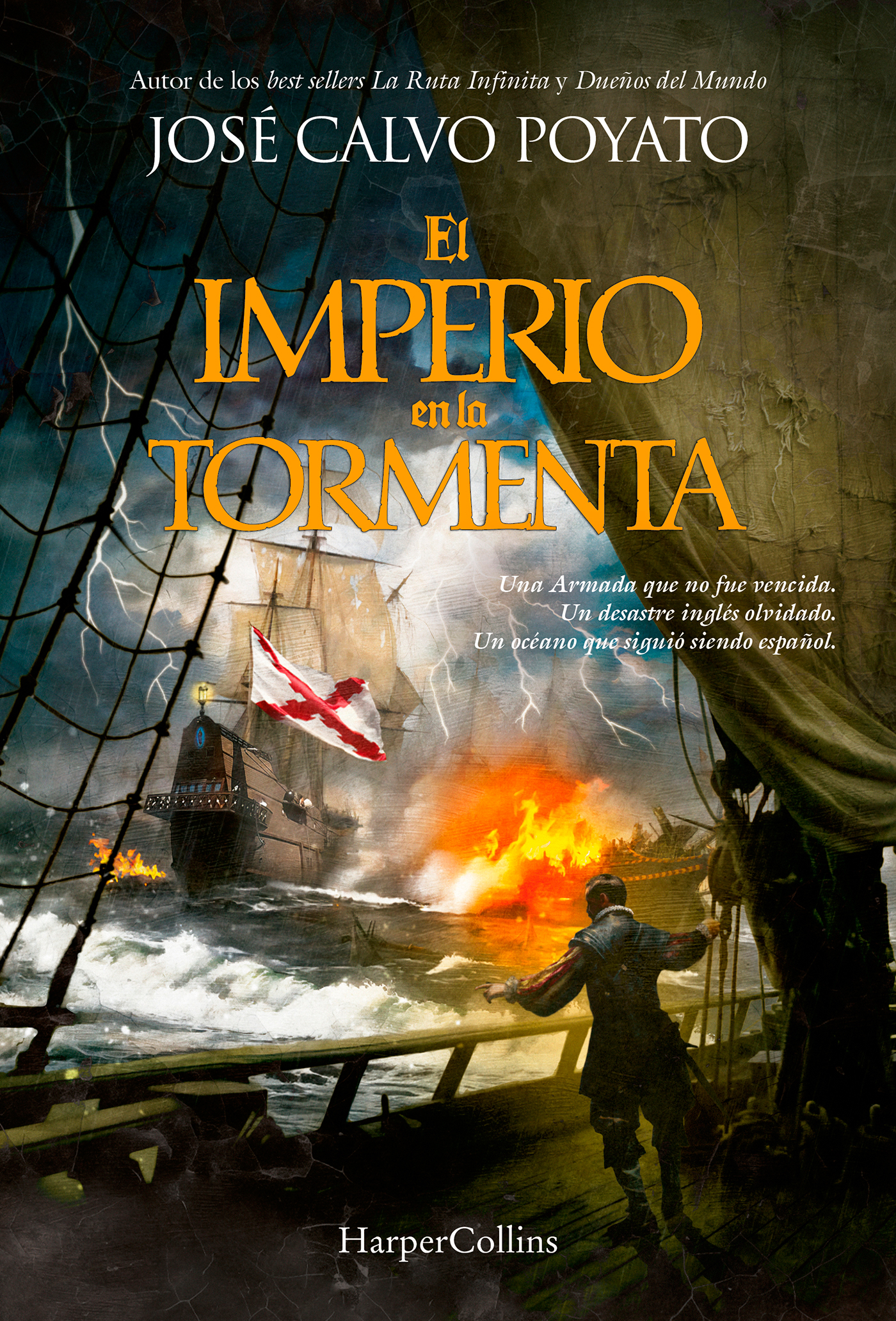
Beyond the historical component, for a novel, the chronicle of the events, that ending which is more or less known, must have a fictional component. The fable in Empire in the Tempest is led by Alfonso de Sandoval, a knight, still green, who embarks in the Armada hoping to return from the expedition full of honors with which to take to the altar Leonor de Mascarenhas, the lady who inspires him. And there is also a clergyman. “Religion has a great importance in sixteenth‑century society.”
In this regard, the historian and novelist recalls an anecdote related to one of his earlier works, The Infinite Route (HarperCollins, 2019), about the voyage around the world by Magellan and Elcano. “I remember a journalist being quite astonished that, before setting sail, everyone had gone to mass. I told him that you cannot compare the religious spirit of a sixteenth‑century society with what may exist in a twenty‑first‑century society. Therefore, one of the characters in Empire in the Tempest is that restless‑life cleric.”
Nobody could be more right, and the comparison is impossible: the religious spirit of the sixteenth century has no parallel with that of the twenty‑first. Social circumstances differ too much. Although in that cleric, in a licence taken by the author, one might imagine Lope de Vega. Calvo does not give more clues and invites us to read the novel.
He does reveal that Sandoval — despite his apparent naiveté — is in fact a young ensign carrying out a secret mission that, through one of his confessors, Father Chaves, has been entrusted to him by Philip II himself.
The cleric’s and the ensign’s experience will allow the reader to discover the true turn of the Great Armada and the disaster of the English counter‑armada, which in the spring of 1589 set out from Plymouth commanded by Francis Drake and John Norris, general in command of the landing troops. Of the 23,375 men who left Plymouth in April to reach Lisbon, only about seven thousand returned to the English port. A couple of thousand fell in combat, and the rest perished due to various diseases. The response of the English fleet, the future Royal Navy, to the Spanish Great Armada experienced an even greater disaster, although British cinema and historiography have silenced it. In A Coruña, when all the men fell, it was the women, led by María Pita, who faced the English. But there is no film about that either.
In addition to the historical component, to be a novel, the chronicle of events, that ending which is more or less known, must have a fictional component. The fable in Empire in the Tempest is led by Alfonso de Sandoval, a knight, still inexperienced, who embarks in the Armada hoping to return from the expedition full of honors with which to take to the altar Leonor de Mascarenhas, the lady who inspires him. And there is also a cleric. “Religion has great importance in sixteenth‑century society.”
On this point, the historian and novelist recalls an anecdote concerning one of his earlier works, The Infinite Route (Harper Collins, 2019), about Magellan’s and Elcano’s voyage around the world. “I remember a journalist who was very surprised that, before sailing, everyone had gone to Mass. I told him that you cannot compare the religious ethos of a sixteenth‑century society with what may exist in a twenty‑first‑century society. Therefore, one of the characters in Empire in the Tempest is that cleric of a restless life.”
Nothing could be more correct, and an impossible comparison: the religious spirit of the sixteenth century bears no parallel to that of the XXI century. Social circumstances differ too much. Although in that cleric, by authorial license, one could imagine Lope de Vega. Calvo does not give more clues and invites us to read the novel.
He does, however, foreshadow that Sandoval — despite his apparent naivety — is in reality a young ensign who is carrying out a secret mission that, through one of his confessors, Father Chaves, has been entrusted to him by Philip II himself.
The cleric’s and the ensign’s experiences will allow the reader to uncover the true turn of the Great Armada and the disaster of the English counter‑armada, which in the spring of 1589 departed from Plymouth under the command of Francis Drake and John Norris, general in charge of the landing troops. Of the 23,375 men who left Plymouth in April to reach Lisbon, only about seven thousand returned to the English port. A couple thousand fell in combat, and the rest perished due to various diseases. The response of the English fleet, the future Royal Navy, to the Spanish Great Armada experienced an even greater disaster, though British cinema and historiography have silenced it. In A Coruña, when all the men fell, it was the women, led by Maria Pita, who confronted the English. But there is no film about that either.
“The characters of a historical novel have to be plausible.” In Empire in the Tempest they will converse with Medina Sidonia or the viceroy of Lisbon, the Archduke Albert. They interact with historical figures, though they form part of the fiction the author introduces into the plot of his novel. That is to say, they cannot alter the historical process. But since they have another mission to fulfill, that is the one that seduces the reader.
No fewer than these new pages by José Calvo Poyato include chapters dedicated to honoring the memory of the Irish, who, united by that common enemy that was England, spared no effort to help the shipwrecked Spaniards who reached their shores.
Regarding the 137 ships that set sail from Lisbon toward the Channel to gather the tercios from Flanders, they returned to Spanish ports — La Coruña and Santander — between 87 and 102. Many of them were battered, to be sure. But more than battles with the enemy, it was the struggle against the inclement climatology that took its toll. His Catholic Majesty had not commanded the fleet to fight the elements, as we used to tell Spanish children of older generations. And we, proudly, believed it.