
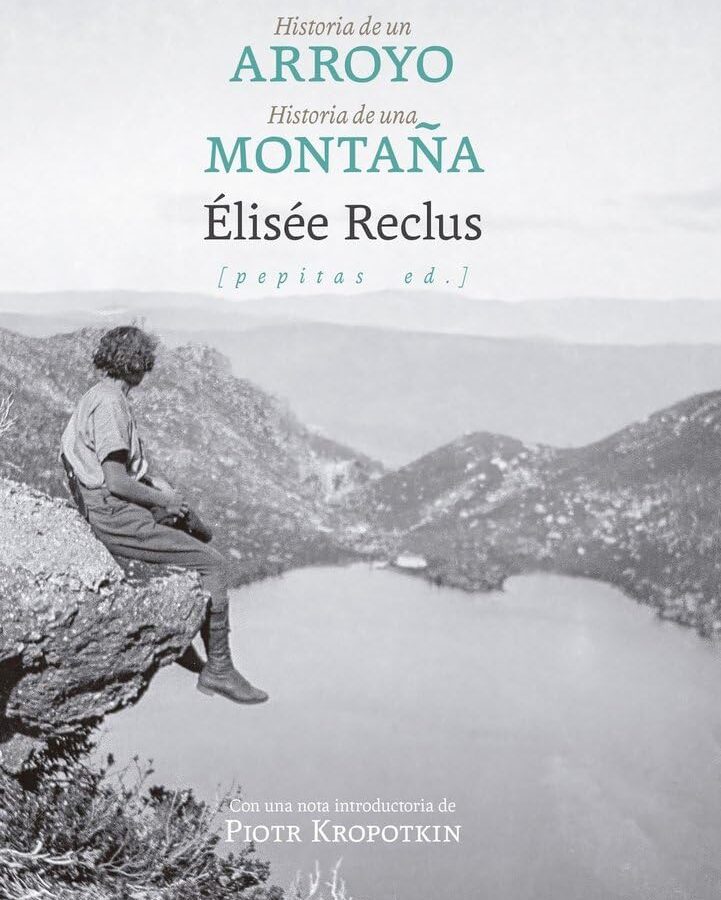
This volume brings together two of the most beautiful and notable books by Élisée Reclus, an author whose vast body of work is devoted to geographic knowledge and to the dissemination of ideas of equality among human beings.
At Zenda we reproduce the opening pages of History of a Stream and History of a Mountain, by Élisée Reclus.
***
THE ASYLUM
I was sad, dejected, worn out by life. Fate had been hard on me; it had taken away loved ones, ruined my projects, and frustrated my hopes. The people I had regarded as friends had turned against me when they saw me besieged by misfortune; humanity itself, with its conflicts of interest and its unbridled passions, seemed dreadful to me. I wanted to escape at all costs, whether to die or to recover, in solitude, the strength and spiritual serenity.
I left the noisy city without knowing exactly where my steps would lead me and headed toward the great mountains, whose profile rose along the edge of the horizon.
I wandered at random, taking shortcuts, and I would stop at distant inns at night. I trembled at the sound of a human voice or the clatter of footsteps, but when I walked alone, I listened with melancholic pleasure to the song of birds, the murmur of the river, and the thousands of whispers escaping from the immense forests.
Finally, still wandering without aim through tracks or trails, I reached the mouth of the first defile of the mountain. The broad plain, etched with furrows, ended abruptly at the foot of the rocks and the shaded slopes by chestnut trees. The high blue summits glimpsed from afar had vanished behind the nearer but lower peaks. Beside me, the river, which further downstream stretched into a broad sheet, folded over the stones and flowed at a slant and swiftly between the smooth rocks covered with dark-green moss. Above each bank, a hill, the first spur of the mountains, raised its escarpments and housed at the very top the ruins of the grand tower that, in times past, stood as the guardian of the valley. I felt enclosed between two walls, having left behind the realm of great cities, of smoke and noise, and the enemies and false friends.
For the first time in a long while I experienced a true sense of joy. My step grew lighter; my gaze became steadier. I paused to inhale with pleasure the pure air descending from the mountain.
In this region there are no longer broad roads paved with pebbles, dust, or mud; I had left behind the low plains and I was in the still-unenslaved mountains. A path, worn by the hoof prints of goats and shepherds, bends away from a wider road that runs to the bottom of the valley and climbs obliquely along the slope of the high lands. It is the route I take to ensure that at last I will be alone.
I rise with each step and the people walking along the rear path grow smaller. The villages and towns are half-hidden by their smoke and by a blue-grey mist that slowly crawls upward and tears apart before reaching the edge of the forest.
In the afternoon, after overcoming several rocky ledges, crossing numerous ravines and leaping from stone to stone over noisy streams, I reached the base of a promontory that overlooked rocks, forests, and meadows from afar. At the summit stood a cabin from which smoke rose and a few sheep grazed on the surrounding slopes. The yellowish path, like a ribbon unrolled in the velvet of the grass, wound up toward the cabin and seemed to end there. Beyond, I could only see large stony ravines, rockfalls, waterfalls, snows, and glaciers. It was the last dwelling of human beings. It would be the house that for many months would give me asylum.
A dog, and then a shepherd, welcomed me warmly.
Free at last, I let my life renew itself slowly according to the will of nature. At times I wandered amid the chaos of crumbled stones on a jagged crest, at other times I wandered aimlessly through a fir forest, and on occasions I climbed to the highest summits to sit on the one that dominated the surroundings. Many times I also ventured into a deep, dark ravine where I felt buried in the abysses of the earth. Little by little, thanks to the influence of time and nature, the lugubrious ghosts that haunted my memory loosened their grip. I no longer wandered solely to flee my memories, but also to let in the sensations provoked by the surroundings and to enjoy them without realizing it.
If I had felt a sense of joy from the very first steps I took on the mountain, it was because I had entered solitude, and the rocks, the forests, and an entire new world rose between me and the past; but one day I understood that a new passion had seized my soul. I loved the mountain for its own sake. I loved its serene and beautiful face still lit by the sun when the shadow fell; I loved its rugged shoulders loaded with ice with bluish reflections, its slopes where meadows alternate with forests and with landslides; I loved its powerful roots that extend far away like those of a gigantic tree, separated by valleys with streams, cascades, lakes, and meadows; I loved the whole mountain, even the yellow or green moss that grows on the rocks, even the stone that shines in the middle of the grass.
[…]
—————————————
Author: Élisée Reclus. Title: History of a Stream and History of a Mountain. Translator: Enrique Alda. Publisher: Pepitas. Availability: All Your Books.