
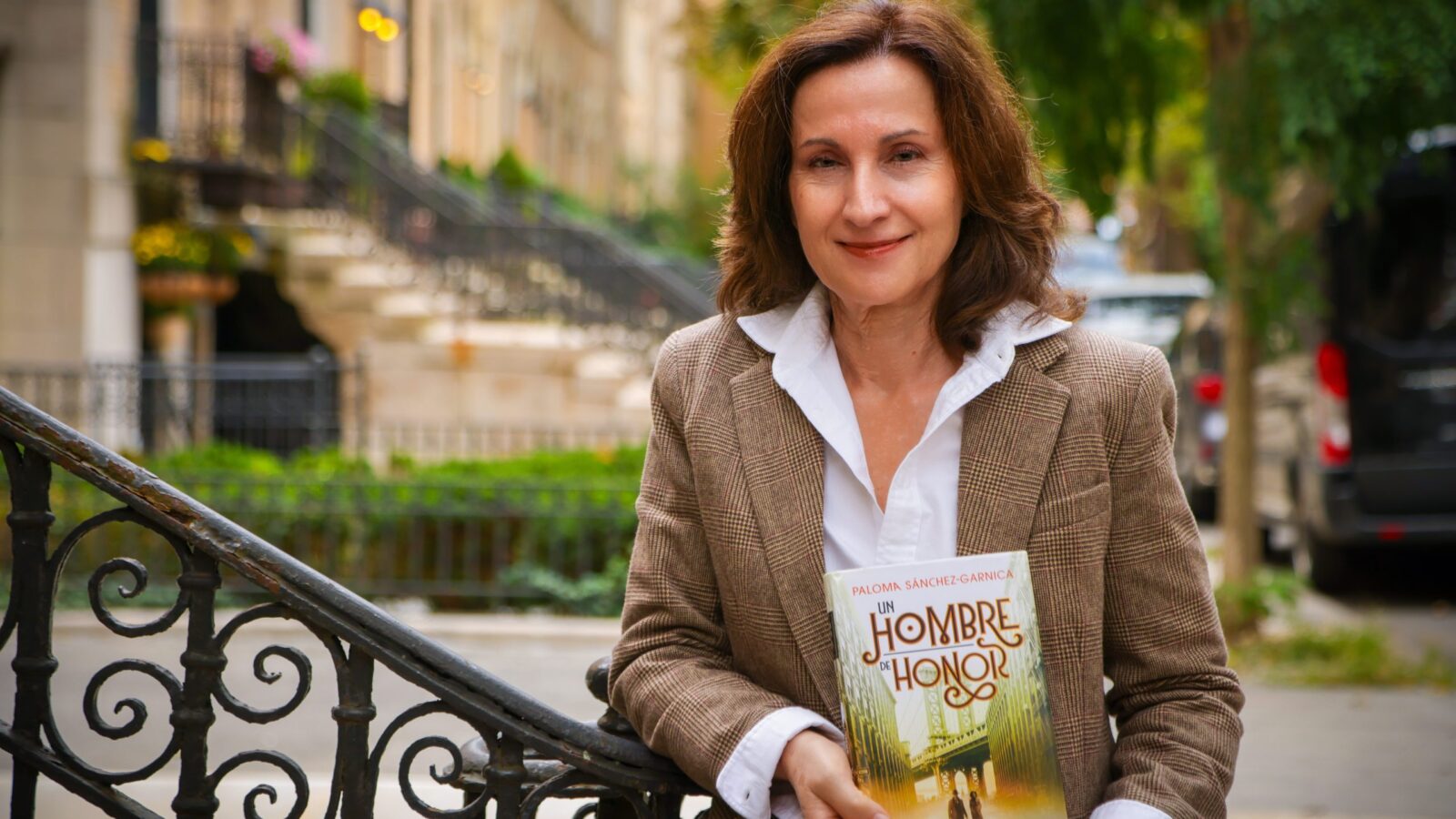
New York, 1968. While the United States is torn apart by the Vietnam War, the civil rights struggle, and a growing political tension, Nicole Donaldson dreams of breaking through as a journalist in a world dominated by men. When she falls in love with Frank Bernstein, a Jewish police officer from Harlem, she believes she has finally found the freedom to decide her own destiny. But facing the powerful Donaldson family will mean challenging everything she has been taught.
Here we reproduce a fragment from Un hombre de honor (Planeta), by Paloma Sánchez-Garnica.
*****
January 1968
Central Park, New York
She cast a quick glance at her wristwatch. She had arrived to the appointment well ahead of time, aware that punctuality was one of Russell’s quirks and she did not want to upset him. She had been walking for a few minutes along the path that encircled the lake in Central Park, observing the placid, enclosed surface. On the far shore, above the wintry canopies of the trees, the two towers of the El Dorado building rose, seemingly emerging from the apartment block. It was very early and she barely crossed paths with people strolling their dogs or with a jogger warming up, letting off in each breath small whitish vapors that vanished in the air as they passed. The ground, hardened by frost, creaked beneath the soles of her sturdy leather shoes. The damp air penetrated the wool of her coat and chilled her limbs. She shrugged her shoulders and tucked her chin into the astrakan lapels. She kept turning the idea of that meeting over in her mind after so long, but she sensed it would not be pleasant. She saw Russell from a distance. He came alone; he walked quickly, with large strides, as if he wanted to reach a goal with every step, his gloved hands and a slight stoop from the cold. A warm scarf protected his throat. She waited motionless, watching his progress. She smiled at him from afar. When he came in front of her they measured one another for a few seconds. The gray strands intermingled with his abundant black hair, brushed back, very short at the nape, the open smile and the keen gaze of his eyes, as black as coal. Russell removed his right glove and they shook hands.
—Fabrizio, how long has it been —he said—. How are you? How is the family?
—Fine, fine —Fabrizio answered warily.
—Gordo sends his regards.
—How is he? —Fabrizio asked, increasingly aware that this was not a courtesy meeting.
—As always, you know him; he’s overweight and smokes like a chimney, but he still has the same vitality as thirty years ago, and more now that he’s in charge. Now he has a lot of power, and I’ve benefited too: I control the clubs, the lotteries, the bets in New Jersey, and the docks’ shipments.
—Things must be going well for you, then.
—I don’t complain —Russell replied haughtily—. The heroin is making us rich.
—In the end you got into that dirty business. —He could not help the reproach.
—It’s the big business; you don’t imagine how much money it makes. Betting isn’t what it used to be. The unions are full of federal agents. But heroin… that’s easy, fast money, and plenty of it.
—A great fucking business that poisons whole neighborhoods. Bets, bars, whores, even loans are the kind of things adults know what they’re getting into, but drugs… —Fabrizio shook his head—. I’ll never understand those who deal in that venom. You make a lot of money at the cost of destroying everything.
—I don’t care whether it collapses or stays standing; now people want to place themselves. If we don’t do it, others will, and others will get rich, and others will be the ones who have control. It’s the law of the jungle, Fabrizio. You know it well.
—I still think it’s not the same. When a guy loses money at poker, he goes home with shame. When he gets hooked on heroin, he ends up dead in a stairwell. —He sighed with weariness. He clicked his tongue and tried to settle the matter—. In any case, I don’t intend to convince you; you’ll know what to do. The risk is big… If you’re caught, you face many years in prison.
—Everything in life carries risk —replied Russell, immune to the criticism. They kept quiet for a few seconds, wary of each other.
—You’re right, Fabrizio, we’re not here for that. There’s a very delicate matter for which we need someone of absolute trust, someone who won’t fail.
—Who exactly needs it? Russell spoke with resolve.
—The Commission agrees, but not only them, there are very powerful people interested in this action. Fabrizio nodded.
—Name it —he added cautiously, awaiting the blow.
—We’re talking about that Irish bastard… He’s stepped out of line again and is becoming a problem.
—I don’t think he’ll achieve anything significant; his adversaries are very strong.
—We can’t take the risk, Fabrizio; look at what he did to Hoffa. He chased him like a rabid dog and locked him up… Jimmy Hoffa himself! —he cried, raising his hands and his face to the sky. He exhaled with a grunt—. If that bastard reached the top, he would bring us all down for good, and could even overturn the matter of his brother. We won’t allow it. —He paused before delivering the final ruling—. We need someone to handle that scoundrel. Fabrizio tilted his head and raised his eyebrows, waiting for him to continue, but Russell kept his gaze on him in silence.
—Do you want something definitive?
—The promoter has been Gordo. He’s the one who thought of you as the right man to handle this matter. —He looked at him as if it were an honor for the recipient and awaited a reaction of gratitude. Noting Fabrizio’s cold stare, he continued—: If the brother’s matter were to be moved, it could affect him directly. You know how cautious he is about everything; he’d rather act in advance, just in case.
—I understand —mumbled abstractedly. Russell gave him a middling smile.
<p—>It’s better to deal with the problem at the root. Fabrizio considered it for longer than Russell deemed appropriate.
—Will you do it? —he pressed.
—Do I have any other option? —he snapped sarcastically.
—No —Russell stated gravely—, the truth is you don’t. Fabrizio swallowed hard and gave in, with no choice but to comply. He forced a grimace that tried to become a smile.
—I’ll need time… —he whispered measuredly.
—When or how you do it is your business. They walked a few more steps in silence. Russell stopped again, quickly looked to the sides, as if looking for something or someone. He fixed his eyes on his friend.
—Gordo Farelli has insisted that I tell you you’ll have at your disposal everything you need. —Russell’s tone became firm, resolute, dominant—. Ask for whatever you want, whatever you need will be provided for you, all right? Fabrizio nodded with a serious gesture.
—I told the boss —the other added, pleased with the handling—, if anyone can get that “bobito” to be a feast for the worms, that’s Fabrizio. —He smiled—. Be very careful, that son of a bitch has already caused a lot of damage; I wouldn’t want this to harm you too…
—Don’t worry. I’ll keep you posted. Russell shook his hand with a strong grip. He said goodbye and walked away in the same direction he had come. Fabrizio stood watching him go, thoughtful, his stomach sour from the restraint, to keep from letting the bile inside spill out. When Russell’s figure disappeared from sight, he thought about the task he had been entrusted with and that he could not avoid. He did not like it, nor did he stop to think about it; they were the rules, and he had accepted them; he did what had to be done, without thinking of anything else, without evaluating or judging whether it was right or wrong. Luca “the Fat” Farelli had told him thirty years earlier: “Someday, perhaps the day will never come, I will demand compensation for leaving you alive.” He knew the moment had come, aware that once inside the mafia it was nearly impossible to get out completely.
I
—I have to go… —she whispered, surrendering. She moved a few centimeters away and looked at his full lips, eyes still closed, absorbed in the taste of the endless kiss. She smiled and cupped his cheeks with both hands; only then did he open his eyes and return the smile.
—Frank… —Nicole murmured—, I should leave.
—I don’t want you to go.
—It’s my father’s birthday. He thinks I’m peacefully sleeping in my room. He would have a heart attack if he knew I spent the night in the arms of a man…
—she looked him up and down and caressed his shoulders as if calibrating him—, a tall, handsome, intelligent man… Frank raised his eyebrows with feigned vanity.
—Any flaws?
—There are some… —she said with a naughty expression—. But I don’t mind. She turned toward the mirror and leaned in to reapply the lipstick.
—What time does your flight leave tomorrow? —Frank asked, not taking his eyes off her as she fixed her makeup.
—At eight.
—I can take you to the airport.
—Don’t worry, I’ll take a taxi. On Thursday I’ll be back. If you want, we could go on Saturday to see Hair at the Biltmore. I’ve heard it’s very good and I’d really like it.
—The critics consider it a scandalous, obscene, anti-patriotic show that disrespects the homeland and the flag. —Frank spoke with a marked tone of irony.
—And that it has turned Broadway into an immoral propaganda circus that promotes sex and drugs, glorifies deviant behavior and corrupts youth. All of that, my father said the other day —she added playfully.
—I don’t know what your father would think if you took him to such a show.
—I’m not going to tell him. Only then, Frank approached the coat rack where his jacket hung. He slid his hand into the inner pocket, pulled out two tickets between his fingers and showed them to her. It took her a few seconds to react.
—Don’t tell me! But how did you know that I…?
—I watch you. —He wrapped his arms around her waist—. I like doing it. I can read your thoughts.
—You’re a sweetheart —she whispered gratefully. She returned the tickets, turned toward the mirror and fixed her hair. Frank noticed the Times copy on the dresser. The front-page headline read: “Fighting continues around Saigon as U.S. and South Vietnamese forces repel new wave of attacks.” And the subheading continued: “Enemy forces resume the offensive; civilian casualties confirmed amid heavy bombardments.” It was by Harold Becker.
—My name should be on it. —He pointed to the printed page—. You did all the work: the investigation, the data gathering; you were the one who obtained the statements from that Staff officer in Washington… —He waved the newspaper in indignation—. That Becker wouldn’t even bother to write the article.
—I can’t sign it; I’m not a reporter.
—It’s not fair that you can’t sign what you wrote yourself.
—I’m only Becker’s researcher —she said proudly, pointing to the newspaper—. He edited it and acknowledged that he had done a great job. Besides, the newsroom knows I wrote most of it, and that most of the research was mine; with that and knowing you know it, it’s more than enough. —She kissed him softly, as if sealing a matter that bothered her more than she wanted to admit—. Now I have to focus on getting a firm statement from Senator Kennedy about the Vietnam War. Since the Tet Offensive things have been very unsettled; President Johnson can no longer mislead the public about the progress of the war. Frank raised the newspaper in the air as if to show it.
—You’re a very good journalist, Nicole, don’t let anyone take advantage of your work.
—I’ll keep that in mind, my knight errant —she breathed, before kissing him sweetly; then, with a finger, she wiped the lipstick remnants from his lips. Smiling, Nicole grabbed her bag and took a final look in the mirror. She opened the door and prepared to leave.
—Wait… —He approached the dresser, opened a drawer and pulled out a package wrapped in gift paper—. This is so you’ll remember me on the trip.
—I won’t forget you for a second. Nicole took the package and felt it.
—Is it a book?
—And with a dedication from the author. Frank smiled without ceasing to look at her as she stroked his cheek.
—Take good care out there —Nicole said farewell. She hurried down the stairs, went out onto the street, and got into the taxi waiting parked in front of the building. She settled into the interior and spoke in a firm voice:
—To 1035 Fifth Avenue, quick. She had met Frank only a few weeks earlier, in what could be considered the worst night of her life. She was dating Brooks Sheridan, a young man who had it all to succeed in life: handsome, charming, rich, Harvard-educated, and they had just hired him at Langford Chasse & Moore LLP, one of Manhattan’s most important law firms; undoubtedly a great match for any girl seeking a comfortable life. They had been an ever-ongoing couple since childhood; their parents were friends and partners in several businesses, especially since ten years earlier, Douglas Sheridan became a congressman for New York State with the Republican Party. Over the years, the two families had kept in close contact; the Donaldsons had spent seasons at the lovely home the Sheridans kept in the Hamptons, and Nicole and Brooks had shared games and adolescence. Everyone agreed that that attractive couple was meant for each other, a pleasant reality both families accepted with pleasure and which Nicole and Brooks took as natural and indisputable. Nicole had never seen the advisability of that perpetual engagement; she liked being with Brooks: he was fun, intelligent; she believed she was in love with him, convinced that he would be the man she would spend the rest of her life with. It was true that since she had begun working at the newspaper, Brooks’s attitude toward her had grown chilly. Like his father, he did not understand nor entirely approve that Nicole worked, especially in a world where men reigned. She attributed this to the natural jealousy of a man in love and tried to endure a situation so uncomfortable and unpredictable—at times even brusque. The couple used to dine out, on weekends they played tennis at the River Club, they hung out with other friends, they had fun. Although to everyone they seemed a couple, they were not yet formally engaged, a commitment that Nicole’s father desired even more than Nicole herself. But Brooks did not seem in a hurry to take the definitive step toward marriage, more inclined to enjoy present pleasures, unable to think about the future. The problem was that his idea of enjoyment was too tied to alcohol and to drugs, in particular cocaine and LSD. Nicole did not mind these addictions, common in the circles where the couple moved. She had smoked marijuana, but did not enjoy the experience, so she avoided drugs. The night she met Frank, Nicole had arranged to dine with Brooks and some friends at Delmonico’s, in Lower Manhattan. It took longer than expected to leave the newsroom because at the last moment, Becker, her reporter, asked her to look up documentation for a story they were preparing. Brooks waited outside the entrance of the New York Times building, at 229 West Forty-third Street, resting on the hood of his gleaming gold Jaguar E-Type; his face told it all, he was furious. When he saw her leave, he pitched the cigarette onto the pavement and stood up. Nicole tried to apologize, but he grabbed her by the arm, opened the car door, and, with brusqueness, pushed her inside.