
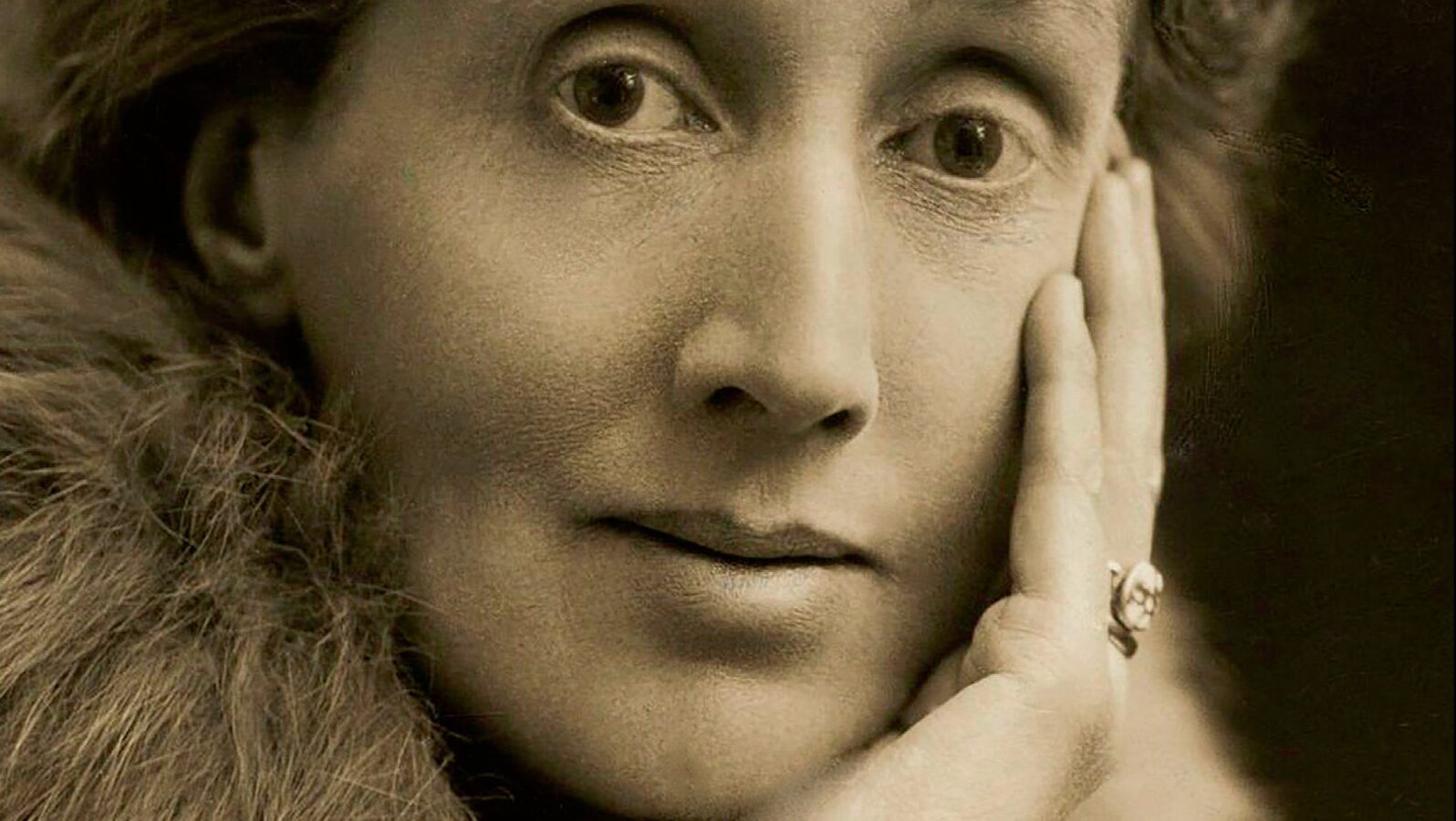
Already on the cover of the book that invites us, History of English Literature Told in an Hour, by José de María Romero Barea (El Desvelo Ediciones, 2026), there appears a Virginia Woolf who is always enigmatic, perfectly recognizable, seeming to look at us with relaxed intentions of hospitality, as if inviting the observer to enter into that “a room of one’s own” that here will be, nothing less than, a scholarly survey of English literature from its beginnings, dated in the eighth century with the first European specimen of epic poetry written in vernacular language — we refer to the anonymous Beowulf, to which, without a doubt, we should place before Geoffrey Chaucer and his The Canterbury Tales as the true father of literature in English—, up to today (Ali Smith).
The first major lesson, among those gathered in the book under review here, is offered, precisely, by the old Chaucer:
“People can die of mere imagination”
.
Because speaking/writing about English literature in one hour, or 118 pages, seems like a daunting task, a challenge that Romero Barea faces with surgical precision and an admirable capacity for synthesis, not devoid of knowledge and contagious enthusiasm in equal measure.
An hour is the standard duration of any lecture or public talk, and it turns out that each of the 45 authors selected for the occasion could easily occupy that time, and much more, by themselves (not to mention Shakespeare, Dickens or Virginia Woolf herself).
To make things clear from the outset, the book opens with the oval portrait of William Shakespeare (the engraving made by Martin Droeshout in 1623) as an indisputable prelude to the reach of the exegesis (the author himself defines his work as such) that awaits us; because, needless to say, British literature is no small matter. Therefore, the challenge undertaken by José de María Romero Barea is worthy of praise, if only for the titanic effort required by this compendium.
The author makes clear in the introduction that “analyzing what we read is something we should devote ourselves to with pleasure, an involuntary tic we should never resist,” and one agrees immediately: yes, indeed, friend Romero, especially when we read about that which awakens our admiration. In this case, English literature.
There would be a naive dilettante willing to discuss the relevance of that literature, just as there would be a naive, misinformed person to pretend that we discover it at this point. Certainly, none of that is conveyed by the pages of this History of English Literature, but rather the opposite. In them we find, with gratifying surprise, a chronological compilation of the most notable authors in the universe treated here and, above all, commented with arduous concision, synthesis, competent analysis and even comforting pedagogy, without falling into the hurried nominal expositions typical of most bio-bibliographic guides.
The most notable thing is the fine erudition the author brings to his text; for example, when addressing Shakespeare’s sonnets (we learn that he wrote 154), leaving aside the arch-known plays of the Stratford-upon-Avon genius. Or the surprising equating of Paradise Lost (the finest English epic poetry) with the Iliad and The Divine Comedy. In relation to Daniel Defoe, his status as a pioneer of modern journalism and founder of the realist novel in Great Britain is highlighted when the author of Robinson Crusoe recounts the Great Plague of London. Likewise, the timeless relevance of another essential: Charles Dickens, that “never-ending storytelling machine.” Or, in the case of Thomas De Quincey, the discovery of a real and accessible London. Of Charlotte Brontë it is said that her “lucidity lies in the revelation of a consciousness that is a war in progress.” We learn that for Joseph Conrad “there are no definitive answers.” Gilbert Keith Chesterton does not want us to be content with merely being modern. T. S. Eliot lets us glimpse “a handful of fear.” George Orwell tells us that “the best books are those that tell us what we already know.” We share with Julian Barnes his skepticism regarding “those comfortable versions of life that some people consider necessary”…
And so on for forty-five encounters.
In the book, it is immediately acknowledged as precedent that History of German Literature Told in an Hour, by the German poet and playwright Alfred Henschke, known as Klabund. Moreover, El Desvelo, the publishing house that has just released this work by Romero Barea, has in recent times been unveiling with a project, already underway, to bring forth texts similar to the one discussed here. In other words, its catalog already includes monographs of the same title relating to Spanish, Nordic or Argentine literatures. The project, without a doubt, is promising.
Finally, José de María Romero Barea remarks: “This is a map, not the entire territory, and the best maps are the ones that fit in a pocket.”
Thus we close the book/map — having completed that substantial hour of reading — with the pleasure of having traversed the sketch of English literature and with the desire to return to it without ever having left.
—————————————
Author: José de María Romero Barea. Title: History of English Literature Told in an Hour.Publisher: El desvelo. Retail: Todos tus libros.