
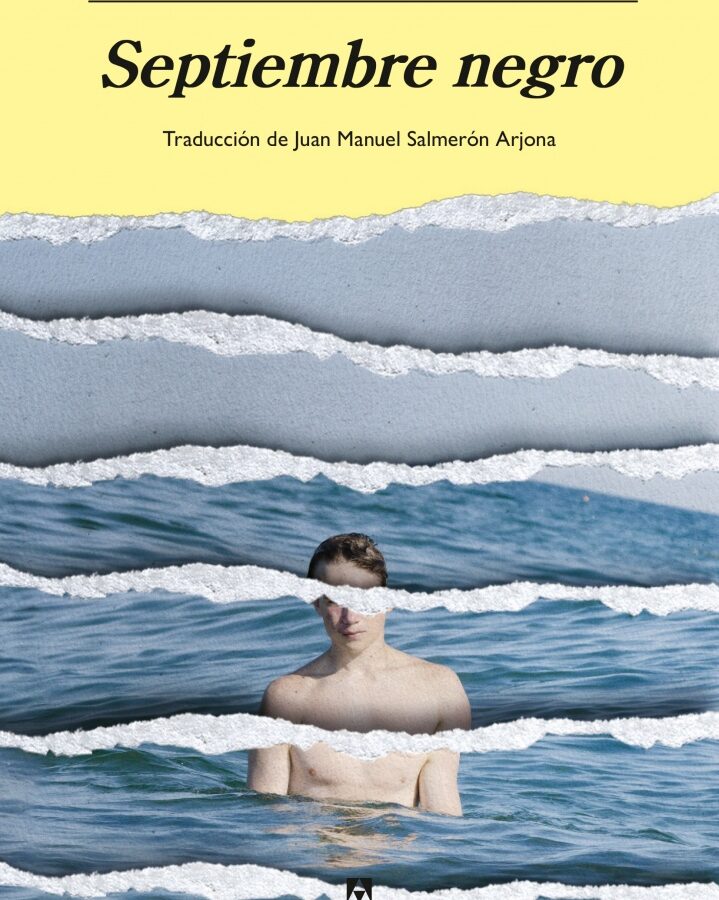
There are memories that do not behave like memories. They do not fit into the family photo album nor submit to the soothing work of time. They remain inside us like a substance that never quite settles, a foreign body whose presence we notice when we brush against it again. From that kind of memory arises Black September, the latest novel by Sandro Veronesi (Florence, 1959), a two-time winner of the Strega Prize for Caos calmo and The Hummingbird. Its protagonist, Gigio Bellandi, returns half a century later to a summer of 1972 to reconstruct not so much what happened as the way in which that event forever altered his way of looking at the world.
The summer unfolds in Fiumetto, a coastal town in Versilia where the Bellandi family seeks refuge from the sun’s glare. The sensibilities of the Irish mother and Gilda, Gigio’s younger sister, compel the family to spend much of the day indoors. For a twelve-year-old boy, that constraint paradoxically becomes a form of freedom: the hours of shade favor observation, conversation, and that state of readiness in which childhood can still linger on things.
Gigio possesses a peculiar tendency to watch before acting. But that summer introduces an alteration. The arrival of Astel Raimondi opens a crack through which enter desire, music, the fascination with another body, and above all, the discovery of words as a territory of encounter.
Astel, daughter of a wealthy industrialist and of an Ethiopian woman, belongs to a universe very different from that of the Bellandi. Intelligent, lively, and enigmatic, she unsettles Gigio. They spend long hours listening to music and translating songs by David Bowie, Roxy Music, or Led Zeppelin. The exercise has something of a playful romance and an intellectual initiation. Gigio discovers that translating a word from one language to another is not simply a matter of substituting it: you have to listen to its rhythm, understand its intention, find an equivalence that preserves something of what is inevitably lost.
Veronesi builds the summer with a meticulousness that has nothing decorative about it. Cycling, chess, sailing, music, television, and family conversations compose a self-contained world. The reader must inhabit it before the novel fractures it. Loss can only gain its true dimension when we understand the density of what is going to disappear.
History waits beyond that small universe. The kidnapping and murder of Ermanno Lavorini had already introduced a restlessness hard to dispel in Versilia. But the decisive event arrives through color television, which allows a distant tragedy to seep into the domestic space. Gigio and Astel watch the broadcasts of the Munich Olympics until, on September 5, the violence of the Palestinian commandos Black September turns the screen into a border between two worlds.
From that moment, what happens in the collective story and what happens within the family cease to be separate spheres. Veronesi is right not to treat terrorism as mere backdrop. The violence that erupts from the television alters the way Gigio perceives his own intimacy. The outside world has shown that it can enter it.
And it enters.
A paternal betrayal, a family secret, and an unexpected criminal event precipitate Astel’s disappearance. The decisive thing lies not only in what Gigio loses, but in the discovery that what he believed stable was sustained by zones of silence that he had not perceived. The boy who watched the world from the shadows discovers that looking does not equal understanding.
Fifty years later, Gigio returns to that summer knowing that memory recovers the past and transforms it. His role as a translator thus takes on symbolic value: to remember is also to translate, to move a past experience into the words of the present until finding a different relationship with what happened. This is perhaps the deepest intuition of Black September, a novel of delicate compassion for human fragility. Its greatest achievement lies in showing that memory can become knowledge when we stop demanding that it return the past to us and instead ask it to help us understand who we are after having lost it.
—————————————
Author: Sandro Veronesi. Title: Black September. Translator: Juan Manuel Salmerón Arjona. Publisher: Anagrama. Available at: Todos tus libros.