
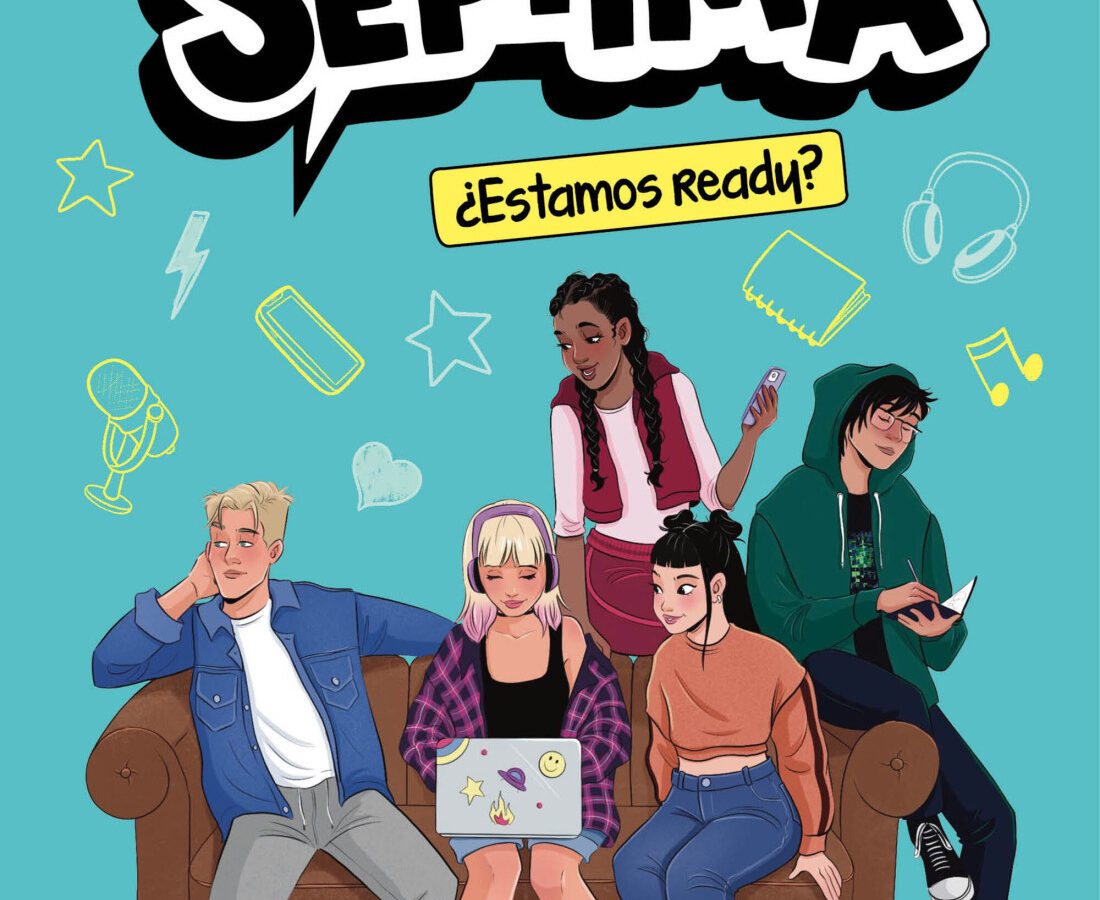
The latest novel by Nando López, Somos la séptima, which is also illustrated by Melania Badosa, revisits that vital space where adolescence begins, the moment when no one is pleased with the world because they have not yet found their place in it. Its chosen ones — Martín, Dany, Fang, Iago, and Valeria — are five first-year middle school students who find themselves at that difficult point of transitioning from being the oldest in primary school to the younger students in secondary, carrying with them, if luck is on their side, the return to invisibility of the bullies and, with a little less luck, that of the rest of the micro-society that forms in educational centers, where each person seeks their place to grow and show that they are not as insignificant as some would have them think. Everything begins with an after-school activity consisting of creating a podcast for the school in which, according to the supervising teacher, there will be no problem guiding his students. After all, he is satisfied with there being more than two of them and letting themselves be guided by a series of easy scripts that lead him to add another line to his résumé and perhaps make the teacher he admires notice him. After a first script that enjoys the expected success, the students find themselves with the opportunity to raise their voices against what they believe is wrong, starting with a teacher who is not very tolerant at all who, after hearing their podcast, triggers a stir because there are attitudes that are better defended behind closed doors than when their opinions are openly exposed.
The novel openly draws from genre classics such as The Famous Five; in fact, five are the students who sign up for the podcast, and Nando places them in a contemporary perspective in which younger readers can see themselves represented in their complaints as well as in their silences. And it is not a work that seeks revolutions or clings to the basic line of cool teachers who take students into the countryside, but the author, like life, takes secondary paths to show that anyone, if given a little attention, has a lot to share. As always, inclusion is one of the themes the work centers on, more from non-exclusion than from inclusion, achieving a naturalness that is lost in other works that insist on difference even if it is framed in a positive light.
The work is aimed at readers from nine years old, but I must acknowledge that the adult I am has enjoyed finally seeing a novel that does not attempt to place the didactic label above entertainment. Often there is talk about the difficulty of giving voice to young characters in literature, but it is even more challenging to write a novel that is not what an adult thinks a young reader wants to read, but what that target audience to whom the novel is addressed truly wants. And that, Nando López has achieved.
—————————————
Author: Nando López. Title: Somos La Séptima. ¿Estamos ready? Publisher: Molino. Sales: Todos tus libros.