
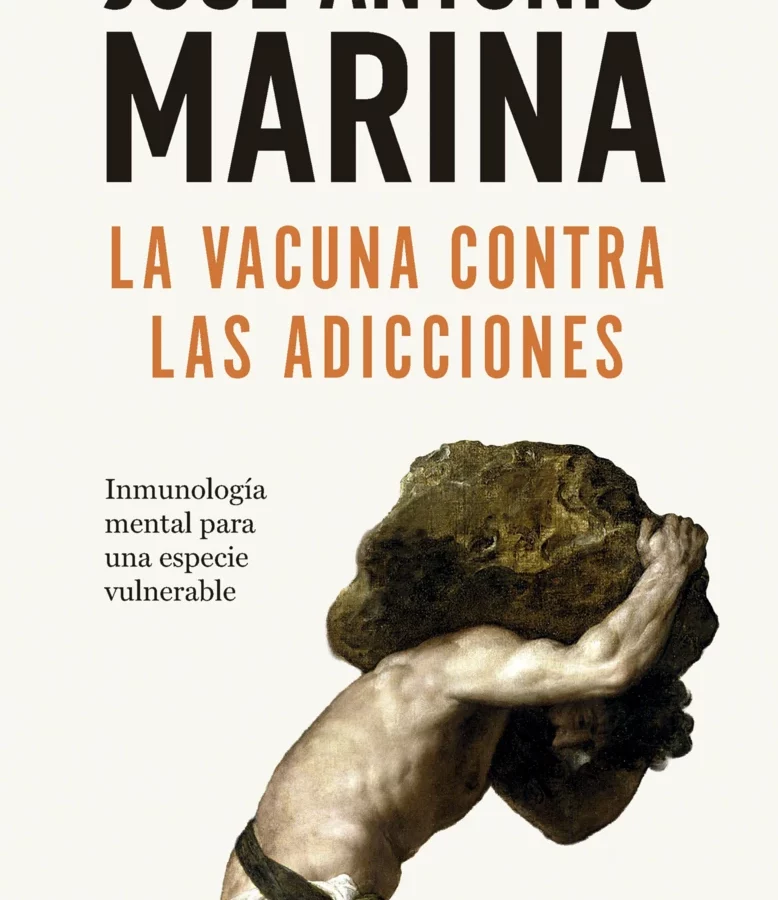
I don’t know whether it’s a coincidence — though León Bloy used to say that coincidence is the providence of fools — or if, by some magic, without anyone intending it, this time one book has come across another. After reading, with the slow pace and attention that a work of such depth and substance deserves, this volume by José Antonio Marina, I came upon Olga Tokarczuk’s latest novel, Land of the Empusas, which, if I haven’t understood it completely, seems to be something like a refined parody of The Magic Mountain, but Polish, with many elements of detective fiction and a generous dose of magical realism and European mystery.
In these pages, the protagonist’s father, who is confined in a tuberculosis sanatorium in a rugged part of southern Poland, near the border with the Czech Republic, insists that the best way to define a given person is by knowing their addictions. Only in that way will we be able to reach the depths of their soul, like an X‑ray of their own lungs.
Marina, with his habitual style —elegant, clear, luminous, and didactic, yet never letting his guard down when it comes to using the terminology required at each moment—, begins by admitting that, in this first quarter of a century, we are surrounded by a genuine plague of folly, and that, in order to survive, we have no choice but to seek the right vaccine to control so much nonsense.
In the opening pages, before turning on the entire machinery, Marina emphasizes that, in these times, we are living historical moments in which our sources of certainty — including philosophy itself — are being discredited, so that we could speak of a proper “Counter-Enlightenment”, in such a way that the so‑called “addictive behaviors,” which he will later explain in detail with a diversity of examples, “are one of the great problems faced by our culture.” It is, to put it even more succinctly, the disease of modern society.
Thus begins a work that, after reading it, feels balanced, not alarmist —the author even feels capable of occasionally pulling a harmless rabbit from the hat in the form of gentle humor— but very firm in his convictions, with which Marina, before getting to the heart of the matter, alludes to anthropological parameters when he asserts that the human being is a “bipolar species,” an animal not yet entirely fixed, in full and ongoing evolution, without us really knowing how our story will end: a “species on the run.”
A great help in understanding his words is that he is not stingy about revealing his closest sources, ranging from his own teachers (the indispensable Husserl among them), to whom he pays due homage, to the dozens of other authors who comprise the complete bibliography attached at the end of the volume, where not even the most forgotten are missing, such as the Baroque writer don Diego Saavedra Fajardo, whose mortal remains rest in Murcia Cathedral. These citations, though numerous, do not annoy or hinder reading; on the contrary, they enrich the thoughts of the author of these pages, giving them the weight and nourishment they require.
In the opening chapters, José Antonio Marina, perhaps with the intent of preparing the reader for what is to come, returns to the idea of that human being in fragile, unstable balance; a being who tries to find happiness, for which a certain impulse is needed that, in turn, destabilizes us: the fish that bites its own tail. Very soon, the work presents the first definition of what is understood by addiction: the tendency to take drugs or to perform acts — gambling included, a matter to which we do not give the attention it deserves — in a compulsive way, “even when the harmful effects are known.” And, furthermore, he warns the reader not to confuse “addiction” with what we call a “passionate hobby,” since in the former the loss of control converges, to the point of producing withdrawal symptoms if it is interrupted.
Perhaps later, if time and strength permit, Marina could dedicate to us a work on internet addiction. For now, he leaves a few, and very precise, brushstrokes with which he warns us about the excessive use of these new technologies, as well as the loss of time they cause, including the reduction of sleeping hours, constant nervousness, anxiety, and the fear of missing something important. And he concludes, a warning to navigators: “When these effects deepen and the connection becomes obsessive, we are dealing with internet addiction.”
Nor does he shy away from another matter that preoccupies us all and sparks confrontation and heated debate among citizens: the so‑called fake news that drifts us away from the truth. In that respect Marina also leaves something to be desired, leaving the reader with a lingering sense of incompleteness. The key might lie, a few lines later, in his discussion of those who are invested in politics today, where we find the most polarized, ideologized, and fanatical figures, “while the rest of the citizenry disengages, leaving them the field clear.”
Equally dangerous would be those other viruses that are part of our daily lives, such as the devaluation of truth, the leveling of all cultures, the glorification of personal opinion, and the impossibility of reaching agreement on ideological topics. Something that, if we look around us, is certainly familiar and everyday.
The immediate question, which every reader might carry in mind when facing a book like this, is why not all of us are addicts: despite the environment in which one lives, despite peer pressure, there are people who manage to reject those siren songs. What resources do they have to avoid being swept along? What protects them?
Also of interest is the entire process that leads toward addiction, sometimes a bit mysterious and particular: does the aspiring addict lose will and freedom, or were those qualities never present in them, or are they faculties that suffer eclipses?
The immense richness of Marina’s ideas, presented as a challenge from which he emerges fairly unscathed, leads us to evaluate other aspects so close to all of us, his readers, such as suicide, happiness, inner speech, Artificial Intelligence, memory, and freedom. About the much‑discussed AI, which is driving us all a little mad, the author sends a message of reassurance to everyone: AI can direct the action of a robot, “but to direct a human being you would have to robotize him first.”
No less curious is all that concerns inner speech, undoubtedly one of the most mysterious phenomena of our mind. And even more so if we consider that, since the studies of renowned neurologists like John Hughlings Jackson, we know with precision that we speak not only to tell others what we think, but also to tell ourselves that very thought.
José Antonio Marina, who defines himself, not without a certain irony, as a “well‑informed optimist,” thus makes it clear that living is not reason enough to live. And he stops on another troubling matter: those children who feel no interest in anything, who live in a flat, unexciting world. A passivity that, he warns, could push us back toward archaic forms of life.
Here, woven throughout the work, is a more intimate Marina; a flesh‑and‑bone person, close and engaged with our time, capable of correcting the agendas of sacred cows of recent years, such as Jean‑Paul Sartre, whom he has no hesitation about calling, with elegance, an exaggeration.
The work ends with the required return to the origins, to philosophy. The ultimate resolution of the most pressing problems begins, according to Marina, with the small, the vulgar and the everyday, which reaches the highest manifestations of our spirit. Since the mission of philosophy is to lead us to action, “for it is she who is responsible for making solutions real.”
—————————————
Author: José Antonio Marina. Title: The Vaccine Against Addictions. Publisher: Ariel. Sales: All Your Books.