
For those of us born at the dawn of this century, the world presents itself as an endless succession of crises with no clear end in sight. Each one chained to the next every few years, and with their devastating effects piling up on our consciences, any horizon of expectation becomes blurred, an intolerable distance for the most fundamental aspirations of any human being. Deprived of hope in a future capable of providing the warmth of a life grounded in the wellbeing and security of a prospective future conducive to realizing a life project, we see the world turning into a hostile environment in which any utopia seems to consist of hollow and abstract phrasing. In the face of the undeniable and atrocious force with which the present reality rains images of discouragement upon us, it might seem that concepts such as democracy, human rights, equality or freedom, for which generations past sacrificed so much, have failed to meet our expectations regarding the direction a world built on them would take.
George Steiner, one of the great intellectuals of the 20th century, asserted that the subjunctive, liberating us from the “despotism of fact,” constitutes one of the main tools of humanization, for through it we are able to imagine scenarios about events that could occur if we oriented our energies in a particular direction. The great Spanish philosopher Carlos París described the human as a being who, living inside a fable about what is to come, hurles himself toward the future and shapes a project. We are, therefore, the “projective being,” a rational animal who spends part of his life in the realm, perhaps metaphysical, of a potential possibility. As Aristotle asserted in De Anima, imagination, understood in its deliberative sense, is the principal scaffolding on which any possible future is erected. Building on this definition, a world in which hope for different configurations of the collective reality has collapsed into disillusion and immobilizing apathy promoted by a present that is discouraging is a world in which imagination has fallen into a deep state of crisis. This slow and progressive lethargy of the imagination, the decline of the ever-essential and encouraging “it could be otherwise,” is one of the darkest processes into which human consciousness can sink. If we lack an idea of what our future should be and the critical capacity to justify it, the prospect of falling under the tutelage of certain wills that may awaken our imagination, but always with the ulterior aim of guiding it toward ends for which we have not been responsible, will progressively become reality.
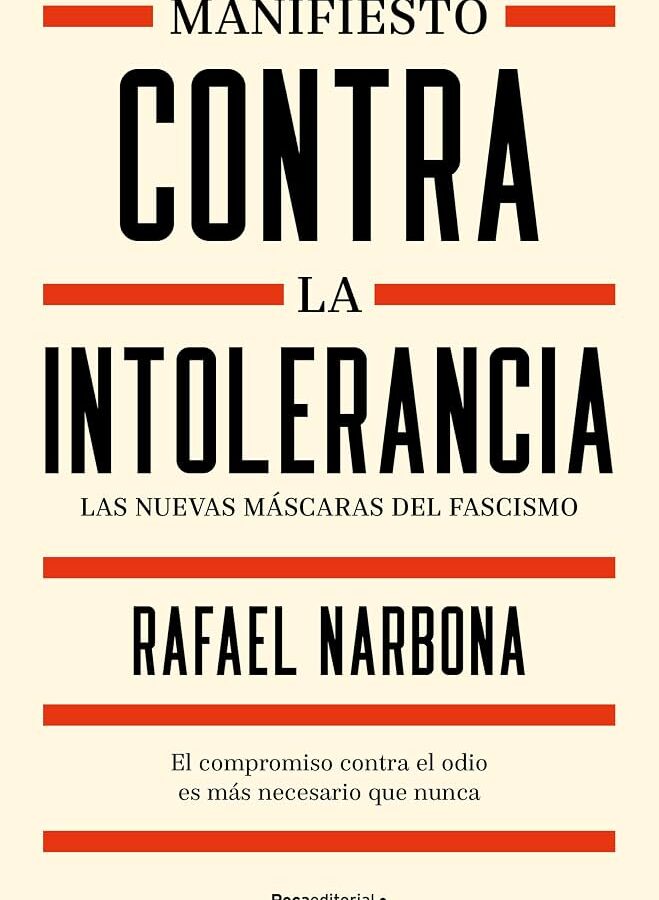
If philosophy, as its original Ionic impulse shows, consists in an effort of the sensibility of reason to understand and untangle everything that happens in the world in which it is rooted, this is undeniably a text marked by a philosophical spirit, for it emerges from a sense of bewilderment and unease at the present state of affairs. Although in some parts of the work Rafael Narbona reveals his remarkable storytelling facet, venturing into essential historical expositions and narratives to illuminate most of his theses, this is not a historical essay, or at least we cannot understand its historical dimension from a purely descriptive vantage point. In Manifesto Against Intolerance there is a clear aim to weave all ideas around a single conception of how society and the human being who develops an existence within it should be, and to that extent we are confronted with a text of pronounced argumentative and propositional character in which the connections between a certain anthropological ideal and the manifestations that can be observed in arts such as literature or cinema are established. Notably, Narbona draws a contrast between the profile of Erich Maria Remarque, author of All Quiet on the Western Front, a work that exposes the deepest miseries of militarism, and Ernst Jünger, author of Storms of Steel, where war, conceived as an exercise in spiritual purification, is elevated to nearly sacred dimensions in a form of violence mysticism. Narbona, following the lead of the best European humanist tradition embodied by Beccaria, Grotius, Diderot, or Zweig, does not hesitate to oppose the enormous suffering entailed by armed conflict, defending, as the papal encyclicals Fratelli tutti and Magnifica humanitas of Pope Francis and Leo X respectively argue, that the use of the concept of a just war as elaborated by Aurelius Augustine and Thomas Aquinas is dangerous, for given the extraordinary development of the armaments industry it could serve to legitimize military interventions that cause utterly disproportionate suffering. Narbona aligns with the position of the great legal philosopher Luigi Ferrajoli, who contends that today one cannot speak of a just war, since the international legal architecture developed after World War II de facto bans and condemns militarism in any of its manifestations. In fact, one of the principal warnings this essay issues concerns the dehumanizing effects of war-mania, responsible, in many cases, for a collapse of the moral values that govern the development of societies when they urge violence against other peoples. Thus Narbona warns that “democracy is collapsing before our eyes. Auschwitz marked a turning point in world history. Hiroshima and Nagasaki intensified the moral and political crisis represented by the Shoah. Gaza marks a new milestone in the history of infamy.”
It is hard not to notice the book’s orderly internal structure. At a first glance, the index of the essay reveals that Narbona’s proposal is organized around ten main chapters that function as an antidote to what he regards as a resurgent, though now dressed in new garb, form of fascism. By adopting this approach, the essay clearly situates itself within the long-standing debate about the nature of fascism, and against a historicist view that confines it to a specific time and the sociological and economic conditions that prevailed then, Narbona—quoting the Jewish writer and chemist Primo Levi, author of the Auschwitz Trilogy—states that “Every era has its fascism.” In this sense, Manifesto Against Intolerance aligns with the aim of the great Italian writer Umberto Eco, who in 1995 published a short essay titled Il fascismo eterno o Ur-Fascismo, in which he tried to synthesize the general characteristics of fascism into fourteen key points to facilitate its identification at any moment in history. In the prologue of the essay, titled Why a Manifesto?, Narbona asserts that “fascism is not a political phenomenon confined to Europe’s 20th century. As Emmanuel Lévinas explained, its origin should not be sought in history, but in the darkest impulses of the human being. It is born of fear, insecurity, frustration and impotence.” It is here, in this desolate expanse of apathy and neglect, where imagination and hope run the risk of being kidnapped and instrumentalized by fascism in order to carry out and implement its own political itinerary. Narbona himself argues: “fascisms exploited that climate of despair to present themselves as providential saviors of a society that had lost faith in democracy, which they accused of having caused the economic crisis or, at best, of not knowing how to resolve it.”
The principal ideological memes of the new fascism that Narbona exposes and dismantles across the essay’s chapters are as follows: supremacist nationalism, xenophobia, racism, Islamophobia, patriarchy, gender essentialism, uncritical submission to authority, religious fundamentalism, anti-intellectualism, bellicosity, and anti-ecologism. In response to this map of misery, Narbona presents himself as a defender of a critical and dynamic conception of democracy, emphasizing that democracy, far from reducing itself to a mere formal system of periodic voting, must be capable of generating an environment in which citizens are conscious of the world’s problems and how to address them. Manifesto Against Intolerance calls for a re-signification of democracy so that it does not suffer the stagnation promoted by leaders who are authoritarian, populist and dogmatic, such as Trump, Milei, Putin, Netanyahu or Bukele, who are disposed to the total destruction of the ideals of freedom and equality and the systematic violation of human rights. If social life consists of a continuous and prolonged collective effort toward the conquest of civil, political, social and economic rights, democracy, as it is conceived here, is the social order necessary to harmonize these struggles within an appropriate political and normative framework. The defense of the legacies of figures such as Olof Palme, Nelson Mandela or Martin Luther King places Rafael Narbona in the tradition of enlightened, humanitarian democratic socialism, with an emphasis on achieving peace through the realization of universal human rights and on rejecting any form of domination over the rest of society’s components. For this reason as well, Narbona emphasizes in the epilogue, titled “For a World Without Weapons or Walls,” that “democracy is a human ideal, one that presupposes our miseries and imperfections” and that, precisely for that reason, “it allows us to coexist without wishing the death of our adversary.”
In the opening, we noted that societies today are traversing a deep crisis of political imagination due to the abandonment in which they find themselves and the apparent failure of their guiding principles. Narbona, however, remains optimistic and trusts that a deepening of democracy, freed from the chains of hatred and a supremacism capable of poisoning and degrading our consciences, can restore confidence in the possibility of building a differently and radically better world: “If today [democracy] is in decline, it is not because it lacks the power to guarantee peace and prosperity, but because of a defective functioning of its principles. If we manage to restore pluralism, which is its matrix and its main identity, the big fish will not eat the small one, and redistributive mechanisms will guarantee the basic rights of citizenship. It is not a romantic feat, like revolutions (which are prone to excesses and acts of brutality), but a solidary, ambitious, and creative work that makes the difference between civilization and barbarism.” Let us therefore work in that direction. Let us strive to reach that horizon. Let us join together in the struggle against the empire of intolerance.
—————————————
Author: Rafael Narbona. Title: Manifesto Against Intolerance. Publisher: Roca Editorial. Sales: Todostuslibros.