
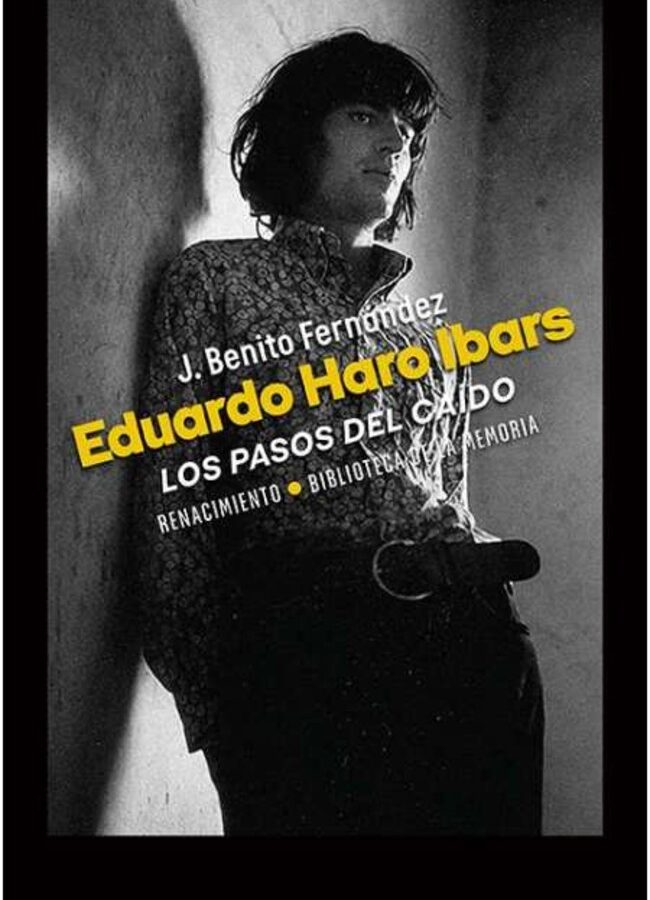
Know how J. Benito Fernández operates. On a phone call he tells me about the gigantic amount of documents still to be read and cataloged in his magnum opus, none other than Rafael Sánchez Ferlosio. I don’t know what motivates Fernández to seek out certain authors, how to put it, writers who inhabit the margins, or the outskirts of the canonical; authors, I mean, outside commercial circuits, who, nevertheless, constitute a huge lesson in Spanish literature, one that does not appear in any textbook. There are his works on Juan Benet, on Ángel Guinda, or the legendary biography of Leopoldo María Panero, El contorno del abismo, which many consider essential because of the amount of material he gathers, and because it sheds light on a poet eclipsed by his own legend. The same thing happens in this superb volume: Los pasos del caído, about another essential figure of Spanish malditismo, Eduardo Haro Ibars, whom, in my case, I came to know when I read the Panero biography mentioned above and obtained the también legendary Obra reunida in Huerga y Fierro that compiles the total works of the Madrid-born poet.
Autores desclasificados, fuera de cualquier atisbo de catalogación lógica, autores para los que habitualmente se les coloca el marbete de “raros”, “ácratas”; hijos de los últimos redobles de la dictadura, como afirma Francisco Nieva en el prólogo a la obra completa de Haro:
“Haro Ibars ha sido el paradigma de una generación española que se encontró todo por descubrir en la intemperie y en el riesgo”
, lo califica además Nieva: “Su precocidad intelectual no engañaba, era de todo punto un creador arriesgado y un adelantado en muchas cosas”. Así fue, un adelantado en un país que despertaba a la modernidad.
J. Benito spends more hours in the National Library than at his own home when he is preparing material for his monumental biographies, and so it results. It is said, as Fernández himself recounts in the introduction, that Umbral thought this book was a novel with a pseudonym of the same Haro Tecglen about his son. He gathers with friends of the autobiographed, calls by phone everyone who knew the author or had significant contact with him, and sets down in writing, reconstructing the life in a methodical way. I don’t think I could recall my life with such lavish detail as Fernández does in his biographies.
He travels, if necessary, to the places he recounts with such detail, which led Fernández to meet Paul Bowles in Tangier, a city Haro loved, and perhaps the only city in which he was happy. That Tangier where his idol William Burroughs lived, visited by beatniks Orlovski, Ginsberg and Kerouac, and where Jagger, Richards and Scott roamed and caroused in a city that came to feel more like New York than New York itself.
In this Renaissance reissue, the work is expanded compared to the first edition; errata have been corrected, comments completed, or new testimonies about the poet have been added.
Parading through these pages is the cream of a cultural panorama that sought to be something else, resembling the foreign, the underground, Eduardo Haro and his inseparable and most constant friend, the translator and writer: Mariano Antolín Rato, whom I also met very late, and his wife María Calonje. But the roster of artists appearing in these pages is enormous and varied: Javier Gurruchaga, Luis Antonio de Villena, Haro’s inseparable friend, both nocturnal seekers of ephemeral youth pleasures, Jaime Urrutia of Gelatina Dura, before becoming the singer of Gabinete Caligari, Ignacio Gómez de Liaño, Rafael Cansinos, son of Cansinos Assens, or a very young Mexican named Olvido Gara Java. Moncho Alpuente, Antonio Ferres, Alfonso Grosso, the cartoonist Carlos Sánchez Pérez, Ceesepé, and photographer Alberto García-Alix, among others. Even Luis Alberto de Cuenca appears in one of the dens where those enormous nights were spent, where Haro always fell prey to excess. A natural provocateur, he did not care who he faced:
“The cafe, located opposite the Fuerza Nueva headquarters, is the meeting place for the ultras’ cubs; given the look of Haro and Rafael Cansinos, they’re soon surrounded by stares and insults such as ‘Faggots!’ and ‘drug addicts!’ A sizeable group of fascists surrounds them […] and they punch and kick them.”
The situation hasn’t changed much.
I read these pages with a sense of loss, knowing in advance how everything will end. Haro, obsessed with evil, read and learned from the texts of Aleister Crowley, Jean Genet and the Kabbalah, malditismo and predestination. He could also have become the icon of the homosexual cause, now that gay references are sought in established writers like Lorca, which I find laudable, but Haro’s case is too complex to manage, given how controversial, so vital and demonic a figure he is. He supported various advocacy groups and helped form others where the figure of the homosexual could be liberated from the evil attributed to it during the dictatorship, a figure that stretched too long into the transition. Projects, like so many others, that died in Haro’s incessant life without going anywhere, knowing in advance that he would never have money and would always live in precariousness.
The Haro generation paid dearly for the arrival of freedom; they suffered maladjustment in a timid democracy, firsthand witnessed the onset of heroin use in Spain, then cocaine, or ecstasy. Haro knew in advance that his departure was doomed. Users of pharmacy drugs like Romilar, which they mixed with other substances, and in Eduardo’s case, with abusive alcohol consumption that inexorably led him to altercations, fights and the use of violence with his lovers and even with his closest companions.
However, one of J. Benito Fernández’s many virtues is making us feel the underground pulse of those years, a movement so denigrated today, but which in certain places, such as Madrid, was a renewing impulse against the moth-eaten official culture, dulled by the long years of Franco’s regime. It’s true that many of these authors paid dearly for interpreting freedom in their own way, but they did so without playing the victims, head-on, and they died the same. The book also mentions groups, now almost unknown except to those who still survive this history of contrasts, such as Los Drugos, Los Pegamoides, Glutamato Ye-yé, Sindicato Malone where Eugenio, Eduardo’s brother, played, or Gabinete Caligari under the very cast-iron leadership of Jaime Urrutia, and the unstoppable Orquesta Mondragón, whose main lyricist, at least on their most successful records, was Eduardo himself.
“Lábiles amores yonquis, rockers de arrabal adornados de camisas de lunares y tacones cubanos, tupés moldeados por la brillantina, belfos que humean trompetas mudas, el orgullo del acero afilado, furcias de farolillos de baja intensidad y jeringuillas de trágica verbena; en definitiva, historias de la mala vida contadas por Ceesepé”.
Particularly interesting is the love-hate relationship shared by two of the most intriguing poets of the seventies and eighties, Leopoldo María Panero and Haro Ibars. Leopoldo was in love with Eduardo, but Eduardo did not return it. They met in Zamora’s prison, where Panero’s mother, Felicidad Blanc, also visited him, who also critiques Eduardo Haro’s mother in Chavarri’s film, El desencanto, that film which devastates a decadent generation and radiographs the Panero family with all its glories and miseries. Blanc says of Eduardo Haro’s mother that whenever she faced a problem with her son, she sent him to his grandmother’s house, and in part, she was right. This ultimately appeared in the film, despite the criticisms aimed at Jaime Chávarri, who did not remove that part of the interview.
This book encloses many characters, many cities hidden within a single city, many people within one, but none is saved; they were destined by the needle to follow the difficult path of desire and excess.
The work also follows not only the litany of falls and relapses of a very vagrant Eduardo to vices, but also his artistic evolution, from wanting to be a poet, to achieving it and producing a body of work coherent with his way of feeling, bare and brutal at once, as could be seen in White Losses, which already foreshadows the contents of his oeuvre, between the margin and the need to express in a single language, without euphemisms, what he felt. He also possessed a style that was not forgiving of the era’s aesthetics, which sought to awaken a different way of saying things in poetry. Something that only happened to his nemesis, Leopoldo María Panero, both founders of a new aesthetic, who, despite their differences, opened up another lyrical vein in Spain. Later would come Sex Fiction and Empalador, a mix of Haro’s obsessions: vampires, blood, sex, semen.
“In Eduardo, oddly enough, two bodies coexist —Jekyll and Hyde— the one of rupture and the one of tenderness, destruction and construction. Alcohol transforms him. This is what happened when, with no money to his name, he approached San Bernardo 107, his father’s house. Concha Barral opened the door to him and when Haro Tecglen saw him, […] with a grave gesture he told him that there was no place there.”
There are also details of his collaborations with radio, with reports, the translations of songs, the concerts in which artists such as Nico participated, and collaborations with various magazines, with other books and assignments, and there is talk of his narrative, as in Las manipulaciones.
Fernández provides testimonies, interviews with friends, photographs of the Haros, concert performances, award ceremonies, as well as messages, dedications, even alluding to television programs where a Haro appears in full bloom and inexhaustible, despite the fact that his light was already fading before contracting AIDS.
A naked, piercing book, the story of loss, of the desolation of a poet who came to change the game. In short, another essential work in the Spanish historiography that many people do not know, and that many others do not want to remember.
Excellent work from an tireless enthusiast of Spanish literature.
—————————————
Author: J. Benito Fernández. Title: Eduardo Haro Ibars. Los pasos del caído. Publisher: Renacimiento. Availability: Todos tus libros.