
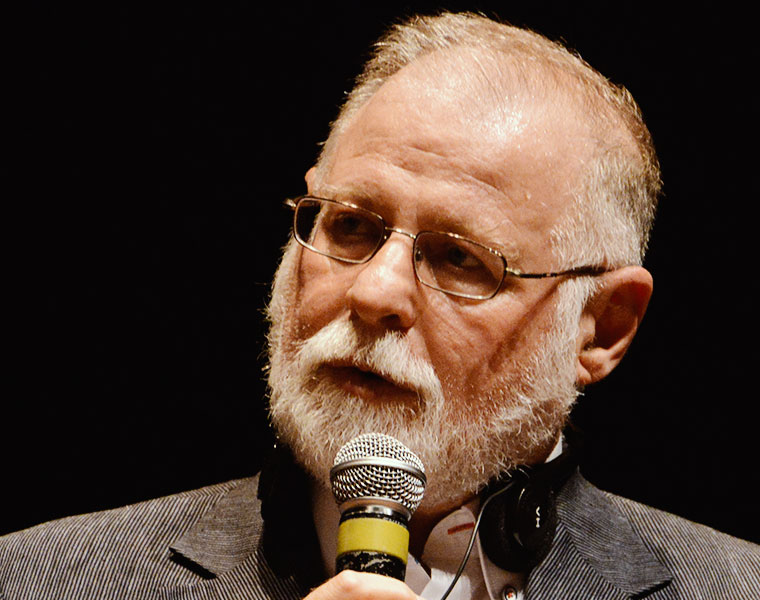
At the Monterrey International Book Fair —the 2026 edition of which closed yesterday and drew prominent authors such as Cristina Rivera Garza, David Toscana and Elmer Mendoza; the French writers Jean-Marie Le Clézio and Emmanuel Carrère (who presented Kolijós), or Socorro Venegas (who presented her book Leche de silencio), Elaine Vilar (with the book La piel hembra) or Héctor Abad Faciolince (who commented on Ahora y en la hora), a testimonial novel recounting his experience after surviving the impact of a Russian missile during a trip to Ukraine)— Argentine writer and essayist Alberto Manguel offered some interesting reflections on reading and our relationship with the so-called new technologies in the wake of presenting his book Five Views on Borges, and argued that although many rigorous statistics show that the number of readers has not globally declined, there is a serious problem with the comprehension of a literary text, which, in his view, eludes the majority of those readers. “How can we be good citizens in a society in which we fail to understand what we are saying to ourselves?” asked the author of works such as Stevenson Under the Palms or The Return of Ulysses. As director of Espaço Atlântida, an international center dedicated to the study of reading based in Lisbon, he explained that reading means participating in the society of the written word, of the alphabet and grammar; it means deciphering the laws and instructions that a society proposes for its conduct; and, most difficult of all, it helps us learn to construct within the gaps that a literary work presents our identity and our interpretation of the world. But that, he says, “is being lost completely, because it is not in the education systems nor in the political sphere.” Economists, he warns, want to erase it and do not consider it necessary for us to have that moment of reflection that reading and its comprehension enables, because for them it is a waste of time to do something that changes the pace of life and makes it slower when we face the difficulty of certain decisions. They do not want us to think, then. Manguel adds that the lack of reading comprehension is not the fault of young people or social media, but of the absence of good public policies. “Social networks can be very useful. They have sparked revolutions. Let us not blame the instrument.” What angers the author is what he regards as a delegation of responsibility in a society that, as a whole, he notes, “is gravely in crisis due to the infinite greed of leaders and financiers.” Manguel emphasizes the point and notes that while every technology changes our habits, we should not overvalue it. “Artificial intelligence, which is neither intelligence nor artificial, does not generate content; it is a statistical machine. When the first computer was created, back in the eighteenth century, it was clearly stated that the machine was not conscious, that it did not generate emotions. What it does is compute. The problem is that human beings have not thought about how to control the growth of that accumulation of statistical information. There comes a moment when the human mind cannot keep up with those calculations. And that is the danger.” In that context, Alberto Manguel argues that literature had already told us all this—from the legend of the Golem to the Frankenstein monster—and that if we want to create something we must know what we are creating, set limits for that creation, and take responsibility for it. The problem, he concludes, is that “we are not doing that, because the large financial companies and the billionaires who manage these technologies, all they want is to make money. So they do not care if these machines will destroy us all.” Will we know how to manage it?