
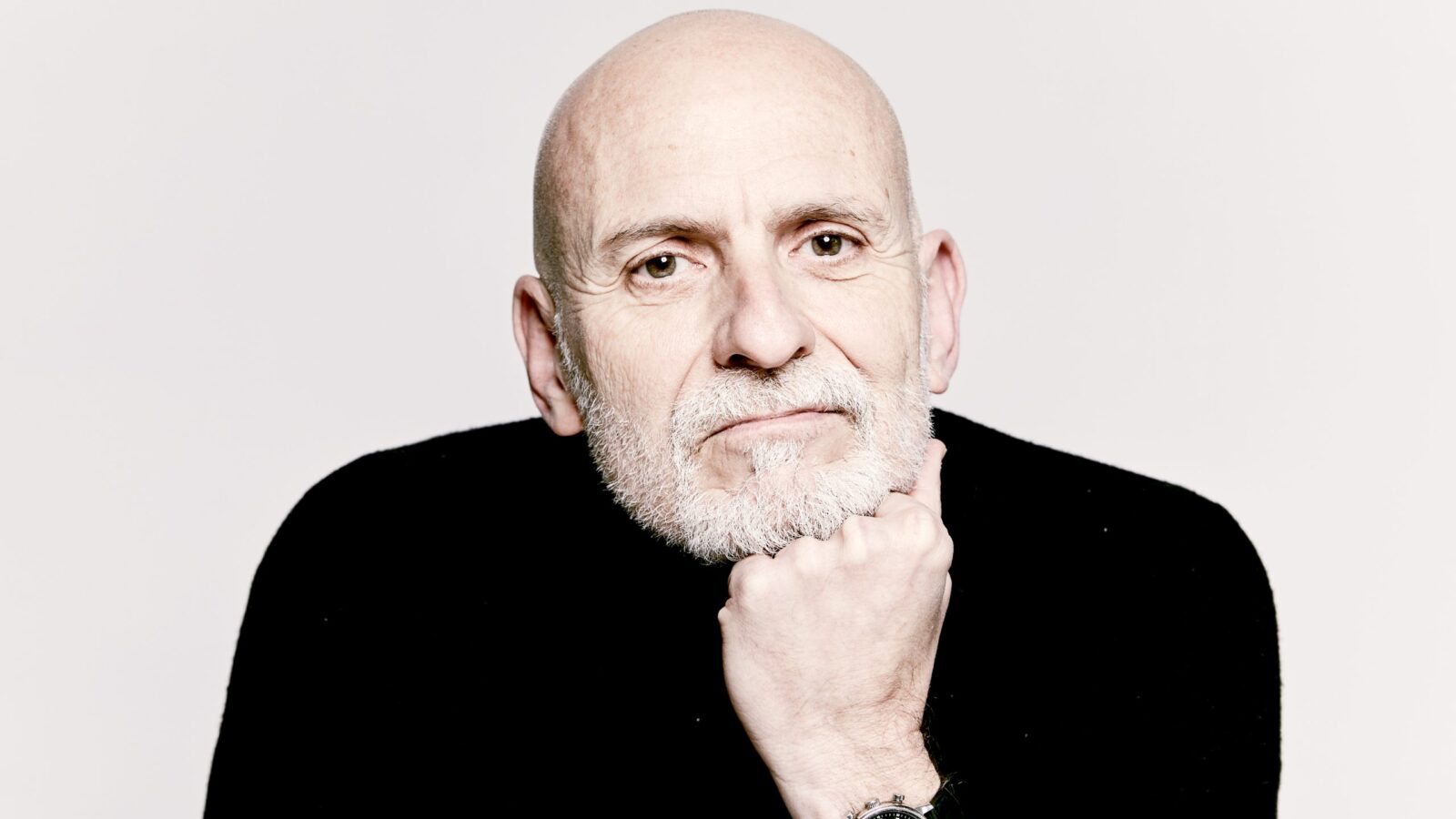
Cover image: Photo: Michal Novak
Alejandro Palomas has a house in the Baztán Valley. The Catalan writer spends a large part of the year in that ancestral land, where he isolates himself from noise and heat, and where he has launched a project worthy of admiration: turning an old grain field into a lush forest. Thus, as it sounds: he plans to plant as many trees as necessary to restore life to a plot so harmed by intensive cultivation that, instead of soil, it looks like a raft of slurry. And it turns out that this very project, of raising a forest where there is nothing left, is what features in the protagonist of his latest fiction, Casa (Espasa), a seven-year-old girl who lives with her father and grandfather in a secluded farmhouse in the mountains. It is evident that Alejandro Palomas is turning his life into a novel’s plot.
*****
—In 1953, Jean Giono published The Man Who Planted Trees, a tale about a French peasant who, having lost his wife and child, decides to turn a barren area into a forest teeming with life. In your novel, Mika also begins to raise a forest with her grandfather.
—It’s because this novel is inspired by my own surroundings. I live in a house on the hillside, literally surrounded by grain fields. For five years now, my two sisters and I have been trying to convert one of those fields into a forest. We stopped cultivating it and began planting trees. We got ourselves into a considerable mess, but we have also learned what it means to create a forest.
—And what does that mean?
—To begin with, we learned how degraded land can be. Ours had so much lime that it bubbled when you poured vinegar. It was a land practically dead, scorched by slurry and chemicals, and we needed five years to restore it until the trees began to want to grow. Because trees, in a sense, decide whether they want to grow in a place. You can plant a marvelous tree and see it seemingly happy for three months… until one day it wakes up dead, as if it decided that place wasn’t for it. And there you learn the same thing Mika learns in the novel: nature’s timing has nothing to do with human timing. I think one of the reasons we are as lost as a society is precisely because we no longer know how to manage time.
—Casa could be categorized in that genre called “liternatura.”
—Yes. It is a genre that interests me greatly. When I began writing Casa I got in touch with Gabi Martínez and Marta Tafalla. I had understood that the novel could be a way to enter into that literary and environmental activism, and they encouraged me to continue. Essays are an essential genre, but they often fail to reach the emotional substrate of readers: there are too many facts and people end up getting tired. That is where literature steps in. I think we must also convey the message from the emotional angle. And that is done by telling stories. Those of us who tell stories have an obligation to try to modify reality through fiction.
—Your relationship with nature didn’t begin with this novel. Years ago you left Barcelona to live in the countryside. What were you seeking when you made that decision?
—But in Casa not only is a forest built. Many other things are built as well…
—In Casa there are two parallel constructions: on one hand, Mika and her grandfather build a forest, and on the other, they build a very peculiar relationship between them. I have always thought that those two generations, grandparents and grandchildren, form a perfect pairing. After all, who hasn’t had a grandparent who marked them deeply, sometimes even more than their own parents? When you grow older and reconstruct your childhood you realize to what extent one or both grandparents were present in the important moments. And I believe that will happen even more with today’s children, because many spend more time with their grandparents than with their parents.
—One of Mika’s friends expresses it simply: “Grandparents know a lot.” Were you interested in contrasting that wisdom born of experience with other forms of learning today?
—There is a privilege in being educated by someone who possessed a wisdom, a human wisdom, acquired through experience. I wanted to speak of that learning process I remember from my own childhood: someone guided you through their own experience. Now we are introducing children, teenagers, and adults to a way of learning that often omits the learning process itself. There are guides and tools that provide acquired intelligence, but they do not come from human experience. And there lies the danger: education can end up dehumanizing itself.
—The title, Casa, seems to refer not so much to a physical building as to a symbolic place.
—The word “home” has many senses. It is the architectural structure, but it is also a refuge, a Sunday with a blanket, a calm place. There is a whole imaginary around that concept. And home is, above all, not having fear. When you are a child and you play hide-and-seek or tag, you climb onto a bench, you say “home,” and no one can touch you. It is the place where there is no danger. Or at least, where there should not be.
Photo: Michal Novak
—We also have two men, the grandfather and the father, who in some way are waiting for the love they felt for their respective wives to return. And between them, Mika.
—In this novel I wanted to affirm that there are also women who give up family for their personal or professional aspirations. That’s why in Casa the one who stays with his daughter is the father. He does it because he wants to and because he decides. He loves his daughter very much and chooses to return to the family home in the village, to become autonomous and to telework so as to be able to stay with her. And then there is Tadeo, who is a bit like the grandfather we would all like to have, almost like the one in The Etruscan Smile. He adores Mika and between them there is an extraordinary companionship. She wants to know everything and he is delighted to satisfy her curiosity. And they laugh a lot together, and that sense of humor between them fascinates me.
—The grandfather is also the one who transmits to Mika a kind of ancestral wisdom. He does so through games, commands and advice. What is he really trying to teach her?
—The same things that a wild animal would teach its cub: the rules necessary to survive. We no longer teach those things, because we have consciously renounced our animal condition, as if that dimension no longer formed part of our learning. The grandfather in my novel teaches his granddaughter to listen, but also to wait and to observe. They are things that seem obvious and, precisely because of that, no one teaches us them anymore. And, yet, they constitute the foundation for having a good life.
—Today the word “survival” seems loaded with violence: learning to survive makes us think of defending ourselves against a hostile world. Yet what Tadeo teaches Mika is almost the opposite: to live in harmony with the world.
—Of course, because we live in a world we perceive as hostile. Therefore, to build this relationship, I needed to take the three characters to a place with no Internet connection, set apart from that hostility that dominates social networks, far from all that violence. In Casa there are practically no references to the present. It resembles a bit our childhood, when there was no permanent interference of data and runaway information. We had a different relationship with time.
—Casa could also be read as a novel about the silences of men. The grandfather and the father love Mika and love each other, but they are rather clumsy when it comes to expressing their emotions.
—They are two men in the most traditional sense: people with many emotional difficulties. The father-son relationship is full of love, but they don’t know how to say it; in fact, they don’t even know how to say it to themselves. I think many men do not talk to themselves about their emotions and don’t even know how to do it. That’s why fathers and sons tend to relate through actions: “let’s watch the football,” “let’s play paddle,” “let’s do something”… Always doing; never feeling. In rural life that can be even more extreme. In my experience, sometimes you don’t even need to speak: a single grunt suffices.
—Family remains, once again, Alejandro Palomas’s narrative territory.
—I often seek other territories to write about. There are writers who handle topics I’m deeply interested in with extraordinary skill, but I wouldn’t know how to approach them. And then there is romantic love, which does not interest me at all as a narrative subject. Falling in love, suffering for love, and all that construction bore me to tears. Perhaps that’s why I retreat to family. For me it is the perfect microcosm: there I can make and unmake, explore life, about myself, about time, silence, who we are, where we are going…

—And what are your literary references when you write about the family? I’m thinking, for example, of Natalia Ginzburg.
—I know I’ll sound harsh, but Ginzburg bores me. I constantly seek new references and I love it when a reading surprises me. I suffer a lot in searching for authors because for me reading is an absolute necessity. I’m not interested in that sort of competition of “I’ve read six books this week,” but in finding something that makes me think: How could I have died without reading this? It happened to me, for example, with Éric Vuillard. I want that sense of discovery to happen constantly and I find it hard to achieve. Precisely for that reason I also look outside fiction: I read a lot of theater, I’m very interested in comics, and I explore other formulas. There are many ways to find things that feed you as a writer.
—For many years you balanced your literary work with translation.
—I hardly translate anymore. I’m involved in so many things that I don’t have time. I would only return for Jeanette Winterson and Gertrude Stein. For many years I translated Winterson, and when they stopped entrusting me with her, I thought: “Well, I won’t translate anymore.” And I take this opportunity to advocate for Gertrude Stein, because we talk a lot about reclaiming classics and sometimes we forget extraordinary authors. I translated a very extensive work of hers and I would gladly translate it again. Winterson and Stein are, moreover, two writers with whom I have a very particular affinity: they are the only two I have translated without needing a dictionary.
—After all you have told and written about sexual abuses within the Church, and I’m referring mainly to your testimonial book Esto no se dice (Destino, 2022), have you perceived any change in the religious institution?
—Honestly, I have thrown in the towel. I fought very hard and I gave my all trying to make things change. Have they changed? Some have, but the essential remains the same. There is only one difference: now cases are known and reported, whereas before they often didn’t even happen. But beyond that I am quite pessimistic. Cases continue to surface and I don’t have the sense that the structural problem has been resolved.
—And at a moment when neo-puritanism permeates everything, will you continue to be the rara avis of our literature?
—I am a rare bird inside and outside literature and I am very comfortable there. But what you say about neo-puritanism interests me especially because of the self-censorship it is causing. That, I think, is a very important matter. If editors, writers and journalists sat down together to speak openly about what is happening, we would be surprised by the degree of censorship and, above all, of self-censorship that currently exists in the cultural world.