
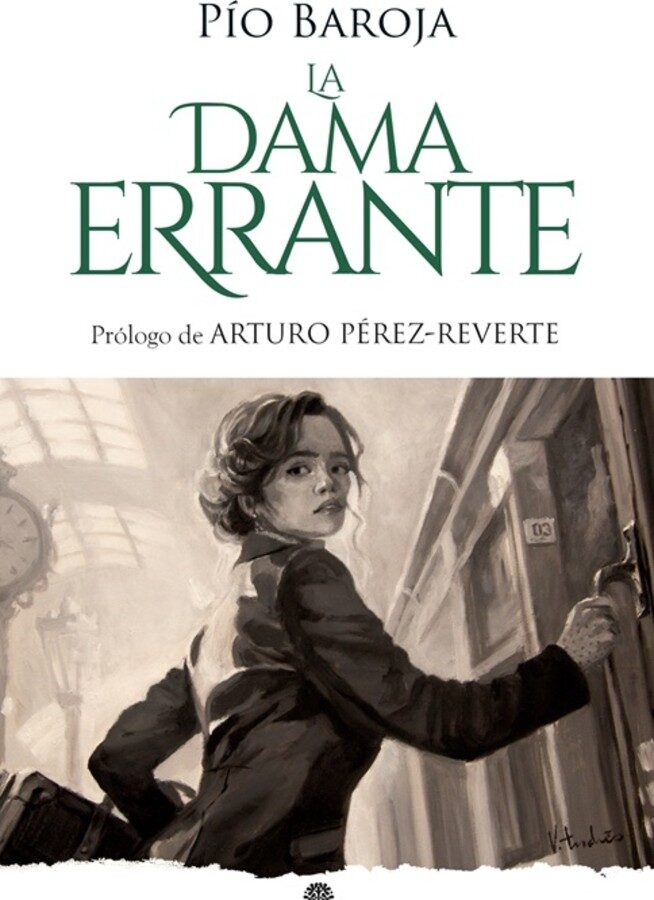
I have to start with a confession: I had never read The Wandering Lady.
That is why, when in the prologue of this new edition from Zenda-Edhasa Arturo Pérez-Reverte states that
Pío Baroja
wrote a work that, more than a century later, remains
«a novel so modern, so astonishingly contemporary»
, that claim immediately sparked my curiosity.
The statement was too sweeping to pass over. I wanted to verify it.
I had to know whether a novel published in 1908, written about a Spain that today seems so distant, could still preserve that striking modernity. If its characters, its concerns, and the society Baroja depicted could continue to tell me something, more than a hundred years later.
So I set out to read it.
One of the first certainties this novel left me with, with which Baroja opened the trilogy La Raza, was to remember how much I have enjoyed the literature of the man considered the father of the modern and contemporary novel. Not only for his direct, brisk prose free of artifices, but because some of his characters could walk, with few modifications, through our present-day society.
The story begins from a real event that shocked Spain: the assassination attempt on May 31, 1906 against Alfonso XIII and Victoria Eugenia on their wedding day. The anarchist Mateo Morral tossed a bomb hidden in a bouquet toward the royal procession from a balcony on Madrid’s Calle Mayor. The monarchs escaped unharmed, but there were numerous dead and wounded.
Baroja, who knew people connected with that milieu, used the incident as a starting point for his fiction.
In The Wandering Lady, the terrorist is named Nilo Brull. After carrying out the attack, he seeks refuge at the house of Dr. Aracil, a physician who lives with his only daughter, María. Aracil’s past ties to the anarchist make him an accomplice and trigger that father and daughter must abandon Madrid. What follows is a flight toward Portugal that will end up becoming much more than a simple journey.
Before setting them in motion, Baroja, masterfully, pauses to present us with his protagonists, endowing the introduction with a narrative rich in descriptions and revealing the psychology of the characters.
María Aracil is an orphaned girl who has been raised by her father according to principles that were far from conventional for Spain of his time. Intelligent, independent, and with ideas that must have seemed extravagant to many readers at the dawn of the twentieth century, she wants to think for herself. It is hard not to see her as a woman ahead of her era.
Her father also does not conform to a conventional model. The doctor Aracil is cultured, contradictory, and with a certain inclination toward that salon anarchism that filled the Madrid tertulias and the Ateneo at the dawn of the last century. Baroja seems to use him to settle scores with that Madrid society fond of grand theories and far less willing to face their consequences.
Very different is Nilo Brull. The psychological analysis Baroja carries out of the terrorist constitutes one of the novel’s attractions. His self-sufficiency, his sense of superiority, his great self-esteem, and his contempt for others are portrayed with precision. He doesn’t need Baroja to deliver grand speeches to strip him bare.
The author’s ability to say a lot by writing a little is one of the many characteristics I have admired most during the reading.
Short sentences, direct observations, brisk dialogues, and descriptions built with just a few strokes. All seemingly simple. It is not. It is difficult to explain how he manages to narrate so much, so well, with so few words.
Behind that apparent simplicity also lies the writer’s pessimistic gaze. We are dealing with a Generation of ’98 author, and it shows. Baroja observes Spain without much complacency at the memory of the loss of the last overseas territories: bourgeois hypocrisy, coffeehouse chats, provincialism, social inequalities, and poverty.
But it will be when father and daughter flee Madrid that The Wandering Lady acquires another dimension.
Dressed as governesses to go unnoticed, the Aracils traverse roads, villages, inns, and taverns toward Portugal. The escape ends up becoming a portrait of deep Spain in the early twentieth century.
Along those roads appear shabby taverns, miserable houses, peasants, travelers, muleteers, show people, gypsies, and people of every station. A peasantry as important as the landscape. Baroja demonstrates that he knows the lands and the people he describes and does not need to elaborate at length: a gesture, a conversation, or the interior of an inn is enough to show us the living conditions of that rural Spain.
The journey allows María to discover an unknown world. Father and daughter, stripped of their social status, witness firsthand the miseries reserved for the poor and humble. And the more María learns of that reality, the more aware she is that she does not wholly belong to the world she comes from.
It is at that moment that the novel’s title fully makes sense.
María is that wandering lady. A woman who seeks her place in a society whose norms she cannot fully accept. Her journey is not only geographical. As she moves toward Portugal, she reaffirms her need for freedom and a way of understanding life that seems more fitting for a woman from decades later than for a young bourgeois woman of 1906.
It is precisely here that the astonishing modernity Pérez-Reverte attributes to the novel becomes clearest. The Wandering Lady is modern because María is, but also because many of the human weaknesses Baroja describes have not aged: intellectual vanity, moral superiority, the gap between grand ideas and their consequences, or the difficulty of finding a place of one’s own in the world.
I have been struck by the realization that Baroja understood, more than a century ago, that even in the bleakest times there could arise characters who herald a modernity his era was not ready to see.
Baroja paints a canvas of the landscape, and above all of the peasantry, that could not be found in the Madrid of the salons, but along the rural roads of Castile and Extremadura.
I finished The Wandering Lady recalling that line from the prologue that had pushed me to read it.
I wanted to know if Pérez-Reverte was right. He was!
And when I closed the book, I feel that I have rediscovered Pío Baroja, not because I was ignorant of the writer, but because I have reconnected with him through a reading that, for me, was new. Now I feel the need to continue with the rest of the La Raza trilogy. I do not want to abandon the story halfway through. I want to follow the journey across Europe of Dr. Aracil and his daughter María and continue enjoying, with them, the writings of the Basque author.
There are novels that age because the world they described disappears. Others endure because, even if the world changes, human beings remain too similar to those who inhabited their pages. The Wandering Lady belongs to the latter group.
—————————————
Author: Pío Baroja. Title: The Wandering Lady. Publisher: Zenda-Edhasa. Sales: Todos tus libros.