
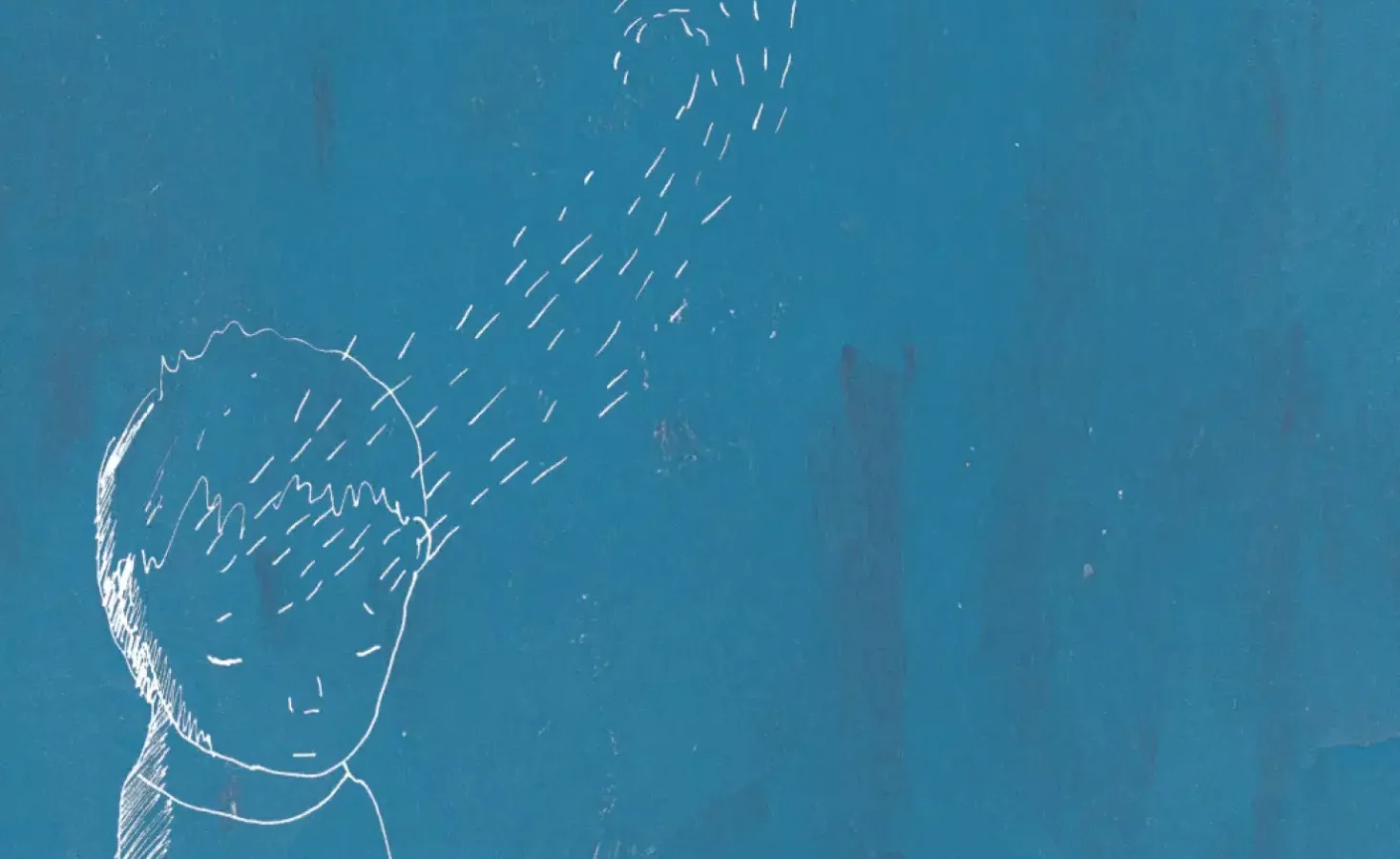
Reissuing poetry is a rarity, a countercurrent bet. Poetic books rarely get a second chance: the next title by the poet tends to replace the previous one, displacing it. When a publisher decides to bring a work from a decade ago back into circulation, it is betting on the idea that that book had something to say then and still has not exhausted itself. The reissue of Canal in Letraversal, scheduled for September 2026, suggests that something is shifting in how poetry catalogs are conceived: less obsession with constant novelty, more willingness to nurture what already exists.
Revisiting the text that already exists is, moreover, what is done in the pages of Canal. In fragment 56, the poetic self shares that the first time he wrote about his brother was twenty years after his death, in the piece “Forbidden Direction,” and adds:
I have not stopped rewriting it since then.
Javier Fernández (Córdoba, 1972) is a writer and editor. He had already explored the visual dimension of the book in Casa abierta (Open House) (2000) and Cero absoluto (Absolute Zero) (2005). With Canal he won the XXIII Ricardo Molina Prize and it was published by Hiperión in 2016. Ten years later, Letraversal gives him a second life: a rescue that returns the volume to bookstores, a copy that now dialogues with the illustrations by Aitor Saraiba. Fernández also coordinates the Ucopoética Cultural Laboratory at the University of Córdoba.
The poetry collection revolves around the death of Miguel, the five-year-old who drowned in a canal in March 1975. The book is built like a fragmentary narrative: sixty texts numbered and a coda. His brother, the poetic I, was three years old at the time and enters the story in the second fragment: “I am present in the prayer. I say: ‘my brother’.” From there, he reconstructs what happened through polyphonic testimonies: the boy who saw him fall, the father who waited by the bank until the boots appeared in the mud, and the mother who, according to her, knew where her son was before they found him. Then, the trail of the tragedy unfolds for decades: the phrases the mother has to hear in the supermarket, the younger sister, the parents’ separation, and the dreams about Miguel. No version fits entirely; family and neighbors contradict one another, and no one holds an absolute truth.
The sorrow of Canal is also visible on its pages. In his article about the first edition in Impossibilia, Vicente Luis Mora noted that the mourning is perceived in the page layout itself: the text runs down a narrow column surrounded by white margins, like a trench or a typographic channel where the words move boxed in and dry.
Not a woman cleaning a tombstone,
but a mother bathing her child.
Javier Fernández
To that typographic channel and to the family testimonies, Saraiba’s drawings are added. Far from merely decorating the pages, his line resumes the impulse of the child shown in fragment 4, where the kindergarten psychologist notices changes in his drawings: where there was once sunshine, now there are storm clouds.
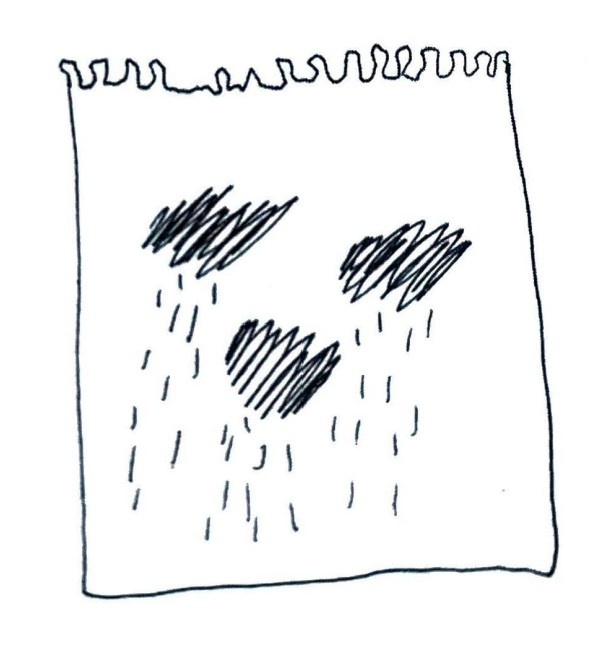
That dam sustained by the text and the drawing for sixty fragments breaks in the coda. In “Forbidden Direction” the punctuation disappears entirely; the sentences rush down in a rush, as if the water carries language along at full speed. Throughout the narrative, the narrator is the boy who is sent back home (I went home, fragment 9) and who imagines what he would have done if he had gone (I would have thrown myself after him, fragment 16). In the coda, however, the house burns, the garden floods, and, upon seeing a log floating in the water that bears Miguel’s shape, he finally reacts: “I dive into the water and swim toward my brother.” It seems he does not arrive in time. The book ends abruptly with a “it is slipping away from me,” without a final period, where the body in the water, the sentence, and the very possibility of an ending all slip away at once.
—————————————
Author: Javier Fernández. Title: Canal. Publisher: Letraversal. Available at: Todos tus libros.