
On June 25, 1982, José Alberto Muñagorri Berdasco (born in Rentería, 1972) went to bed furious because Spain had lost 0-1 to Northern Ireland in the 1982 World Cup. The next day, a couple of minutes before noon, he ran out of his grandmother’s house, happy because she had just given him his five pesetas as weekly allowance. The boy crossed the Aralar square of his town, where there was an abandoned backpack containing half a kilo of Goma-2, which exploded at exactly noon and blew off his left leg, disfigured his face, and filled his body with shrapnel.
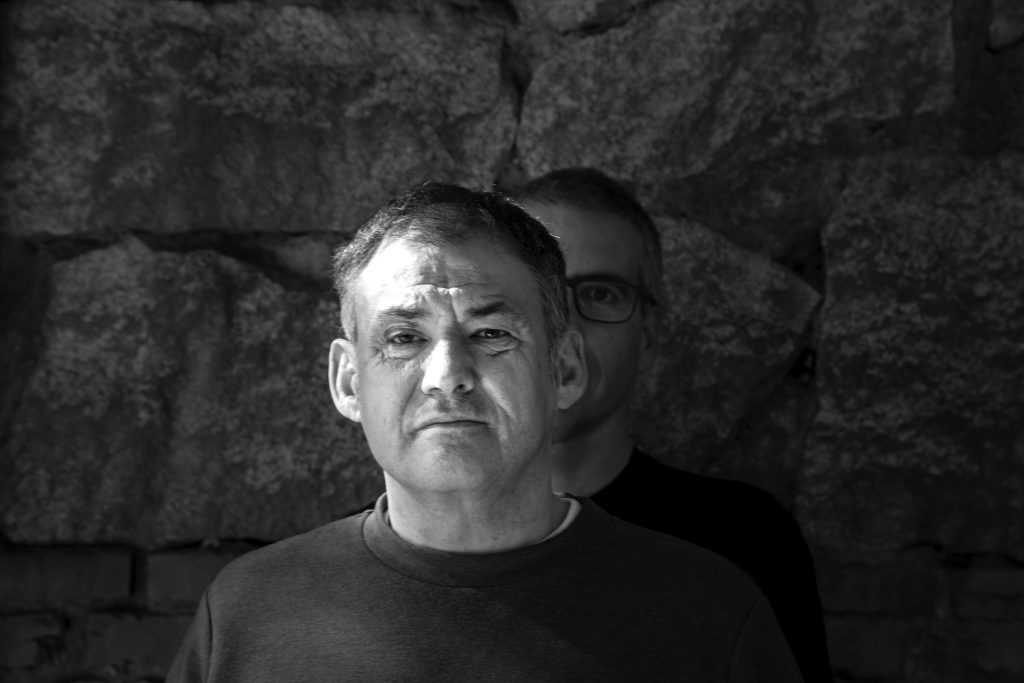
When Ander Izagirre (Donostia/San Sebastián, 1976) was a child, Muñagorri’s name was a warning: “If you come across a backpack in the street, don’t touch it because it could explode, like Alberto Muñagorri.” In 2018, the journalist and writer decided to write the story of that ETA victim, a member of a terrorist group that killed twenty-one boys and girls between 1980 and 1982. Eight years later, the Euskadi Literature Prize publishes The Backpack. The Life of Muñagorri (Libros del KO, 2026), the passionate—and, importantly, unprettified—biography of a man who chose life, rejected hatred, and who aims to contribute, besides giving a thorough pilgrimage through the hell that was named Rentería for roughly fifty years. Zenda interviews them in Chamartín, moments before they return to their homeland. “ETA does not exist and society is very different from when it did exist,” declares the author, “but we have not managed to close the wound completely.” We discuss:
*****
—Ander, how do you write a life like Muñagorri?
—AI: With a lot of patience and a lot of time spent with him. We met in 2018 and the first thing we did was have long conversations at his home and walk around Rentería, so that he could show me the key places of his history. There I saw that, instead of being a single story from a planned series of several stories on terrorism and violence in the Basque Country, it was an incredibly impressive biographical journey and, moreover, it had around it a host of surrounding stories—about the people around him, his family, his friends, the town—that helped me explain fifty years of violence in the Basque Country.
—When you read the book, Alberto, what did you think, what did you feel?
—Alberto Muñagorri (AM): I can’t describe it. It is the life of a victim of terrorism, whose bomb exploded when he was ten, and everything surrounding it. Something we normalized that wasn’t normal. Society was permeated by those violent events. A notable point is how all of that affected families. I see myself very reflected in what Ander has told.
—If I say “ETA,” you say…
—AI: For many years it was a nightmare I thought would never end and that marked our lives. Besides the evident physical damages of the attacks, of the murdered and the wounded, it made society a disaster, a society seized by fear, unable to speak out. It shaped a society in the worst possible way. We are very glad to have gotten rid of ETA.
—AM: It is a fundamental part of our dark past. Of our terrible past. A past full of suffering, of pain. ETA is something that no longer exists and we must keep working so that it does not exist again. If any crack appears through which violence can slip in, in the form of ETA or any other movement, we must be capable of stopping it and not allowing it. Part of society also bore responsibility for keeping ETA alive for so many years.
—When Alberto was ten years old, he understood little or nothing about these issues.
—AM: No. We lived as spectators to many events in our town. I didn’t know what ETA was, what objectives it pursued, how it had formed, or when… I knew there were many people shouting in favor of ETA in the town, that there were continual clashes, that they blew up bombs, that they shot; that they killed, mainly police officers, soldiers and Civil Guards, and that it was the air we breathed in our society.
—Muñagorri was a victim of an ETA campaign against Lemoiz.
—AI: That’s important to understand to see how ETA operated in the late seventies. It was a moment when even within the Basque left (abertzale), the use of violence, what they call “armed struggle,” was being questioned. The hard-line supporters within ETA needed causes to drag people along. They identify, for example, the anti-nuclear struggle, which had been a civil and peaceful campaign before, because people forget that three nuclear plant projects had already been halted… Sometimes people say: “Thanks to ETA, there’s no nuclear plant on the Biscayan coast.” Well: there already existed a strong civil movement, with thousands who supported that cause. And ETA saw a banner: “We will take it for ourselves and impose it. No debates or assemblies. This will be about bombings and attacks.” They killed five people, planted bombs like the one that wounded Muñagorri… One must understand that context: ETA was trying to become the head of a revolutionary struggle.
—And it sidelined its rivals.
—AI: It ended crushing all kinds of civil peaceful resistance movements, which were framed in a “you’re with us or against us.” Either you were against the “oppressive State and with Iberduero,” or you had to accept that the only alternative was to plant bombs and shoot.
—Rentería, more than a backdrop, is almost a character. Ander mentions a veteran journalist who said: “It was almost a fixed section of the newspaper: national, international, economy, culture, sports, the weather and Rentería.” What the hell was going on in Rentería?
—AI: In Rentería, the same thing happened as in many other places, but multiplied. It is a city with several circumstances. It is an industrial city that grew enormously with a lot of immigration. Two communities were formed: the native Basques and those arriving from other regions of Spain. That creates a social divide and at the end of Franco’s regime there is a very strong industrial crisis: there is a lot of unemployment, a lot of political tension, Basque nationalism resurges, independence movements resurge, ETA acts, there is police repression and state terrorism, there is a long tradition of strikes, of assemblies… all those ingredients are there.
—Plus the heroin.
—AI: It is a place with a great flow of heroin through the Pasajes port; the border is nearby… All the ingredients of the era are concentrated at maximum power in this town.
—How many times did you hear, Ander, the phrase “If you come across a backpack in the street, don’t touch it because it could explode like Alberto Muñagorri”? That is, by the way, a highly venomous line.
—AI: For me, and for many eighties kids, Alberto Muñagorri was the name of a warning. We grew up with that perception of our surroundings: a place where backpacks left in the street could explode and reach you. And Alberto Muñagorri operated as a warning for an entire generation. Everyone remembers the poorly told story of the boy who kicked it. It’s as if it shifted the blame, no? But we grew up with that.
—AM: I didn’t kick the backpack. The memory I have of that day is walking by the place where that backpack was, stopping to stare at it, and at that moment it exploded. It’s something that has bothered me for many years. There were many people who said: “If you hadn’t kicked it…” When I was ten or twelve I would stay quiet, but when I was old enough to respond, I would tell them: “I’ll give you five seconds to think about what you’re saying.”
—AI: Even if you had kicked it, what would have happened?
—AM: The attempt was to shift responsibility away from the person who caused it. There were a series of events around the explosion of that backpack for which the state security forces were condemned, but really, the true culprit was the person who placed the backpack there. I passed by there thousands of times and nothing happened to me until someone placed half a kilo of Goma-2 in a backpack.
—AI: To explain things properly: first, you didn’t kick it. Moreover, it blew off his left leg: he is right-handed. It’s a backpack, not a can of beer: kicking a backpack is rather odd. And then, that backpack had been placed the night before, probably set to explode at midnight. Whether it didn’t explode at that moment, or because the person who placed it did so poorly, that backpack was moved by many people and it didn’t explode anyone.
—Sara Berdasco, Alberto’s mother, urged him not to hate. How does one do that, given your circumstances? Were you able not to hate?
—AM: When I was in the hospital room, I was aware of what had happened to me, of the physical consequences it had on my body. How does one do it? I don’t know. If you asked her, I think she isn’t aware of how she did it. She did not convey messages of hatred or spite. What she told me, wrapped in affection, love, and compassion, was that I should not hate and that I should be happy.
—She has done more for Jehovah’s Witnesses than anyone. Those sorts of things aren’t humane!
—AM: (Laughter) My mother has incredible faith. She is a tremendously empathetic, very human person, and she knew what would help her son. She knew that carrying a backpack loaded with hate would prevent me from leading a normal life, from being a happy child. She chose the message that has kept me here and that led me to co-write this book with Ander. She told me very clearly: what happened there was no solution, there was no going back, and either I stayed caged, full of complexes, hate, and rancor, or I adapted and achieved all the things I set out to do. It is clear I chose the second. It probably wasn’t the easiest path, but it has yielded the greatest benefits and the best reward in my life.
—Sara is a fascinating person/character. Ander notes: “First she had to endure problems with her husband’s drinking and neglect; after separating from him, she cleaned houses while raising her three children alone; she had to take care of her younger son, shattered by a bomb, and her older son hooked on heroin.”
—AM: Yes, she had to take on alone the care of my ten-year-old son, whose body had been shattered by a bomb, and, subsequently, she had to help my brother. My mother is a superhero. I always say she gave birth to me twice (laughter). With that I think I’ve said it all.
—AI: Alberto is a very generous, constructive, and forward-looking person. This book isn’t a victim narrative. The verb he uses most is “to contribute.” He has met in prisons with repentant ETA members. He has participated in meetings with victims of ETA, of the GAL, and torturers. All of that, to build a story of coexistence in the town. And all that cannot be separated from his mother’s role. That bravery and that courage come from the strength his mother gave him from the start.
—The Backpack, indeed, is a book free of victimhood and sentimental pornography. How do you tell, Ander, the depression of a victim of terrorism without falling into those temptations?
—AI: There’s an advantage: this person has developed his own reflection and his own discourse. This book had a several-year pause. We thought the book would be published in 2019 or 2020. Alberto went through a divorce and fell into a deep depression. He realized it wasn’t just because of the divorce, and he needed a few years to recover. When Alberto returns and we resume the story, he delivers a more reflective account of his past and what led him to the depression. In other words, he gives me the processed, chewed-over narrative: I don’t have to act as a psychologist, I just have to record his words. The merit is simply in recording his words. Moreover, the generosity of wanting to tell things. You might say: “We don’t need to tell this part.” There are people ashamed of their mental health problems, who don’t want to talk about a depression, and Alberto hasn’t had problems. I find that very generous and very fair.
—We’re nearing the end. Why do you think no one ever investigated the exact authorship of the attack?
—AM: I was on the front page of the newspaper on the 26th and 27th, and on the 28th, the paper’s front page said that three Civil Guards had been murdered or something like that. The whirlwind of violence was such that there was no time to investigate. That’s what I understand. It was the Years of Lead: every day, practically, there was an attack. Maybe it started with mine, but two days later there was another one.
—AI: I think one thing is that the State was overwhelmed and unable to cope. And then, related to this, there was very little sensitivity toward victims. It’s not only that there was an investigation into the specific culprit of this attack: no one bothered to see what a ten-year-old boy with a leg amputated needed.
—Then there were those who said: “Hey, you’ve been given so much money, you can’t complain.”
—AM: Yes. “What happens to you, it happens to you.” “How nice that you ended up with the money they gave you.” Comments that are hard to understand but that were products of the awful society we lived in.
—AI: And that compensation came after several years of lawsuits against the State. The victim’s family had to fight in the courts because the State had very little sensitivity. The State argued over the compensation, the amount… that was very hard.
—AM: There is a notion there that victims have been helped, that a red carpet has been rolled out for them. In 1982, it wasn’t like that: when the spotlight faded, the victims were forgotten. Perhaps my focus took longer to fade because I was a ten-year-old boy there, but if a Civil Guard or a police officer was killed, they disappeared after the funeral.
—At the end of the book, Ander, you write about Gazte Koordinadora Sozialista (GKS). Where do they come from? Is it wise not to lose track of them?
—AI: Let’s see, I think there’s nothing like ETA. Saying “ETA is alive” is a frivolity; it’s a partisan use of that claim, it’s not fair and it’s done in bad faith or due to ignorance. Fortunately, ETA does not exist and society is very different from when it did. But we have not managed to close the wound completely. We have not managed to make clear what must never happen again. 99% of the people who have known ETA are relieved. Even people who did not know that era, young people, may feel tempted to romanticize or to give an epic talk about violence. There are attempts to which we must stay alert. And there have been several attempts, small and not overly worrying, but we must not lose track of them. There are splits on the Basque left. In Rentería, a graffiti appeared: “Bildu, servant of Spain.”