
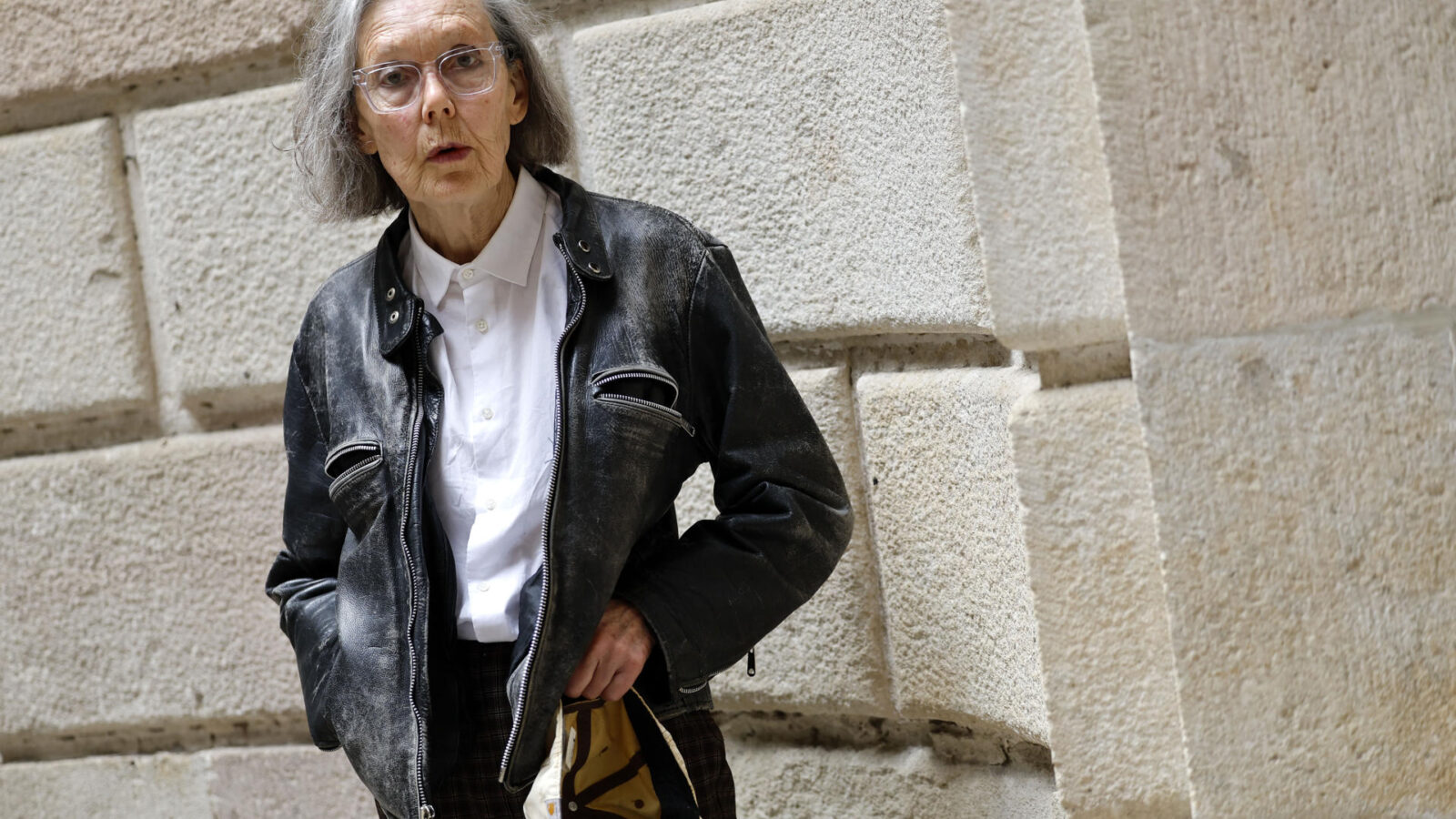
Before this Thursday’s ceremony conferring the Nobel Prize in Literature on Anne Carson, she had already walked a substantial stretch of Spain on foot. In 1983, the Canadian poet crossed the Pyrenees from France to Santiago de Compostela and then continued on to Finisterre, an experience that decades later would become literature in her essay Types of Water: The Camino de Santiago.
The bond Carson maintains with the Camino is not that of a writer who merely wanted to document a journey. The Camino appears in her work as a territory of movement, observation, and search, an external experience that gradually becomes an inner journey.
The Galician poet Alba Cid, National Poetry Prize winner, scholar, and admirer of Carson’s work, interprets it this way: for her, Types of Water (edited in Spain by Vaso Roto) is really a kind of “false diary”: “it has the appearance of a pilgrim’s diary, but Carson hardly recounts her own personal experience directly,” she explains in statements to EFE.
Carson began her journey on June 20, 1983 in Saint-Jean-Pied-de-Port (France) and finished it on July 26 in Finisterre. Between the two extremes lies Santiago, but also a literary itinerary in which classical, medieval, Japanese, and contemporary references coexist.
Cid underscores precisely that way of writing that Carson employs, capable of mixing genres, eras, and materials without forcing them into a conventional structure. “This freedom to roam between genres” and the “porosity between the scholarly and the poetic” are, in her view, some of the traits that explain the singularity of an author who has become a benchmark for much of 21st-century poetry. “Carson can stop in front of a landscape, a bridge, or an element of Jacobean tradition to open a reflection that immediately departs from description. There are erudite annotations, references to different poetic traditions, and observations about concrete places, but there are also silences and deliberately veiled zones,” warns Cid, who regards this book as “a diary, not a diary”.
The Galician author recalls the way Carson tests her own ideas about pilgrimage, resulting in a work in which “to move forward seems as important as arriving.” The itinerary ends in Finisterre, where the Camino physically ends and the ocean begins, and Carson turns that geographic boundary into another point of questioning. “Ultimately, it is an inner journey. It is clear that she is seeking something and she seems to return without finding it,” considers Cid.
Regarding her style and voice, Cid, who dedicated her poetry collection Atlas to the Canadian author, highlights the virtuosity of “roaming between genres,” as well as her “fascinating translations of classical texts.” She also emphasizes “her essayistic drive” and “that kind of preserved intimacy,” so that she never feels “confessional in the classical sense,” since she manages “to preserve the intimacy of lived experiences in a brilliant way.”
Carson had already revisited that Spanish experience in 2020, when she received the Princess of Asturias Award for Literature. In her acceptance speech she recalled that she had walked across Spain on foot in 1983 up to Santiago and joked about the difficulty of eliciting a smile from Spaniards during that journey. Now, with the Nobel Prize in Literature, that pilgrimage takes on a new reading: not a chronicle of the Camino, but an inquiry into what it means to move, to search, and to keep walking, henceforth with a Nobel under her arm.