
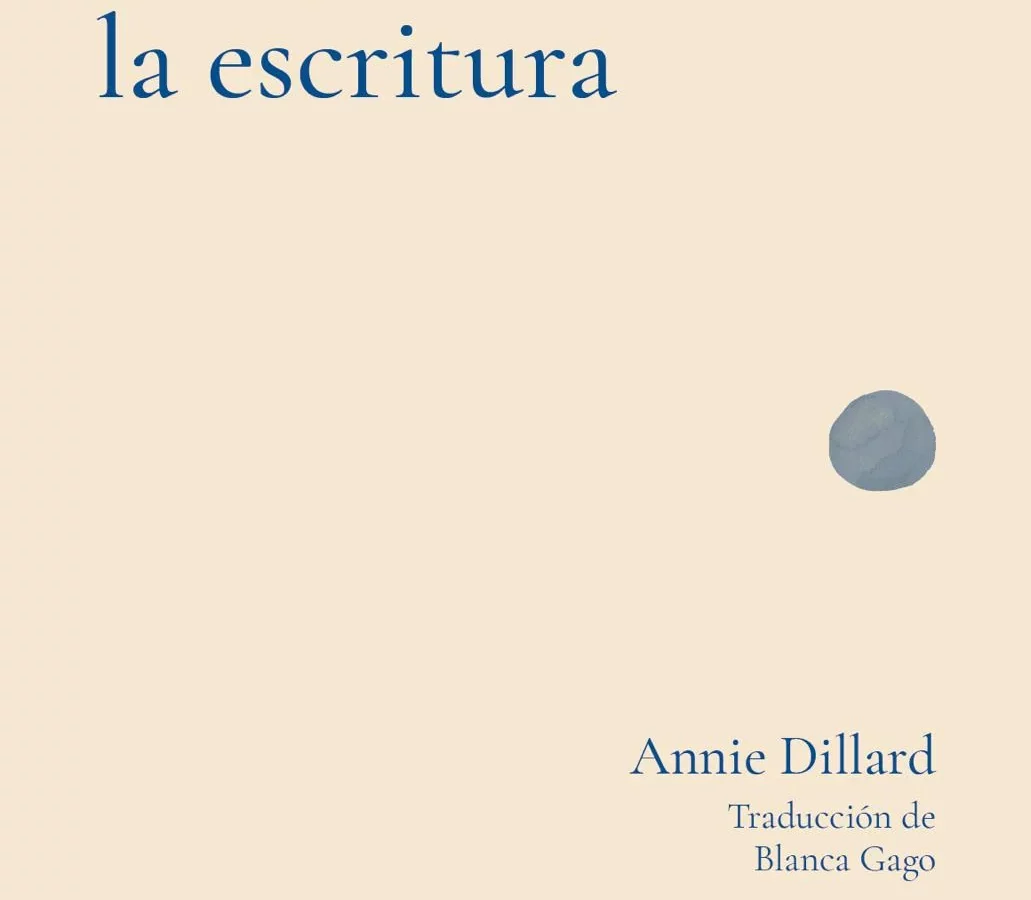
If death and love always catch us by surprise, perhaps it is because we have grown too accustomed to the inertia of daily life. The fibers of our heart have worn thin, like the elastic in an old pair of underwear, and they barely manage to sustain the radical experiences of existence. This thought seized me upon finishing The Writing Life, Annie Dillard’s book, recently translated by Blanca Gago and published by Bamba Editorial, with the care and singular beauty they always bring to all their editions. This same year they rescued another unpublished work in Spanish by the author: Sacred Matter.
El pasado 15 de septiembre, la escritora, ganadora del premio Pulitzer, falleció. Pocos son los libros que se han traducido de ella al español, por ello, resulta un tesoro encontrarnos con este ensayo, donde nos adentramos en el pequeño cobertizo de Dillard, en el que se retira del mundo, en medio de la naturaleza, para escribir. ¿Qué nos impulsa a la escritura, cuando sabemos que el mundo real está ahí fuera, al alcance de la mano? ¿qué nos hace aislarnos y elegir la copia en lugar del original?
On September 15, the writer, a Pulitzer Prize winner, died. Few of her books have been translated into Spanish, so encountering this essay is a treasure, as we enter Dillard’s small shed, where she withdraws from the world, among nature, to write. What drives us to write, when we know the real world is out there, within reach? What makes us isolate ourselves and choose the copy over the original?
A lo largo del ensayo, ofrece diferentes metáforas, la mayoría relacionadas con la naturaleza, que pueden esclarecer esta inclinación. One of them refers to an experiment with a male butterfly that, faced with the choice between a real female and a painted one, larger and more beautiful, approaches the second. Fiction seems to exert a similar attraction, not because it faithfully reproduces the world, but because it transforms and intensifies it, making it more desirable than reality itself.
The fiction offers us a kind of beauty that is often hard to find in everyday life. Literature, and art in general, teach us to look, extolling, but also exaggerating, the unknown facet of the routines that embalm us. On the other hand, it also provides a resolution and a coherence that life, by itself, lacks. We need words, stories, to renew the fibers of the heart and marvel at the constant loss that being alive entails.
No reparamos en ello, pero algo muere un poco cada día. El atardecer no será el mismo mañana, tampoco los sentimientos que nos asaltaron y que pasamos por alto, como la hoja amarillenta de un árbol a punto de precipitarse. Escribir puede ser una forma de rendir un momento de luto, acaso también de celebración, por todo lo que desaparece, pero que se ha gozado, si hemos sabido apreciarlo.
La escritura, para Dillard, apresaría como una goma elástica la frágil intimidad que nos inspira el mundo, donde cada día puede rescatarse algo que nos asombra. Eso hace ella, aunque pase el día en un pequeño cobertizo, entregada a la reflexión sobre las cosas minúsculas, acaso insignificantes, que pueblan su entorno. No dar ningún rostro por conocido, ningún paisaje por definitivamente recorrido. No existe escasez de días buenos, lo difícil, acaso, es construirse una vida con buenos materiales, y la escritura, para Dillard, forma parte de ese andamiaje que nos sostiene.
Writing, for Dillard, would seize like an elastic band the fragile intimacy that the world inspires in us, where each day something that astonishes us can be salvaged. She does this, even if she spends the day in a small shed, devoted to reflection on the tiny, perhaps insignificant, things that populate her surroundings. Do not give any face for granted, any landscape as definitively traversed. There is no shortage of good days; the hard part, perhaps, is to build a life with good materials, and writing, for Dillard, is part of that scaffolding that sustains us.
El libro es una reflexión sobre la escritura, y la paradoja que supone retirarse del mundo para representarlo, que es otra forma de habitarlo, acaso más intensamente. A lo largo de sus páginas encontramos diversos recordatorios, entre ellos, la paciencia y el sacrificio. La primera es necesaria para sentarse cada día, incluso cuando la página en blanco suponga un vacío de eternidad, y a avanzar a tientas, pues vivir y escribir supone desplazarse en la oscuridad. Dejarse sorprender es una de las claves para perseverar. La segunda exige la capacidad de desprenderse de aquello que uno amaba, una frase, un capítulo o una estructura que nació con la vocación de convertirse en obra, pero cuya dirección ya no conduce al lugar que prometía. También es preciso despedirse de aquello que entorpece el destino de las primeras intuiciones, aceptar que no todo lo escrito merece permanecer.
The book is a reflection on writing, and the paradox of withdrawing from the world in order to represent it, which is another way of inhabiting it, perhaps more intensely. Throughout its pages we find various reminders, including patience and sacrifice. The former is necessary to sit down each day, even when the blank page seems an eternal void, and to progress by trial and effort, for living and writing involve moving in the dark. Allowing oneself to be surprised is one of the keys to persevering. The latter requires the ability to detach from what one loved, a phrase, a chapter, or a structure that was born with the vocation of becoming a work, but whose direction no longer leads to the place it promised. It is also necessary to bid farewell to what hinders the course of early intuitions, to accept that not everything written deserves to remain.
La escritura se convierte así en un simulacro de la vida, una preparación que, aunque requiera lejanía, afina y tensa las fibras del corazón, para que el mundo, repleto de novedades si se mira con atención, no deje de abrazarnos. Quizá escribimos para aprender a vivir, pero también para que la vida, con sus pérdidas y revelaciones, siga encontrándonos desprevenidos. Como si cada página nos devolviera, por un instante, la elasticidad necesaria para amar aquello que no podemos retener.
Thus writing becomes a simulacrum of life, a preparation that, even if it requires distance, tunes and strains the fibers of the heart, so that the world, full of novelties if viewed with attention, does not stop embracing us. Perhaps we write to learn how to live, but also so that life, with its losses and revelations, continues to find us unprepared. As if each page returned to us, for a moment, the elasticity needed to love what we cannot hold.
—————————————
Autora: Annie Dillard. Título: The Writing Life. Traducción: Blanca Gago. Editorial: Bamba. Venta: Todos tus libros.