
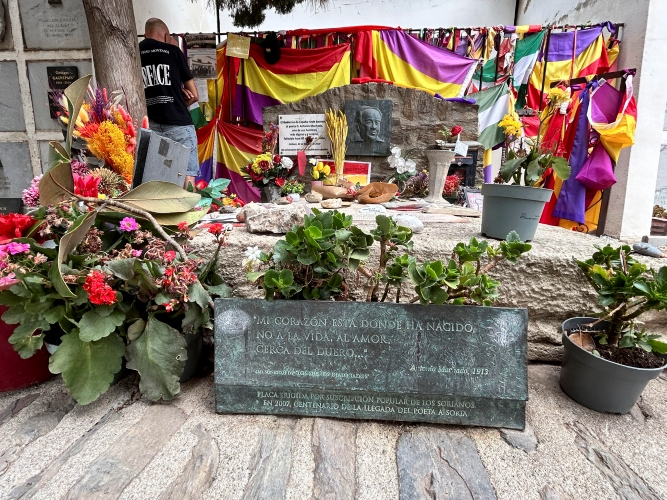
You only have to walk a few meters in the Collioure cemetery, in southeastern France, to reach the tomb of Antonio Machado, where lie the remains of the Seville-born writer and his mother, Ana Ruiz, who, nearly 90 years later, remains a pilgrimage site for hundreds of people each day to pay their respects to the writer.
The tomb is placed in a privileged spot at the main entrance of the cemetery, a choice that is not by chance in a town of 2,700 inhabitants that keeps Machado in its memory as one of its most illustrious neighbors, even though he stayed there only between January 28 and February 22, 1939—less than a month—and yet his arrival, fleeing the Francoist troops, was a full-blown event.
This coastal town, 39 kilometers from the Spanish border, has seen its growth integrate its cemetery into the urban fabric, and even the signage not only shows the way to reach it but directly points toward the “Tombe d’Antonio Machado,” which is never alone since the municipal worker on duty opens its doors at 8:00 a.m. The rush at the tomb is such that the cemetery supervisor jokes it is “the most accompanied grave in all of France,” and when you enter any shop in town and ask for any item, it is not unusual for the seller to remark “Spaniards, like Machado,” and recount their own story about living in streets that place a poet born in Seville in 1875 at the center of attention.
Everything related to Machado in Collioure is coordinated by the foundation created in the French municipality, which even has a mailbox beside the tomb where hundreds of letters are deposited, which the members of this organization take care to answer, although some are left directly on the tombstone, with messages such as “Go on for you, Dad,” deposited on August 13, in which they express “thanks for so much” to the writer.
In front of the tomb, a Catalan couple explains to Efe that visiting the writer every couple of years is part of their life ritual, and they are moved not only by seeing how the flags of the republic and other symbols that each person leaves have increased, but also by the personal messages left on the stone, such as a small white stone bearing the flag of the Republic and the message “People from Triana.”
About 200 meters from the cemetery is the Antonio Machado Space, in the hotel where he was greeted upon his arrival. There, the poet’s room has been recreated, with the bed where he died next to his mother’s, who was fading and passed away three days later. The museum guide, available for a euro, explains some curiosities, such as the guest book, “perhaps due to a translation error,” which notes that the poet was 74 years old instead of 63. The museum is, precisely, on Antonio Machado Street, in Casa Quintana, once run as a hotel by Pauline Quintana, who, aware of who her guest was, sheltered him with all she could when he arrived with no money or belongings. Given his precarious situation, he was buried in a niche of the Py-Deboher family, friends of Quintana, like his mother, but when the family needed the burial space the Town Hall acted quickly and ceded the land for the current tomb, inaugurated on July 16, 1958.
People of all ages continue to come there to pay homage to Machado, where “the poet died far from his home, his dust covering the soil of a neighboring country,” as Serrat immortalized in Cantares, in his memory, and where the 26 days he spent in that French town are, for the locals, a significant part of their history.