
This book explores the rise of contemporary Latin American women narrators and their role in transforming Spanish-language literature. Through a reading that intertwines literary criticism, memory, and political sensibility, the essay uncovers the affinities and resonances that unite some of the most relevant voices of our time.
In this making of Erica Durante explains how she wrote Arpilleras: Latin American Women Writers of the Twenty-First Century (Páginas de Espuma).
***
Arpilleras: Latin American Women Writers of the Twenty-First Century began to take shape when airplanes stopped flying. In 2020 I completed a book about the role of air mobility in the imagination of globalization, published just as the pandemic kept the world grounded. After several years immersed in that research, I found myself between the end of one project and the first ideas, still directionless, for the next.
I remember the WhatsApp calls with Gustavo Guerrero, a friend and editor. It was he who introduced me to several contemporary Latin American narrators.
I started with Mariana Enríquez; from her I moved to Mónica Ojeda and, later, to Fernanda Melchor. With those early readings, the thread began to wind from one writer to another and to bind them together. I read them, studied them, and brought them into the classroom; the corpus grew like a living creature, demanding more space every time. I look at my library: fiction lives alongside essays on contemporary philosophy, anthropology, textile arts, and feminist thought, stacked in piles that spill off the shelves and spread between the sofa and the suitcases; almost all the spines bear the names of Latin American women writers.
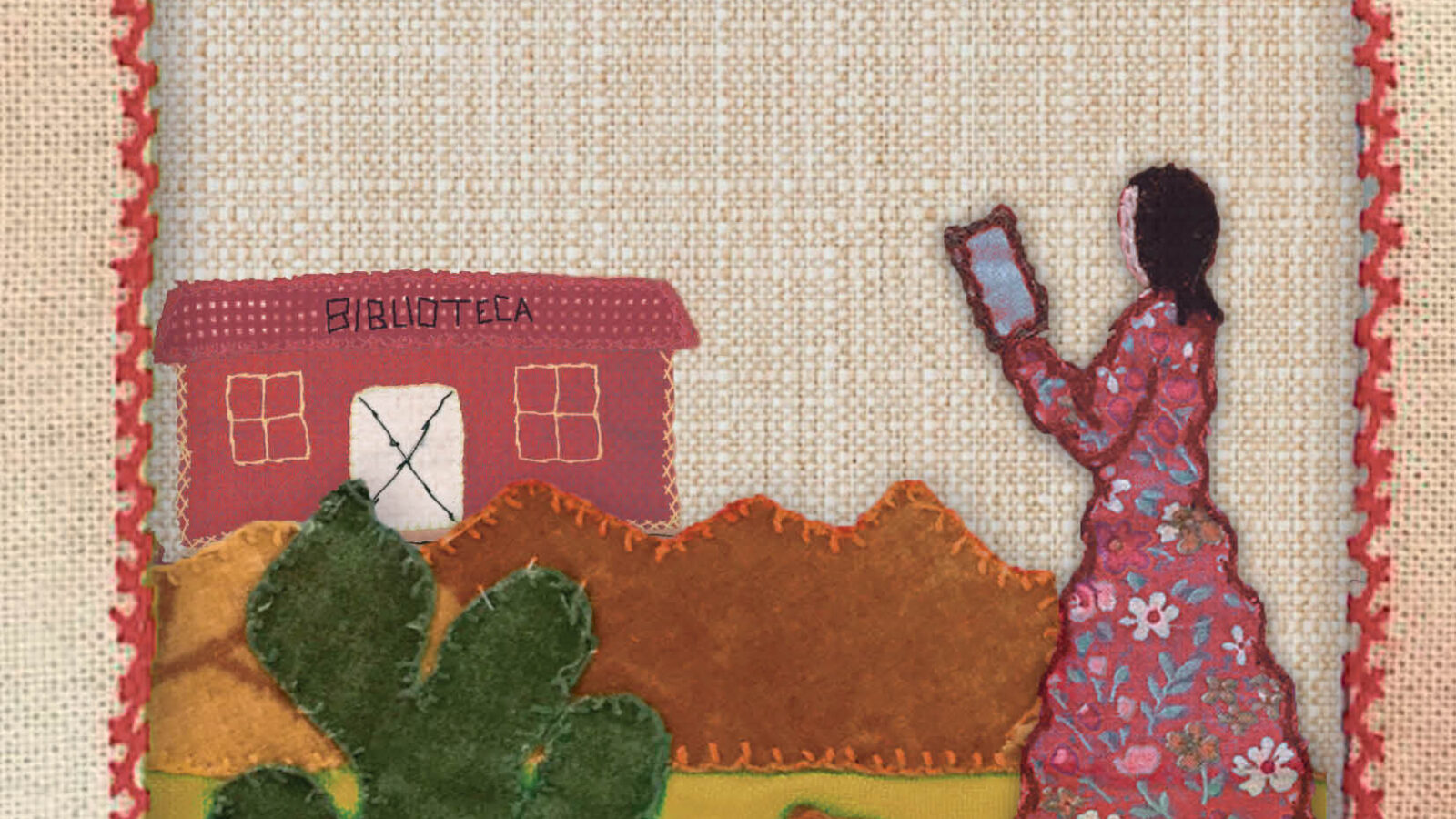
Arpilleras found its name aboard a plane that carried me from Peru to Chile. In Lima I had toured a Peruvian arpilleras exhibition at the Place of Memory; upon arriving in Santiago, I would visit the Museum of Memory and Human Rights. At some moment during the flight, while we crossed the Andes, I thought of those colorful fabrics, made from remnants of clothes once worn, and of the Chilean women who, under the dictatorship, began to embroider arpilleras to narrate with needle, thread, and scraps the disappearances, the tortures, the hunger, and exile, but also care and daily life.
I don’t know how to sew, and yet I thought that a burlap banner was what I had been doing for years: moving the needle from one book to another, recognizing common threads and linking distinct narratives without equating them. The burlap banner ceased to be merely a textile piece and became a method for relating the works I studied. Thus emerged five “seams,” more than chapters: “Simbiosis,” “Perras,” “Blanco,” “Sangres,” and “Verdugos.” The initial corpus unfolded into an expansive network of novels, short stories, and essays. That breadth responded to a methodological challenge: to account for the most representative lines of this body of writing, without aiming for exhaustive coverage or reducing the essay to a catalog of names and titles. Read together, the fictions revealed a chorus that I had intuited from the start, which the critical work confirmed and which my writing had to give substance to without diluting the texture of each author. As new titles entered into conversation with the earlier ones, the plot reorganized and previously unsuspected connections emerged, though they were inscribed in the texts themselves. Investigating was following those threads and showing how, when tied, they formed a diverse and living weave of Latin American literature written by women in the last twenty-five years.
Twenty-five years of literature and a book woven from questions, conversations with the writers, seminars with students, meetings with booksellers and reading communities, and meticulous editorial work. One of the most delicate gestures was to find a voice in which the woman, the reader, and the researcher I am could coexist. The critical thinking of Cristina Rivera Garza was decisive in shaping it and runs through the entire essay: she taught me to attend to the pulse of the texts and to conceive reading and writing as practices of relation, “sharing” and “communal living.” From that conviction arose the will to open and close each seam with personal passages, fragments of lived experience that form the reverse of the critical work sustaining Arpilleras. They also connect my own reading experience with that of other women who, like me, have spent years reading these writers and threading their books, while that literature continues to unfold.
Writing Arpilleras has been a way of sitting at the loom alongside those who write, read, and study this literature. Now that the book comes off the loom, its threads pass into other hands and new works, writers, and readings will extend the fabric where these pages end.
—————————————
Author: Erica Durante. Title: Arpilleras: Latin American Women Writers of the Twenty-First Century. Publisher: Páginas de Espuma. Availability: Todos tus libros.