
To commemorate the 90th anniversary of the Civil War, José Ángel Mañas recreates in Zenda, day by day in this section, what happened in 1936, perhaps the most pivotal year in all of Spain’s recent history.
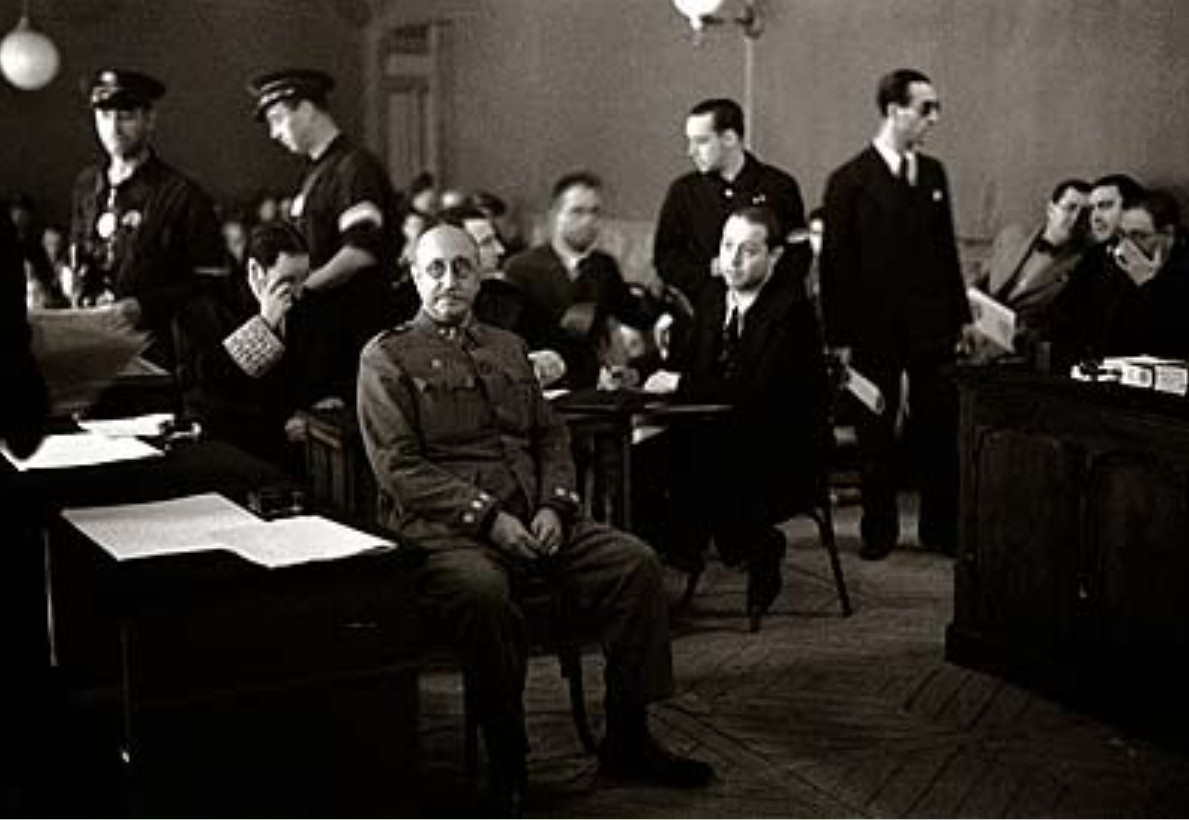
Saturday, August 15, 1936: Trial of General Fanjul
Transcript of the Republic’s prosecutor’s interrogation of former General Fanjul in the courtroom of the Modelo prison
FISCAL. His record is well known. He rose to brigadier general almost simultaneously with the former generals Franco and Goded, for merit in Morocco. He was dismissed after the advent of the Republic, and then he turned to political activity. He was elected deputy for the province of Cuenca. In 1933 he was again elected deputy for the same province at the head of the slate that swept the six seats of the majority. In January 1934 he renounced his seat. He entered the Ministry of War as undersecretary to Mr. Gil-Robles. In the last elections he participated, again for Cuenca, aligned with Renovación Española, though he withdrew in the second round so that José Antonio Primo de Rivera could present himself. It gives the impression that you were in a position of forced availability at the start of the uprising. Could you tell me where you were in the days prior to the Insurrection?
FANJUL (in robes, defending himself). I can. The news of the Insurrection was known by the Lieutenant Colonel Valentín Galarza, in his flat on Calle Espalter in Madrid, on the morning of July seventeenth. It was being transmitted from Ceuta in code. Galarza, acting as liaison, conveyed it to General Álvarez Rementería. The other news was learned through foreign newspapers and, above all, through the French press in Morocco. Unfortunately, from the seventeenth onward we lost contact with Galarza. When General Villegas and I met General Saliquet at General Villegas’s house, Saliquet told us that he was departing for Valladolid, because he had received the order, just as General González Carrasco had…
FISCAL. And you didn’t?
FANJUL. No, I did not receive any order. And General Villegas, either.
FISCAL. Did you know that at the same time the uprising began in the Protectorate there was a meeting at the home of Román Álvarez Omaña, on Fernán González Street, 16, presided by Álvarez Rementería, where Ex-general García de la Herrán was introduced as the head of operations in the city?
FANJUL. I wasn’t aware.
FISCAL. But you assert that a few days earlier an emissary of the ex-general Emilio Mola communicated to you verbally, during a walk along Calle de Alcalá, that he would be in command in Madrid.
FANJUL. That is so.
FISCAL. Does that not strike you as odd?
FANJUL. Sir prosecutor, the organization of the uprising in Madrid was very deficient. It is possible that, given my public character, General Mola believed I would not have the same mobility as others. It is not improbable that some directions were lost for me during those days.
FISCAL. Let us return to the concrete facts. At the same hour that the meeting of the Committee that was to lead the uprising is held, you, dressed in civilian clothes, with the uniform in a briefcase, left your home on Calle del Arenal to settle in with a sister-in-law at Calle Mayor, 86, opposite the building of the Primera División Orgánica.
FANJUL. It was a precautionary measure. To evade police surveillance.
FISCAL. I ask again: did you have any orders?
FANJUL. I repeat that no. I know that General Villegas, who was hidden in a rented apartment, did not either. The Insurrection was planned for the nineteenth. We were at the eighteenth. I assumed I would soon receive news.
FISCAL. According to what has come to light, the plan of the rebels was for García de la Herrán to go in the morning to the María Cristina Barracks, where he enjoyed the support of the officers, and from there to move to the Carabanchel Camp to take command of the operations. Once at Carabanchel, the plan was to set out toward the Manzanares, where the troops from María Cristina would also depart. From El Pardo, the Regiment of Transmissions would head toward Madrid, and in the city the troops from the barracks of La Montaña would depart. Meanwhile, the Regiment of Light Artillery of Getafe would approach the airfield and the other Artillery Regiment, Vicálvaro, would advance toward Madrid. If the Uprising proved victorious, García de la Herrán would seize the Ministry of War and Rementería the Division. Were you aware of these plans?
FANJUL. I repeat: neither García de la Herrán nor Rementería contacted me to inform me of that plan. Nor did I ever receive any order from General Mola relieving me of my mission. Hence my concern and confusion.
FISCAL. And why did the Montaña officers come to you?
FANJUL. Because my son Juan Manuel was stationed with them. First they located General Villegas, who refused to move to the barracks and also, via our liaison, sent me the information that García de la Herrán was the overt head of the Uprising. Seeing that García de la Herrán refused to take the Division, Villegas urged me to take it over. I made clear that I did not have the cover for such an undertaking. While all this was happening, some Montaña officers came to ask me to assume command of the barracks. It seemed to me that this was where I could be most useful, and I agreed.
Todas las entradas de 1936 día a día
Entrevista con José Ángel Mañas sobre 1936 día a día